

Tesuque Pueblo Historic Pottery Figural Smoking Pipe - C3687B
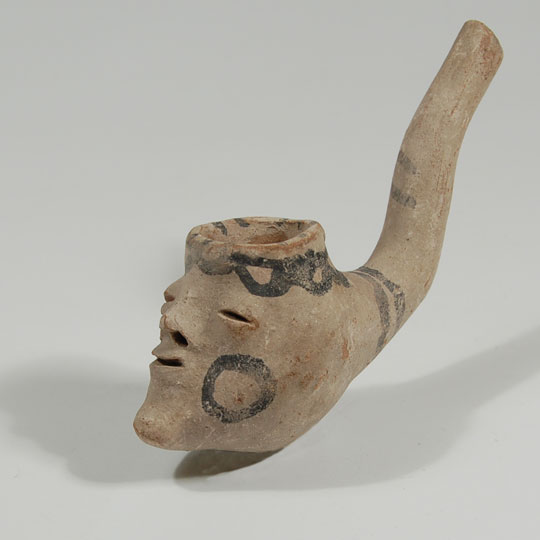
Tesuque Pueblo is the closest pueblo to Santa Fe and, as a result, was the pueblo selected by Santa Fe merchants in the late 1800s as a source for tourist pottery items. The most famous, of course, are the Tesuque Rain God figurines, which were made in the tens of thousands. Also popular with tourists were small bowls, sugar and creamer sets, salt and pepper sets, ashtrays, and vases.
Perhaps, too, smoking pipes were popular, but they do not appear that frequently today, so it is surmised that not too many were made. It is not likely that they were purchased to be used as a smoking device, but rather were considered souvenirs. The popular design for smoking pipes was a figural element, mostly poking fun at Spanish noblemen or merchants.
Read more about this pottery pipe here..
Tesuque Pueblo Pottery Figural Smoking Pipe - C3687A
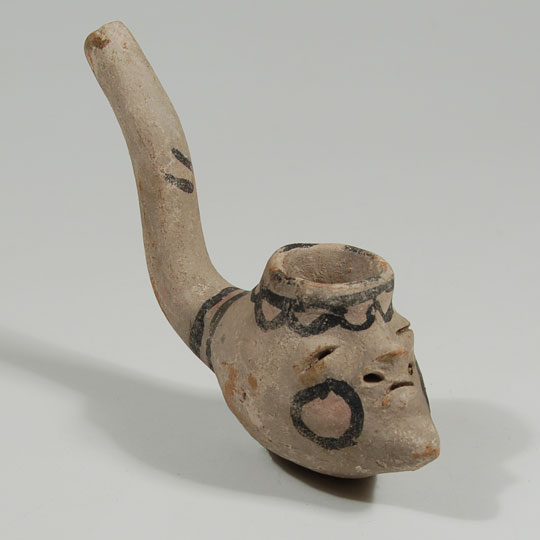
Tesuque Pueblo is the closest pueblo to Santa Fe and, as a result, was the pueblo selected by Santa Fe merchants in the late 1800s as a source for tourist pottery items. The most famous, of course, are the Tesuque Rain God figurines, which were made in the tens of thousands. Also popular with tourists were small bowls, sugar and creamer sets, salt and pepper sets, ashtrays, and vases.
Perhaps, too, smoking pipes were popular, but they do not appear that frequently today, so it is surmised that not too many were made. It is not likely that they were purchased to be used as a smoking device.
Read more about this pottery here..
Hopi Seed Jar with Eagle Tail Design by Adelle Lalo Nampeyo - C3691D
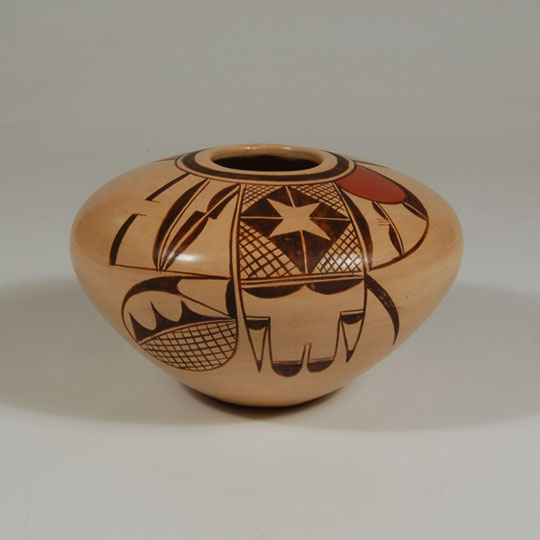
Hopi Pueblo potter Adelle Lalo Nampeyo is a daughter of Elva Tewaguna Nampeyo (1926-1985) and granddaughter of Fannie Polacca Nampeyo (1900-1987). Her sisters are Miriam Tewaguna and Neva Polacca and her brother is Elton Tewaguna. Adelle credits her mother and grandmother for teaching her the techniques of making pottery and she uses designs traditional to the family, which are mostly designs from Sikyatki pottery that Nampeyo of Hano reintroduced a hundred years ago.
Read more about this pottery here..
Sikyatki-revival Design Hopi Seed Jar by Adelle Lalo Nampeyo - C3691C
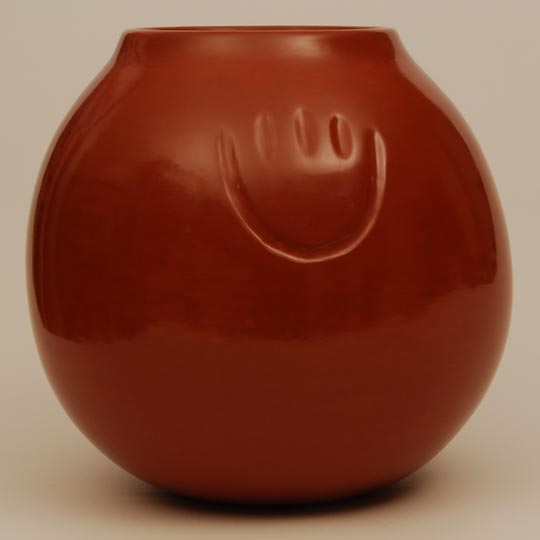
Hopi Pueblo potter Adelle Lalo Nampeyo is a daughter of Elva Tewaguna Nampeyo (1926-1985) and granddaughter of Fannie Polacca Nampeyo (1900-1987).
This jar by Adelle features a very traditional Nampeyo family design using a painted square around the opening and four eagle tail designs radiating from that square.
Read more about this pottery here..
Polished Red Bear Paw Storage Jar by Tina Garcia - C3505A
Tina Garcia was a granddaughter of Severa Tafoya (1890-1973) who was a sister of Van Gutierrez of Lela and Van fame. Tina's mom, Lydia Tafoya, was from Santa Clara Pueblo and her father, Santiago Garcia, from Ohkay Owingeh Pueblo, so Tina signed her pottery with her name and the names of both pueblos.
Tina received awards as early as the 1974 Santa Fe Indian Market, where she took a First Place ribbon. She continued getting First Place awards and Best of Division awards for her pottery and one can understand why she received so many awards when looking at this highly-polished red jar.
Read more about this pottery here..
Acoma Polychrome Jar with Straight-Beaked Birds - C3746
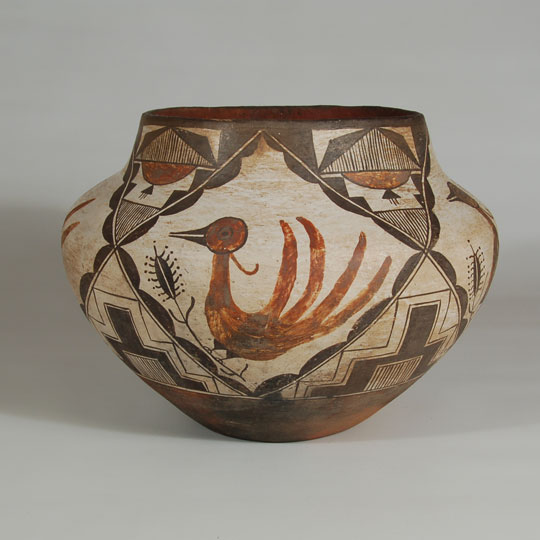
James Stevenson collected jars at Acoma, for the Smithsonian, before 1880 with birds with straight beaks such as those on this jar, indicating that they existed as early as the 1870s. We think of birds on Acoma jars as always being represented as parrots, but birds of this style were also painted, although certainly not as frequently.
The birds on this Acoma jar have slim bodies and elaborate tail feathers. They are not outlined in black except for the head. They have fat thighs and short skinny legs whose feet are attached to plants. The black circular eyes on all four birds are covered with orange paint almost to the point of obliteration.
Read more about this pottery here..
Cochiti and Kewa Pueblos Black on Cream Olla by Harlan Reano and Lisa Holt - C3129A
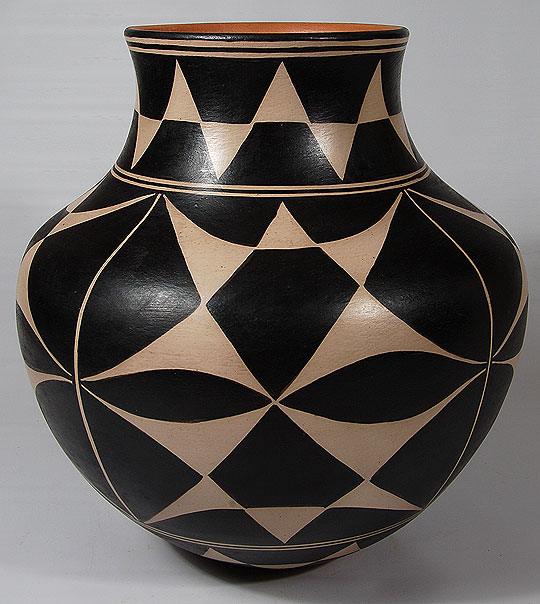
It's refreshing to see a young couple pool their talents and create something that is traditional in form and yet contemporary in design. Harlan Reano, from Kewa Pueblo, and Lisa Holt, from Cochiti Pueblo, have done just that. Lisa Holt creates the pottery vessels and Harlan Reano paints the designs. The designs chosen are traditional to Kewa Pueblo and yet with a contemporary style.
Read more about this pottery here..
Historic San Ildefonso Pueblo Polychrome Serving Bowl - C3148W
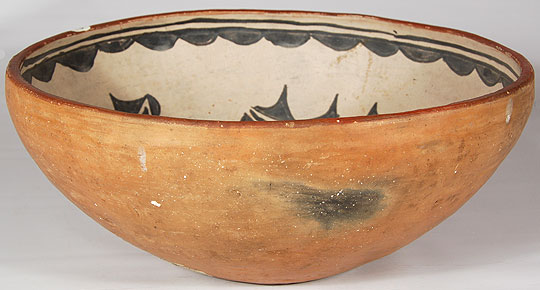
San Ildefonso large pottery bowls are among the scarcest items made at the pueblo. One rarely sees them. Water jars or ollas are much more available. This bowl was coil formed from native clay and slipped with bentonite (Cochiti variety) that required only rag polishing as opposed to the pre-1900 San Ildefonso slip that required stone polishing. The use of bentonite slip and a red rim are clues to the period of the bowl, which is around 1905-1910.
Read more about this pottery here..
Kewa Pueblo Olla with Four-Leaf Floral Design - C3334
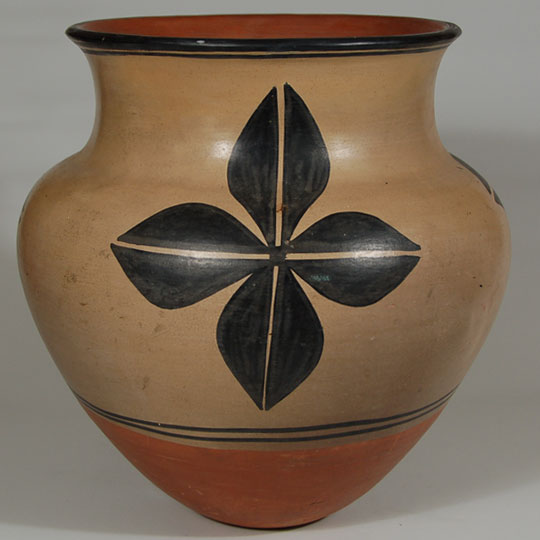
Kewa (Santo Domingo) Pueblo has a tradition of strong and bold designs on its pottery. Potters from there have always approached designs in a manner of repetition of the same element throughout the vessel, yet the repetition is not monotonous but is one that evokes admiration.
This jar has three identical floral elements, each with split leaves and a single black dot at the intersection of the leaves.
Read more about this pottery here..
Zia Pueblo Medium Size Storage Jar - C3744
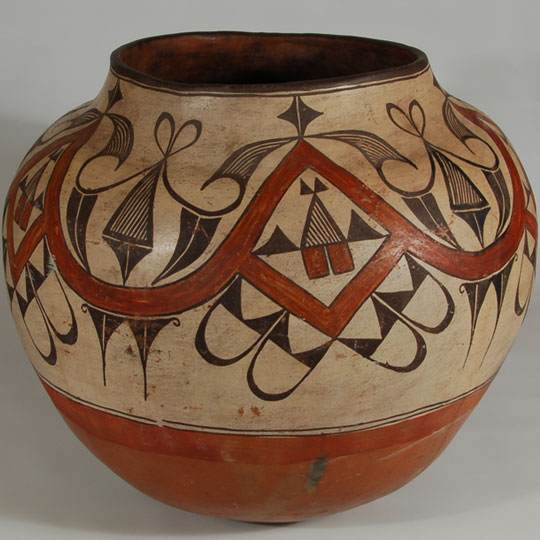
Tradition is a hallmark of life in the pueblos, whether in art or lifestyle. It is not an accepted practice for an individual to seek personal attention for his or her accomplishments. Yet, at the same time, potters at Zia Pueblo, starting around the mid-1800s, began to express a freedom of style in pottery designing, but still tempered to traditional ideas. This continued into the 1930s. This Zia storage jar is very traditional in vessel shape.
Read more about this pottery here..
Acoma Black-on-white Canteen with Appliqué Turtle Figure by Jessie C. Garcia - C3639
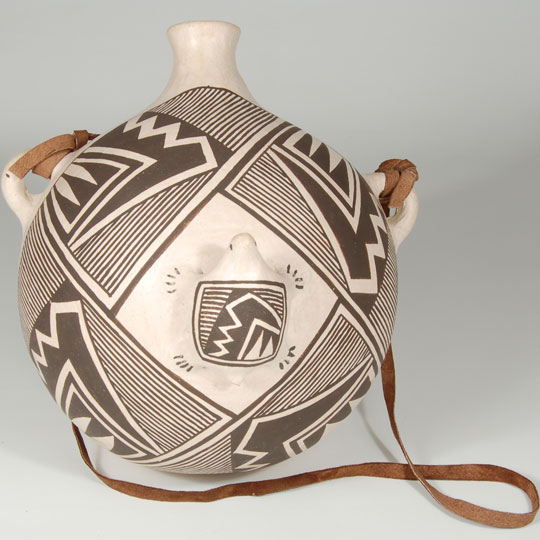
Jessie Garcia was considered by Rick Dillingham (author of Acoma and Laguna Pottery) as one of the three most important 20th century potters from Acoma Pueblo, along with Lucy Lewis and Marie Z. Chino. She was the mother of Anita Lowden and Stella Shuivta and the mother-in-law of Sarah Garcia, all three of whom are recognized as outstanding potters. In 1941, Museum of New Mexico director Kenneth Chapman donated a Jessie Garcia seed jar to the Indian Arts Fund.
Acoma Black-on-white Fine Line Design Jar by Lucy Lewis - C3736B
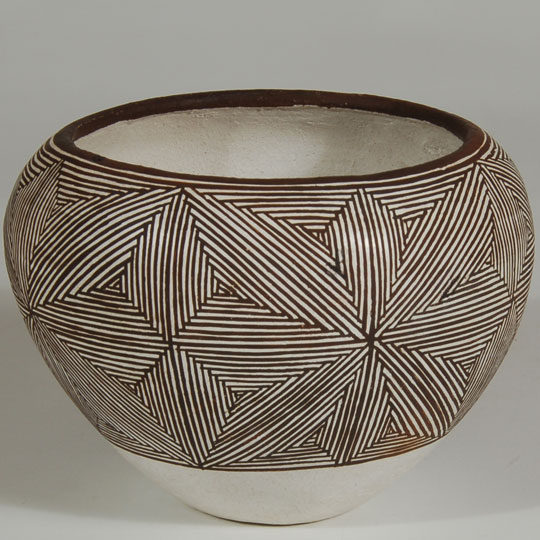
Lucy Lewis was a potter whose name most collectors recognize because she was at the forefront of potters following World War II when pueblo pottery began to be collected in earnest. One of her best-known designs was this complicated fine line style where the lines crossed in every direction. One must remember that these were painted using a brush fashioned from the leaf of a yucca plant. That certainly added to the complexity and is the reason not too many Acoma potters ever achieved the level to paint such a design.
Read more about this Acoma pottery here..
Tall Expanding Hopi Cylindrical Jar by JoFern Silas Puffer - 25741
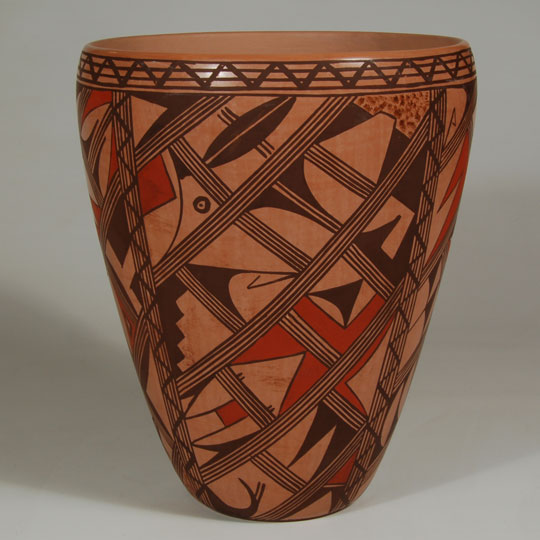
JoFern Silas Puffer is a daughter of Roberta Silas. She is Hopi Tewa and Laguna mixed heritage. She has been an active potter since 1990 but there is scant information published on her.
Read more about this pottery here..
Navajo Sterling Silver and Domed Turquoise Ring - 24836
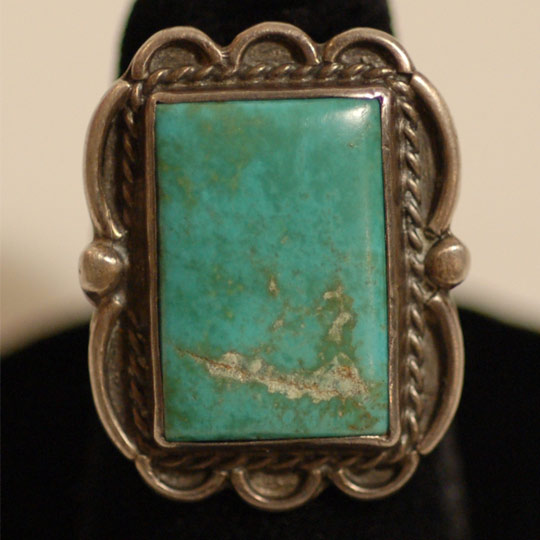
This rectangular domed turquoise ring is surrounded by a twisted silver rope and mounted on a scalloped-edge backing, all of which is mounted on a split shank silver band. The ring is a wonderful example of the silverwork by Navajo smiths in the 1940s and 1950s.
Read more about this ring here..
Acrylic Painting on Tile of a Male Figure by Helen Hardin (Tsa-Sah-Wee-Eh) C3745A
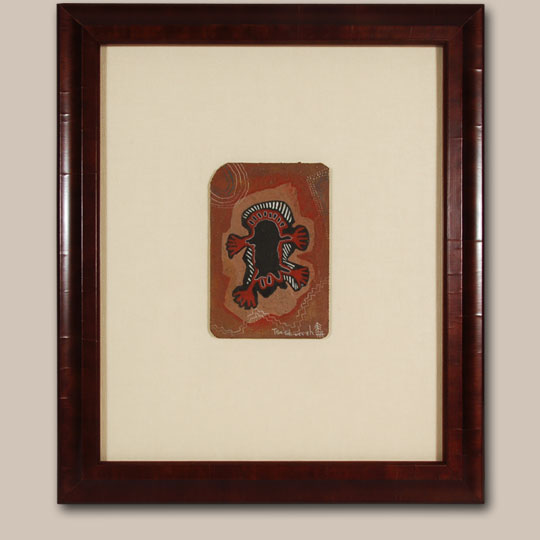
I was never aware that Helen Hardin ever executed one of her paintings on a small clay surface, but here is one, and maybe the only one in existence. The image is very similar to an acrylic painting on artist board entitled "Portrait of Man" by Helen Hardin. There is no title on the tile unless it is on the back of the tile which is not visible since it is framed. The tile is dated 1972.
Read more about this painting here.
Acomita - Acoma Polychrome Jar with Parrot Design - 25778
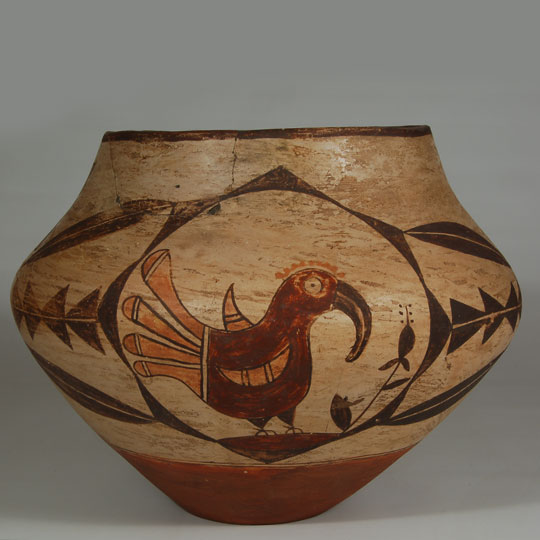
Somewhere, sometime, somebody established names for different periods of pueblo pottery. Excavations at prehistoric sites unearthed hundreds of years of pottery examples and names were assigned to each period.
At today's occupied pueblos, archaeological excavations have generally not been permitted. One very limited excavation permitted at Acoma in the early 20th century revealed that earlier pottery was decorated glazeware-designs applied with a paint containing lead ore. From excavated examples Frank Harlow was able to extrapolate that Acoma glazeware spanned the years from 1300 to 1700.
Read more about this pottery here..
San Ildefonso Pueblo Polychrome Jar by Carmelita Dunlap - 25740
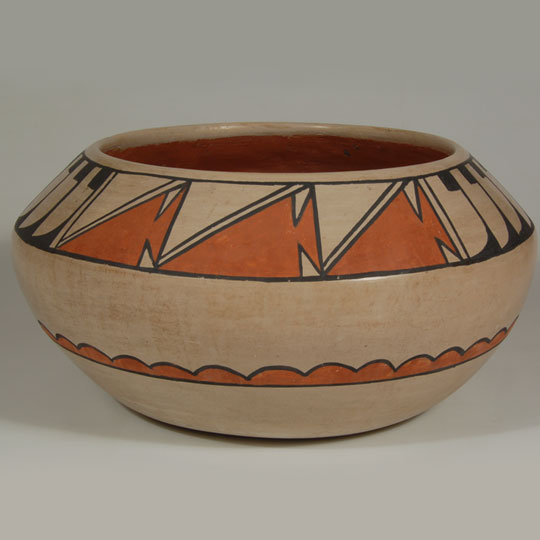
Carmelita Dunlap (1925-1999) was the daughter of Juanita and Romando Vigil of San Ildefonso Pueblo. Juanita was a sister of Maria Martinez and she passed away when Carmelita was very young. Juanita's two sisters, Maria Martinez and Desideria Montoya, raised her. She took turns staying with Maria for a few months and then with Desideria for a few months. She learned to make pottery by watching Maria and Desideria at work.
Read more about this pottery here..
Zia Pueblo Four-Color Polychrome Olla with Birds - C3684
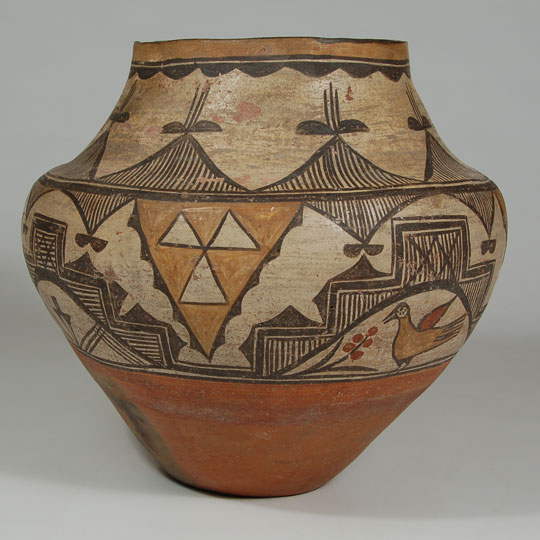
This is a superb historic polychrome jar created most probably between 1890 and 1900. This fine vessel is coil-formed in native clay with the addition of traditional Zia paste temper, crushed basaltic lava. The concave base and underbody are stone-polished bare paste with a red band at the top of the underbody, with the neck interior red slipped with a black rim.
Read more about this pottery here..
Kewa Pueblo Large Traditional Design Aguilar Jar - Felipita Aguilar Garcia & Asuncion Aguilar Caté - C3651B
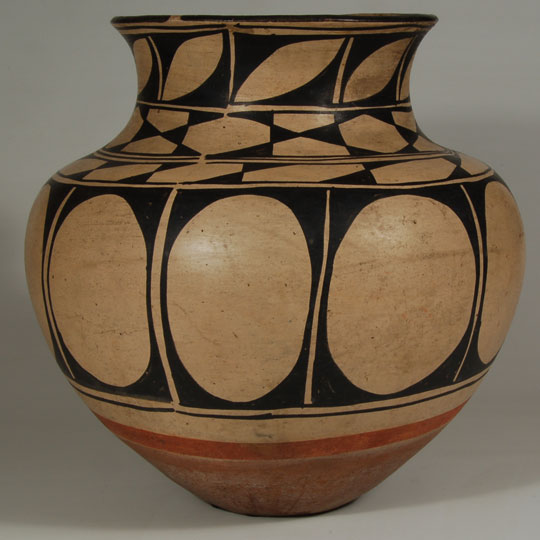
Felipita Aguilar Garcia was an active potter from the 1890s to the 1930s and her sister, Asuncion Aguilar Cate, was active from the 1890s to about 1915. They were exceptional potters, probably the best at the pueblo at that time, and they produced beautiful ollas with traditional Santo Domingo designs. Later, they became famous for the jars that were largely black and red or mostly black, but they earlier produced ones like this one.
Read more about this pottery here..
Zia Polychrome Jar with Capped Spirals, circa 1900 - 25233
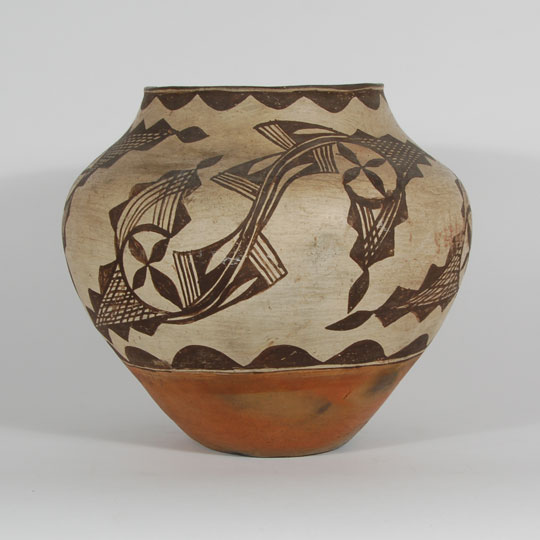
The predominant design element on this pottery jar is a spiral with a circle at each end on which are two triangular elements on each circle. This element has appeared on Zia pottery from as early as 1800 on what has been referred to as San Pablo Polychrome, continuing through the Trios Polychrome period and into the Zia Polychrome era.
Read more about this pottery here..

