
MARVELS OF THE NEW WEST by William Makepeace Thayer - B0008ACK3M
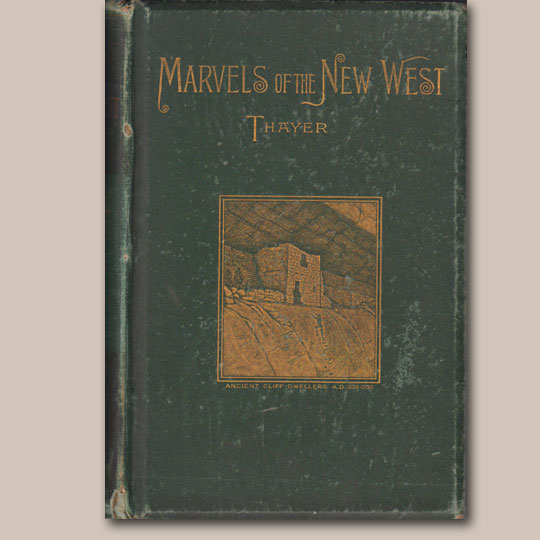
MARVELS OF THE NEW WEST: A Vivid Portrayal of the Stupendous Marvels in the Vast Wonderland West of The Missouri River
Six Books in One Volume
Comprising: Marvels of Nature, Marvels of Race, Marvels of Enterprise, Marvels of Mining, Marvels of Stock-Raising, and Marvels
of Agriculture
Graphically and Truthfully Described by William M. Thayer
Illustrated with Over 359 Engravings and Maps
The Henry Bill Publishing Company - Norwich, Conn
1887
Lifetime Furniture "Chair and Rocking Chair Set" - 24913
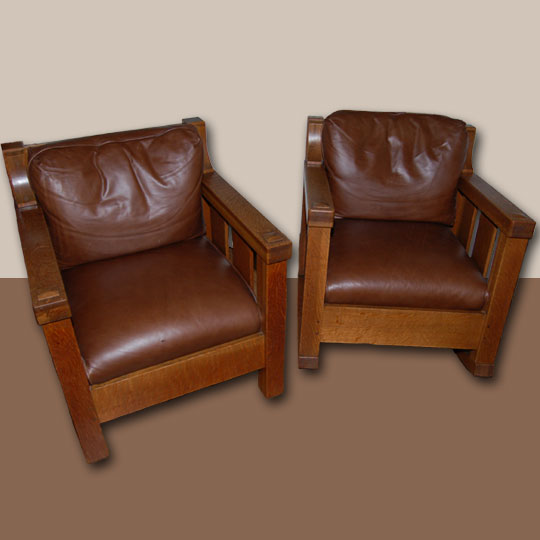
The company completely succeeded in its mission in the manufacture of this pair of chairs. They embody the simplicity of Mission Oak furniture, they are massively heavy and strong, and they are sturdy and extraordinarily comfortable. They have endured for over 100 years as evidenced by their inclusion in the company's 1910 catalog. Each has a paper label attached on which the chair number 688 (rocking chair) and 688-1/2 (straight chair) is marked.
Grand Rapids Bookcase and Chair Company
- Category: Mission Oak Furniture
- Origin: Arts and Crafts Movement
- Medium: Quarter Sawn Oak, Leather
- Size: 32" height x 22" width - PAIR
- Item # 24913
Hopi Miniature Warrior Maid (Hé-é-e) Katsina Doll - C3627H
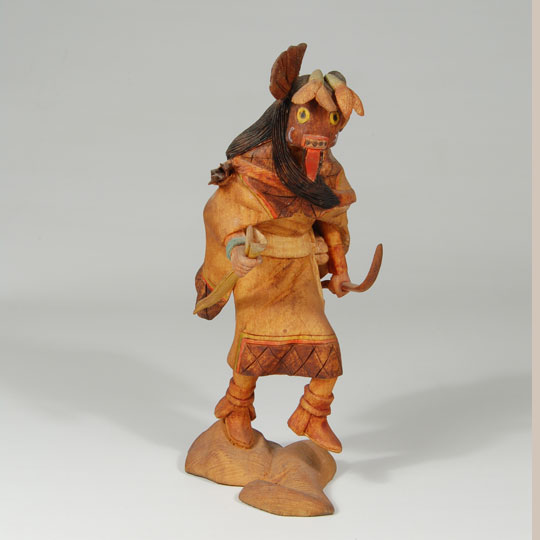
As usual, Brian Honyouti, from Hopi Pueblo, has presented this doll as a one-piece carving, with the hand-held items and possibly the pair of feathers on the head being added. Brian is one of the best carvers on the reservation and has been for several decades. This is an excellent example of his very fine carving of a doll in a smaller scale.
- Category: Traditional
- Origin: Hopi Pueblo
- Medium: wood, oil stains
- Size: 6-3/4" tall
- Item # C3627H
Hopi Soyok Wuhti - Ogre Woman Katsina Doll - C3627B
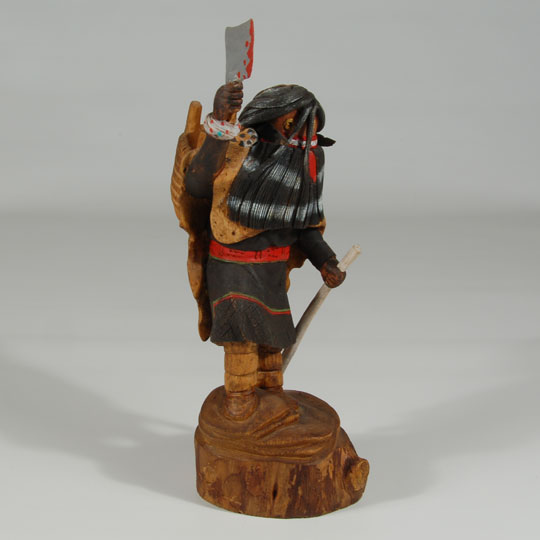
This Katsina Doll carving by Kevin Pochoema was completed in 1994, at which time we sold it to the current owner. It is an all-wood carving with oil base stains highlights. Kevin illustrated in this Hopi Pueblo doll, completed over 20 years ago, his early ability to carve dolls of great motion with expressive features and flowing hair. This is an excellent carving in every respect.
- Category: Traditional
- Origin: Hopi Pueblo
- Medium: wood, oil stains
- Size: 7-5/8" maximum height
- Item # C3627B
Soyok Wuhti (Ogre Woman) Small Katsina Doll - C3627C
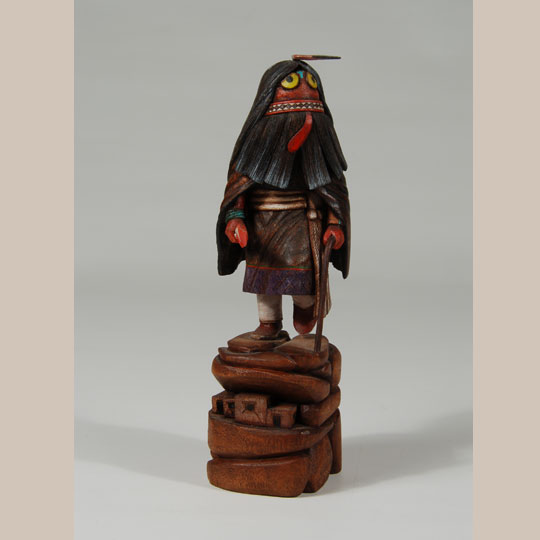
This small version of Soyok Wuhti, the dreaded Ogre Woman of Hopi, was carved by Lester Quanimptewa in 1997, at which time we purchased it from the artist. It is an all-wood single piece carving with the exception of the lone feather on the head and the items in her hands. The artist achieved an amazing amount of detail in such a small figure. The katsina stands 3-3/4” tall and the pedestal is another 2 inches.
- Category: Traditional
- Origin: Hopi Pueblo
- Medium: wood, oil stains
- Size: 5-3/4” Tall
- Item # C3627C
Zuni Shalako Ceremony by Santa Clara Artist Pablita Velarde - C3719A
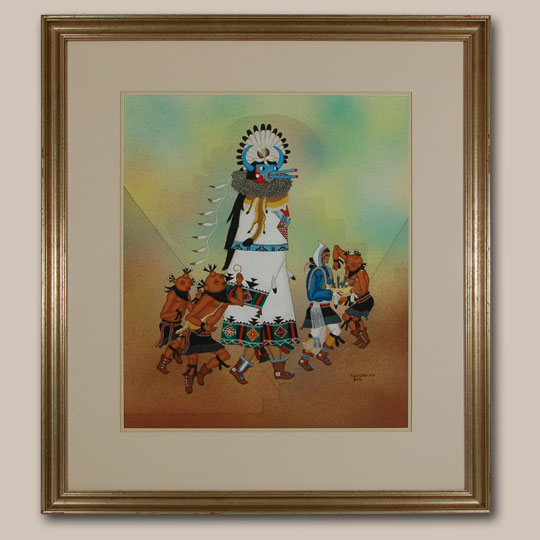
The Zuni Shalako ceremony, held every year in late November or early December, draws an audience of mixed variety-many Navajo Indians, Pueblo Indians, Hispanic New Mexicans, and Euro-American tourists flock to the all-day and all-night event. It is not unusual then to see parts of the ceremony painted by Navajo and Pueblo artists who have witnessed the event in person.
Read more here..
Black Pottery Carved Engagement Basket by Elizabeth Naranjo - C3708E
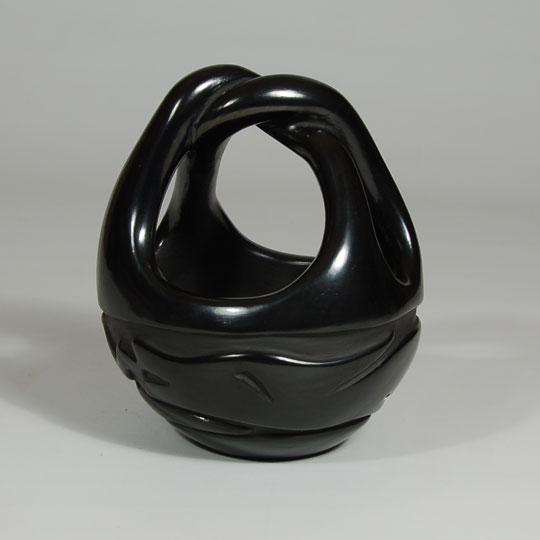
Southwest Indian Pottery vessels of this shape have been designated engagement baskets. They are a 20th-century development, having first appeared in the 1960s. The twisted handle is a symbolic representation of the bond that ties the couple together. It is not known who made the first one.
Read more here..
San Ildefonso Very Large Black-on-black Jar by Carmelita Dunlap - 25791
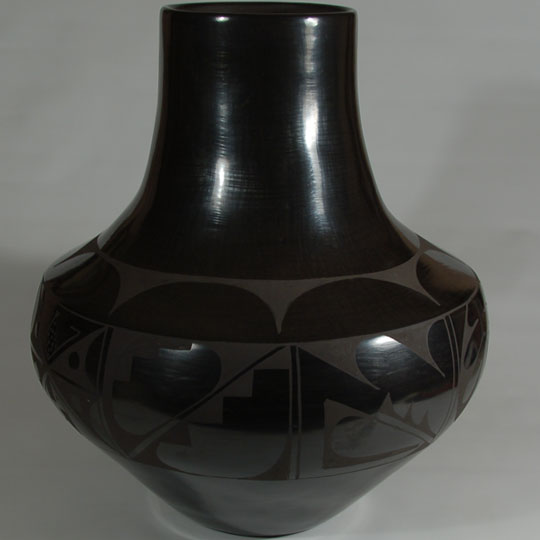
This is the largest and finest Southwest Indian Pottery Jar by Carmelita Dunlap that I recall ever seeing. It is massive in size and beautifully made and designed. The design is confined to the mid-body and consists of rectangular panels, each of which contains a unique design. The jar is beautifully thin-walled.
Read more about this pottery here..
Santa Clara Black Jar with Carved Design by Jennie Trammel - C3708C
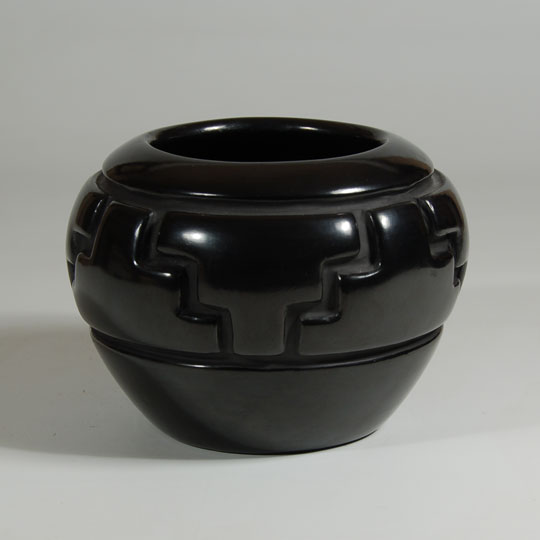
Most collectors are aware that Jennie Trammel made fewer pottery items than any of the other daughters of Margaret Tafoya. She had a full-time job away from Santa Clara Pueblo and had little time for making Southwest Indian Pottery. Interestingly, she was absolutely a phenomenal potter and produced the most beautiful carved wares of the 20th century.
Acoma Pueblo Large Swirl Design Seed Jar by Dorothy Torivio - C3708D
Dorothy Torivio was the most progressive artisan at Acoma Pueblo since as early as the 1980s. She was born at Acoma Pueblo and is renowned for her innovative work in exaggerated seed-pot forms in large and miniature sizes. She painted her hand-coiled and outdoor-fired pots with black and white or polychrome patterns of staggering intricacy, painted fresh, and with computer-like precision.
Tall neck Black-on-white Acoma Jar by Grace T. Chino - C3637E
Grace T. Chino was an exceptional potter. Her vessels were formed with consistent wall thickness and her designs were tailored to fit the shape of the vessel. She was a daughter of Marie Z. Chino. She was a consistent ribbon winner at Santa Fe Indian Market from 1980 through 1993. She was one of the artists featured in Seven Families in Pueblo Pottery exhibit at the Maxwell Museum in Albuquerque in 1979 and also in One Space, Three Visions exhibit at the Albuquerque Museum.
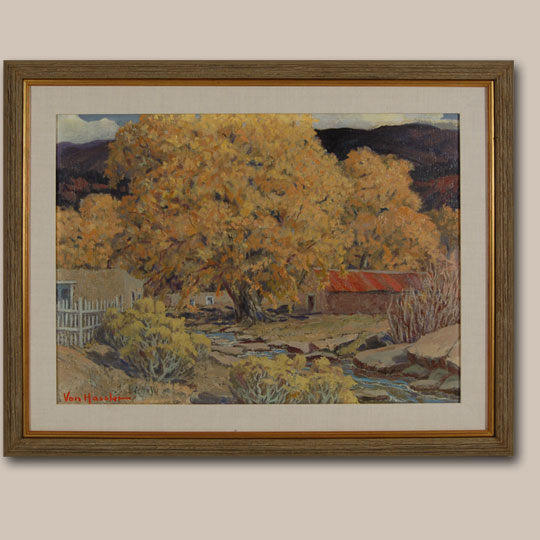
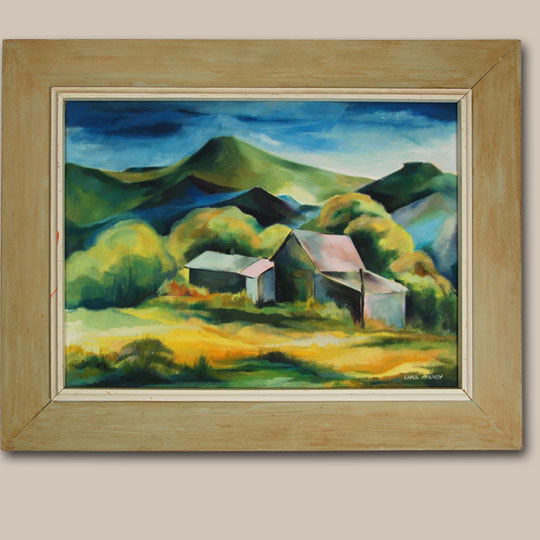
Springtime in Albuquerque Painting by Carl Von Hassler 25744
Carl Von Hassler was fond of painting villages and landscapes in and around New Mexico. He moved to New Mexico in the early 1920s and established his studio in Albuquerque's Old Town. For 47 years, he painted New Mexico scenes and became an Albuquerque legend. Almost everyone living in Albuquerque in the 1920s through the 1960s knew him and had a story they could relate about him.
SPLENDID HERITAGE Perspectives on American Indian Art - C3713B
The Splendid Heritage catalog of American Indian artifacts represents the commitment of American collectors to share the beauty and significance of hundreds of ethnographic treasures with a worldwide audience. Originally exhibited as the Akicita Collection at the Southwest Museum and as Splendid Heritage at the Wheelwright and Eiteljorg Museums, the expanded collection of artifacts was on display at the Utah Museum of Fine Arts from February 10, 2009 to January 3, 2010.
Three Strand Turquoise and Shell Hieshe Necklace with Appendages - C3710B
The Anasazi are the ancient ones, the ones who preceded the contemporary pueblo peoples. At an Anasazi ruin in Utah in 1960, archaeologists unearthed a burial of a female who had passed away around circa 1100. Around the neck of the remains was a beautiful turquoise necklace. Necklaces such as this are still the most favored among the Pueblo people of today.
Turquoise Jaclas and Silver Beads Necklace - C3710C
Jaclas, which means ear strings, were originally made to be worn as earrings. Later, they became an addition to what is considered to be the most traditional form of pueblo necklace-a turquoise nugget necklace. These were made and worn long before the art of working in silver was taught to the Natives. Each cylinder of turquoise was cut from a larger piece, in square form, drilled through the center, strung on string, and then sanded to circular shape. By doing this, each bead would be the same diameter or graduated diameter per the wishes of the artisan.
Twentieth-century Santa Ana Pueblo Pottery Jar - 25787

The original location of Santa Ana Pueblo was close to Zia Pueblo and pottery from the two villages was quite similar in materials, technique and construction. In the mid-1700s, the pueblo acquired land near Bernalillo, just north of Albuquerque, for better farming. This change in location effected a change in pottery as well.
Zia Pueblo Polychrome Olla with Creative Design - 25657

Rachel Medina claims dual relationship to Zia, her native pueblo, and Santa Ana Pueblo, where she has lived. She is a daughter of Sofia and Rafael Medina, granddaughter of Juanita Toribio Pino, and great-granddaughter of Rosalea Medina Toribio. Her brother is Marcellus Medina.
Rachel's mother, Sofia, taught her the techniques of Zia pottery and Eudora Montoyaof Santa Ana taught her the techniques of Santa Ana pottery. In addition to making pottery of the styles of both pueblos, Rachel acquired a Nursing degree from Eastern New Mexico University in Portales.
Diane Menchego Santa Ana Pueblo Polychrome Jar 25670

Santa Ana Pueblo received its name in the 1600s when the Spaniards set about assigning saint's names to all the pueblos. The native name of this Keres-speaking pueblo is Tamaya. At that time, the pueblo occupied land adjacent to Zia Pueblo close to theJemez River. Because farmland was scarce at their native lands, the pueblo chose to move close to the Rio Grande in the early 1700s. That location is just north of Albuquerque.
Tony Abeyta Original Oil Pastel “Symbols”

For those who have followed the meteoric career of Navajo artist Tony Abeyta, it is obvious that he has passed through a number of painting styles. His earlier works were more graphic and the later ones more abstract. This 1985 painting of petroglyph form is entitled "Symbols" and is in a realistic presentation of cave drawings or pictographs. This was predominately the style of art painted by Abeyta 30 years ago. It is interesting to see his evolvement from then to now.
Eighth Annual Historic Canyon Road Paint and Sculpt Out

Eighth Annual Historic Canyon Road Paint & Sculpt Out
Saturday, October 17th, 10am to 4pm
Art Walk
Friday, October 16th, starting at 5pm
Cham Benvenutti will be painting in front of Adobe Gallery
Every so often an event comes along that no one should miss. The Historic Canyon Road Paint & Sculpt Out is one of them.
Every year, on the third Saturday of October, hundreds of artists bring paint, easels, clay, carving tools, fire, fibers, beads, precious metals, and stone to Canyon Road for the iconic event. Continuing a hundred year tradition, artists line the road to create new work “en plein air” and involve onlookers in the process.
The natural beauty of the pure mountain air, the ethereal quality of the light, and the clear vistas have proven an irresistible draw to artists for more than a century. The Paint & Sculpt Out brings together all these elements for one glorious autumnal weekend.
Each year, wonderful new elements are introduced to the “Paint Out”. In 2014, sculptors were added to the roster, and many revealed their fascinating processes for the first time on Canyon Road. This year, the event is open to all creative artists including glass blowers, fiber artists, jewelry designers, weavers, carvers, and potters.
Many take inspiration from Canyon Road’s carefully preserved historic adobes and gardens. Belly dancers, riders on horseback, passers-by, live musicians, and a festival parade with marching bands provide subject matter for others.
Friday Evening: Most galleries will be open late with artist receptions, demonstrations, and new exhibits. Take time to meet the artists and preview their work. Restaurants and many boutiques, designer jewelers, galleries and shops will be open late.
The event is organized by the Canyon Road Merchants Association