

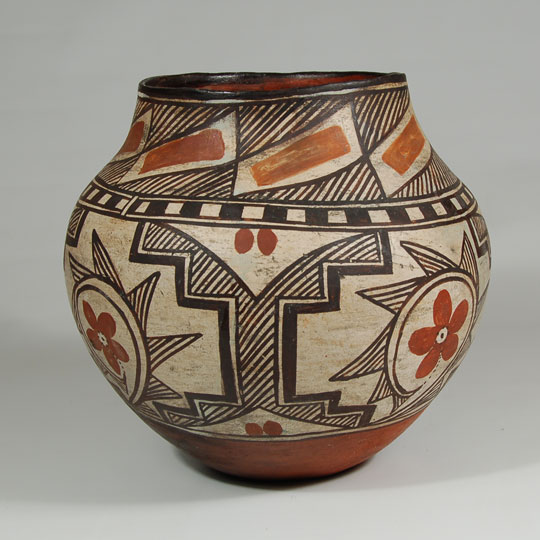
Isleta Pueblo Four Color Polychrome Water Jar, circa 1900 - C3711B
Posted by Adobe Gallery Team Member on Tue, Feb 2nd 2016, 15:15

Historic Isleta Pueblo Pottery - C3711BLarge water jars and functional bowls were made for use at the pueblo.  This water jar is typical of the size that was made for pueblo use although such jars did find their way to the train station and into the laps of the train travelers.  The potter of this jar took special care to paint an extraordinary design consisting of large amounts of fine lines, orange bars around the rim and red flowers inside a "Rain Bird" element.  This is an amazingly beautiful example of the finest work from Isleta Pueblo at the turn of the last century.

Read more about this pottery here..

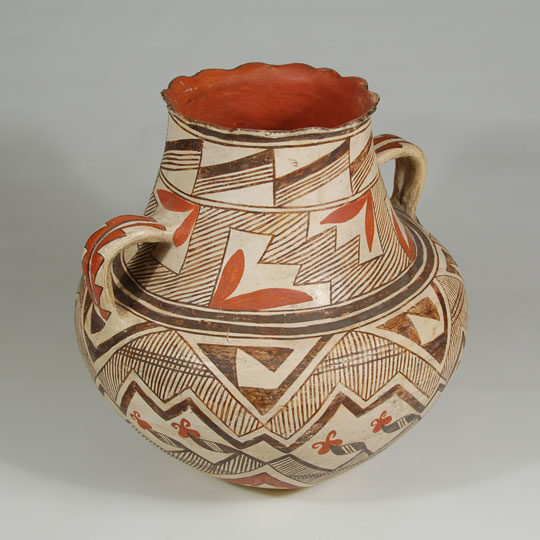
Extremely Rare Isleta Pueblo circa 1900 Polychrome Jar with Handles - C3711A
Posted by Adobe Gallery Team Member on Tue, Feb 2nd 2016, 15:06

Historic Isleta Pueblo Pottery - C3711APrior to 1880, potters at Isleta Pueblo made plain red pottery that was devoid of design or decoration.  The poor quality red clay at Isleta was not suitable for making high-quality thin-walled pottery.  Pottery from Isleta of that time is not in large quantity in any museum collection because it was not considered worthy of such.  When one looks at it today, however, it is amazingly beautiful in its red purity and simplicity.

Read more about this pottery here..

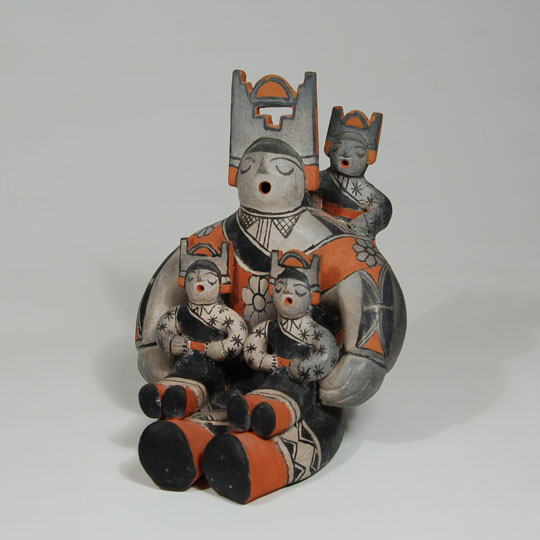
Cochiti Pueblo Female Storyteller by Louis and Virginia Naranjo - C3691B
Posted by Adobe Gallery Team Member on Tue, Feb 2nd 2016, 14:22

Louis and Virginia Naranjo Pottery - C3691BThis seated female storyteller figurine with her eyes closed and her mouth open is beautifully dressed in a highly-decorated blouse over which she wears the traditional pueblo dress.   She has a tableta on her head and is wearing high-top moccasins.  Her dress is covered at the waist with a belt.  Each of the three little girls is similarly dressed and each has her eyes closed and mouth open in the same manner as the adult.

Read more about this storyteller here..

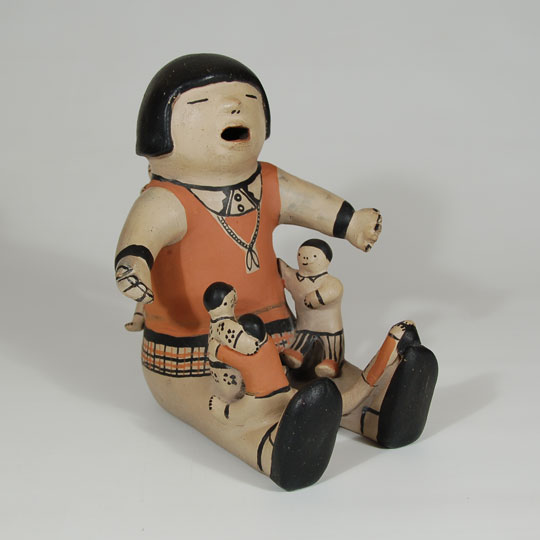
Seated Male Storyteller by Helen Cordero with 6 Children - C3725
Posted by Adobe Gallery Team Member on Tue, Feb 2nd 2016, 13:50

Helen Cordero Pottery - C3725What is known today as a Storyteller Figurine had its beginning in 1964 from the hands of Cochiti Pueblo potter Helen Cordero.  Alexander Girard, the noted architect and major folk art collector, saw a figurine by Helen at a Santo Domingo feast day arts and crafts booth and requested that she make more and larger ones and bring them to him.  At the time, these were simple human figurines. 


When Cordero began thinking about his requests, she made a male figurine and added a child in its lap.  He liked it and asked her to make more, make them larger, and add more children. Later, based on her remembering that her grandfather was a storyteller at the pueblo, she made larger figurines and added more children in remembrance of him.  Her creation, based on her grandfather, was the beginning of the storyteller figurine tradition at Cochiti Pueblo.


Read more about this storyteller here..


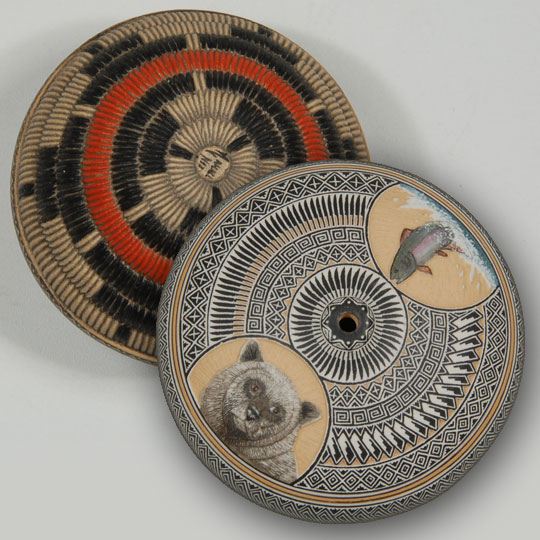
Miniature Pottery Masterpiece with Bear and Trout by Wallace Nez - C3612
Posted by Adobe Gallery Team Member on Mon, Feb 1st 2016, 17:42

Wallace Nez Pottery - C3612This small seed jar is as intricate as Moroccan mosaic tile work but even more detailed and miniaturized.  It is amazing to examine this seed jar with magnification and see the perfection in the application of all the very small triangles, dots, feathers, lines and other combinations of elements.

Forty-two year old Wallace Nez has set the standard for contemporary Navajo pottery.  He produces pottery in the traditional manner by gathering and processing natural clay.


Read more about this pot here..

Painting of Antelope Dancers Observed by Katsina Face by Romando Vigil - C3724A
Posted by Adobe Gallery Team Member on Mon, Feb 1st 2016, 17:31

Romando Vigil Painting - C3724AIn the early days of the 20th century, La Fonda Hotel, at the end of the Santa Fe Trail, situated on the Santa Fe Plaza, displayed paintings in their guest rooms by New Mexico Indian painters of the period.  These original paintings were removed in the early 1960s-probably because their values had increased but justified as a result of remodeling.  The paintings were sold at that time and, occasionally, one or more appears on the market, usually identified by the frame, if the frame had not been changed.  This painting by Romando Vigil (1902-1978) Tse Ye Mu - Falling Cloud has the indication that it was one of the ones in La Fonda, in that in the lower left, in pencil, is marked R-320 94-A.  Now, of course, this is speculation that it was in room 320 in La Fonda but we have verified that La Fonda has a room #320.  It is not in the original La Fonda frame.


Read more about this painting here..

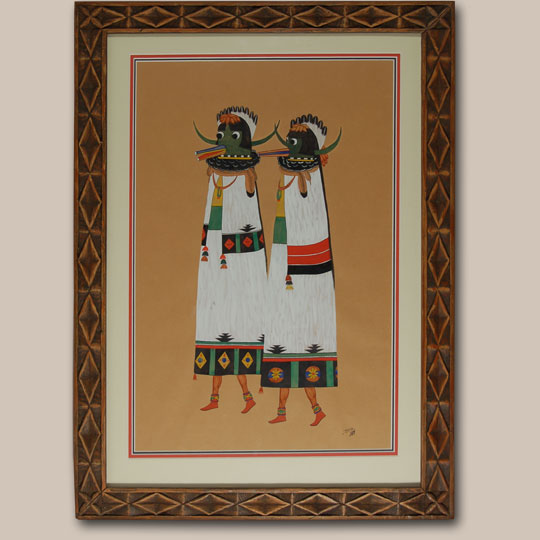
Original Painting of a Pair of Zuni Shalako by Romando Vigil - C3726A

Posted by Adobe Gallery Team Member on Mon, Feb 1st 2016, 17:24

Romando Vigil Painting - C3726ARomando Vigil (1902-1978) Tse Ye Mu - Falling Cloud must have attended Shalako on one or more occasions and painted this reminder of his visit.  He presented two of the ten-foot tall Shalako from memory as neither sketching nor photographing during the ceremony is permitted. 


Read more about this painting here..

Original Acrylic Painting Ancient Portraits by Helen Hardin - C3723B

Posted by Adobe Gallery Team Member on Mon, Feb 1st 2016, 15:26

Helen Hardin (1943-1984) Tsa-Sah-Wee-Eh - Little Standing Spruce blazed a trail and was at the forefront of Indian-influenced art and this acrylic on board painting is a perfect example of her particular talent and skills. This amazing work is deeply rooted and inspired by her Indian culture in its subject matter. With an effortless grace she uses modern materials and techniques to bring her history into the modern age with this intricate composition.

Read more about this painting here.

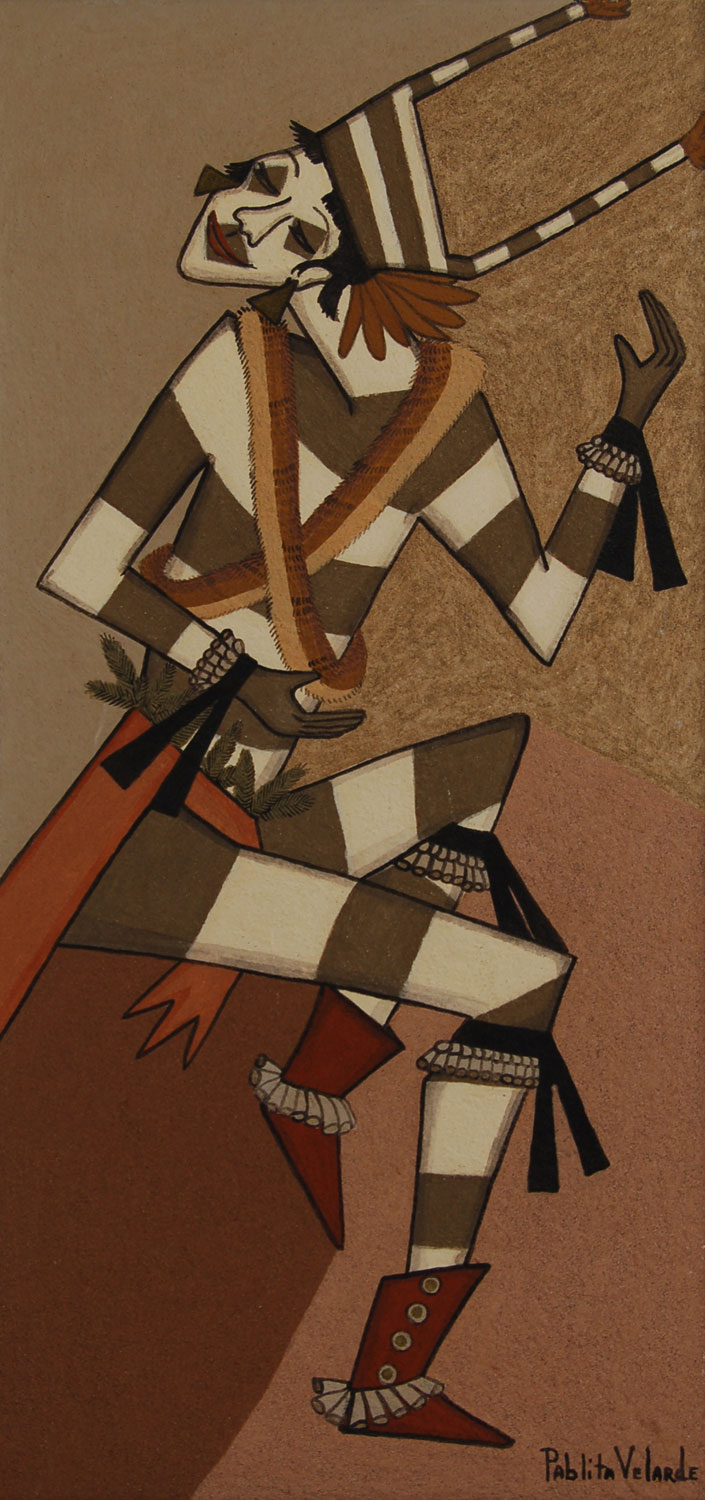
Mineral Earth Painting of a Koosa Clown by Pablita Velarde - C3682C
Posted by Adobe Gallery Team Member on Mon, Feb 1st 2016, 15:02

Pablita Velarde painting - C3682CThe Koosa clown portrayed by Pablita Velarde (1918-2006) Tse Tsan - Golden Dawn in this painting is, like many of her works, a subject that used to appear at the *Tewa Pueblos [Nambé Pueblo, Pojoaque Pueblo, San Ildefonso Pueblo, Ohkay Owingeh (formerly known as San Juan Pueblo), Santa Clara Pueblo, Tesuque Pueblo] but may not at this time. They are part of the history she was so fond of and that was relayed to her by Old Grandfather the Storyteller.

Read more about this painting here..

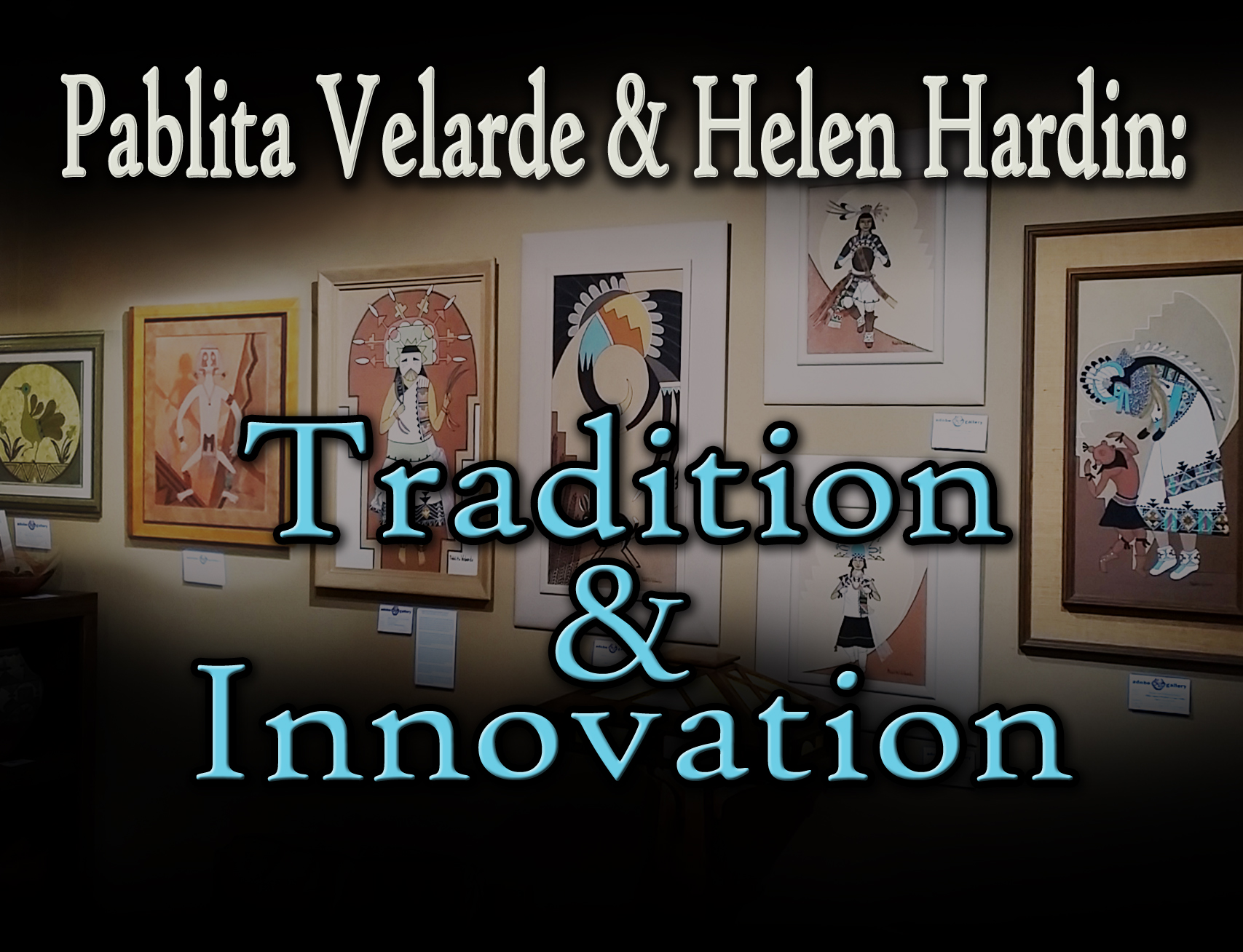
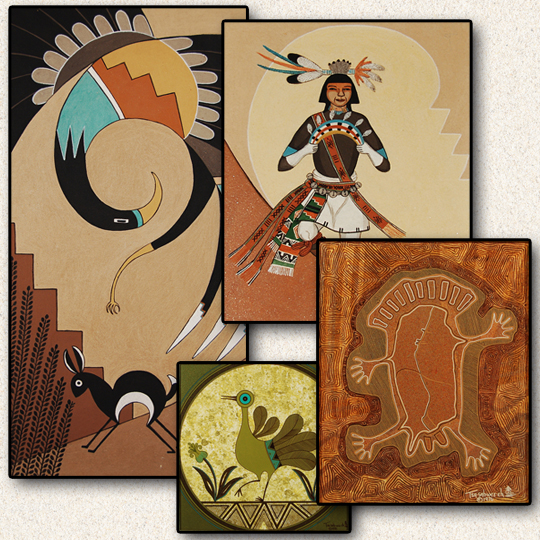
Pablita Velarde and Helen Hardin: Tradition and Innovation Exhibit
Posted by Adobe Gallery Team Member on Mon, Feb 1st 2016, 14:09


Pablita Velarde and Helen Harden Exhibit 2016

Adobe Gallery is pleased to announce our new exhibit

Pablita Velarde & Helen Hardin:

Tradition & Innovation

Opening Reception - 4pm to 6pm, Friday January 29th

Please join us for light refreshments

Click here to view this show


Working in the studio she built herself and primarily working with pigments she made herself, the art of Pablita Velarde is mesmerizing. Her art simultaneously honors a faithfulness to her people and culture while showcasing her own unique style. The art of Helen Hardin depicts the dichotomy of her Indian and non-Indian upbringing. She managed to capture her native heritage while departing from the Studio style of her predecessors, including her mother, Pablita. On display will be original works from both artists.

The paintings are on display Monday - Saturday, 10am - 5pm until April 30th, 2016

All items available for sale via email info@adobegallery.com or  

phone 505-955-0550
 

Pablita Velarde and Helen Harden Exhibit 2016


Navajo Sterling Silver and Turquoise Ranger Set - C3521o
Posted by Adobe Gallery Team Member on Sat, Jan 30th 2016, 16:38

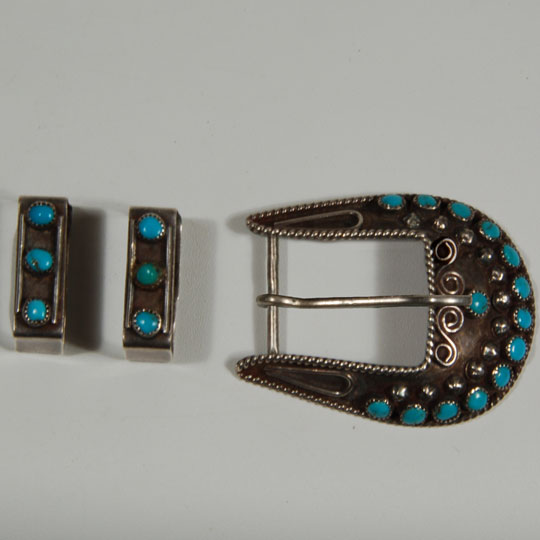
Navajo Jewelry - C3521oRanger sets traditionally include a buckle, a single or pair of belt guides and a belt tip.  This set is missing the tip which, fortunately, is the least important part of a ranger set.  We believe this is Navajo in origin based on the silver work.  Small round turquoise stones encircle the buckle edge and there are three stones on each belt guide.

Read more here..

Cochiti Pueblo Nineteenth-Century Male Figurine - C3683F
Posted by Adobe Gallery Team Member on Sat, Jan 30th 2016, 16:25

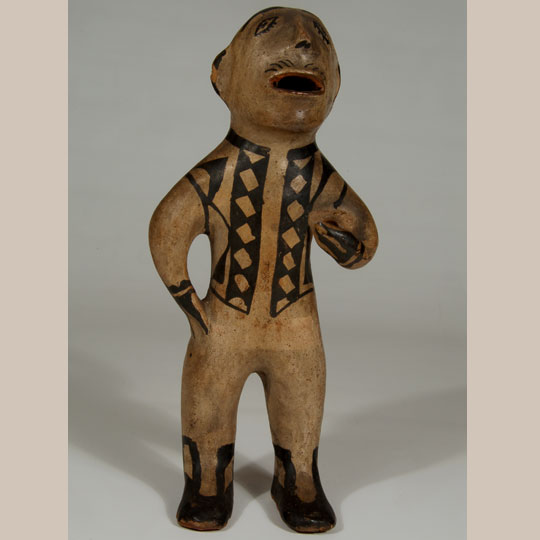
Cochiti Pueblo figurine - C3683FCochiti Pueblo potters are responsible for providing hundreds of pottery figurines as early as 1880 to satisfy a demand for "Indian curios," a term coined by merchants in Santa Fe for "curiosities."  It is not likely that the Cochiti potters dreamed up the scheme on their own but most likely that the merchants needed something unique, mysterious, ceremonial or perhaps just mockingly funny to sell to the influx of tourists arriving on the AT&SF rail line that made its way to New Mexico in 1880.  Even Tesuque Pueblo potters were encouraged to make Rain God figurines, something that did not even exist in their culture but was probably from the fertile mind of Jake Gold, a Santa Fe merchant, and probably based on pre-Columbian figures from Mexico.

Read more about this male figurine here..

Cochiti Pueblo Well-Used Drum with Beater - 25811
Posted by Adobe Gallery Team Member on Sat, Jan 30th 2016, 16:15

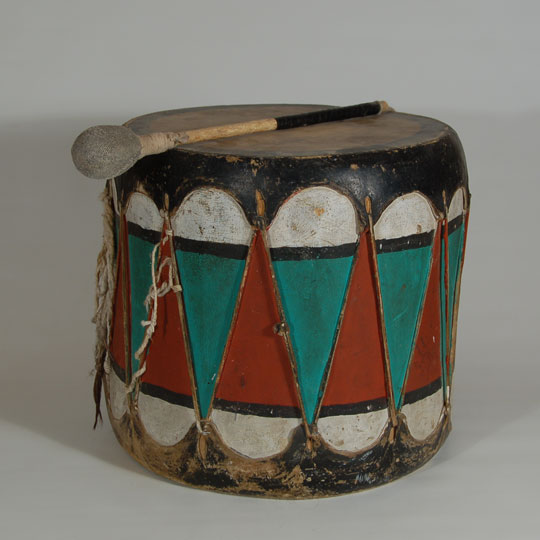
Cochiti Pueblo Drum - 25811Painted and unpainted drums of all sizes are used in pueblo ceremonies. The drum suggests the thunder that comes with rain. The drum has two heads. Pueblo songs are written to start slowly and then go to a climax. At a certain point of the song, the drum is flipped over to achieve a higher beat. This lifts the dancers and gives them the impetus to continue dancing.

Read more about this drum here...

Historic Rare Zia Storage Jar with Whirling Log Design, circa 1920 - C3697
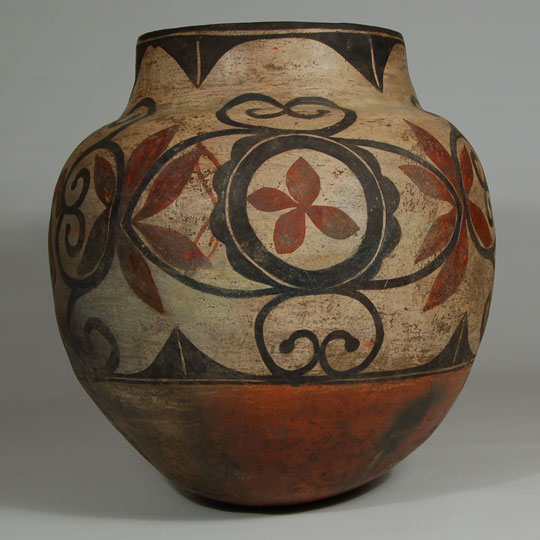
Posted by Adobe Gallery Team Member on Sat, Jan 30th 2016, 16:03

Historic Zia Pueblo Pottery - C3697Native American tribes traditionally used symbolism in their arts and crafts-jewelry, basketry, pottery, textiles-that had specific meaning to them and they also used symbols that were purely decorative.  One such symbol often seen on pre-1930 Apache baskets, Navajo jewelry and rugs and, occasionally, Pueblo pottery, was the symbol internationally known as the swastika. It is a symbol that had been in use for several thousand years in cultures over the world.  What meaning it had for Native Americans has only been thoroughly documented in its use on Navajo rugs.  Dennis J. Aigner has studied the symbol for several decades and has published The Swastika Symbol in Navajo Textiles.  Its use by the Navajo originated with a Navajo sandpainting used in The Nightway Chant, a nine-day ceremony for healing purposes.  The symbol consisted of what may be called a plus mark, with The Twin War Gods, side by side, attached to the four lines, forming a swastika-looking symbol.  Legend has the twins riding down the river on logs, rotating or whirling, thus the accepted name for the symbol being Whirling Logs.  Unfortunately, there is no published documentation on the origin of its use by other tribes.

Read more about this pot here..

Black Seed Jar with Deep Carved Eagle Feather Design - Nancy Youngblood C3723A
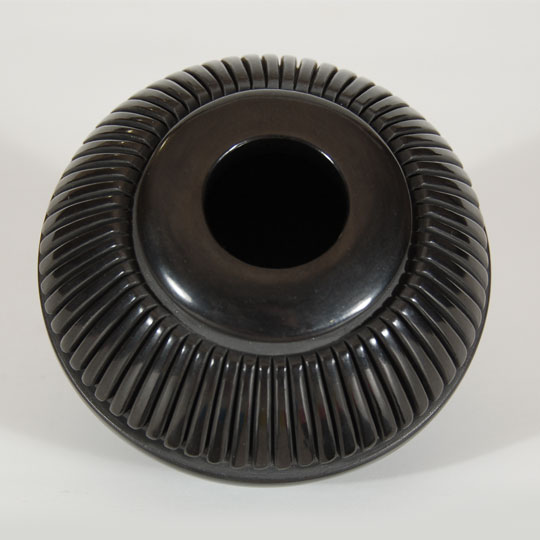
Posted by Adobe Gallery Team Member on Sat, Jan 30th 2016, 15:45

Nancy Youngblood Pottery - C3723AThere is probably no one who does not know who Nancy Youngblood is but, if that is not the case, then here is a short introduction to her.  She is the granddaughter of Margaret Tafoya and daughter of Mela Youngblood.  She is a master crafts person and certainly one of the most famous younger potters of today.  Nancy is known for her patience in making the most precise and perfect pottery.  She spares no effort in producing the perfect pot.  For more information on her, check the more detailed biography on our website by clicking on her name above.

Read more about this pot here..


San Ildefonso Pueblo Twisted Stem Polished Black Single Candlestick - 25808
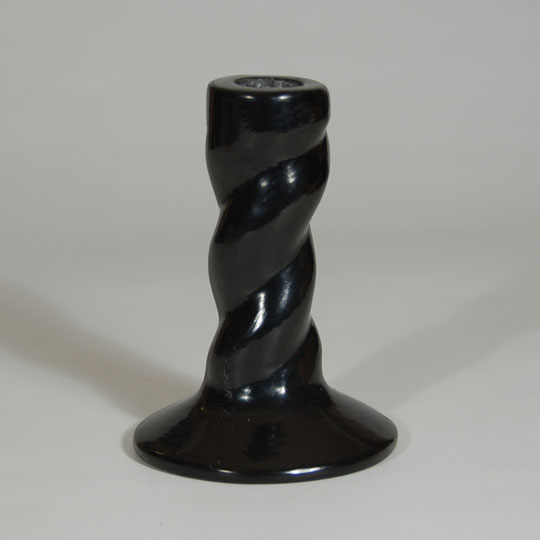
Posted by Adobe Gallery Team Member on Sat, Jan 30th 2016, 15:35

Lupita Martinez Pottery - 25808Lupita Martinez (1918- 2006) was the niece of Maria and Julian Martinez through marriage to the son of Julian's brother, Louis Martinez. I do not know if she was a full-time potter or an occasional potter.  She was, however, an excellent potter.

Read more about this candlestick here..

Zuni Pueblo Lidded Ceremonial Jar with Butterflies - 25806
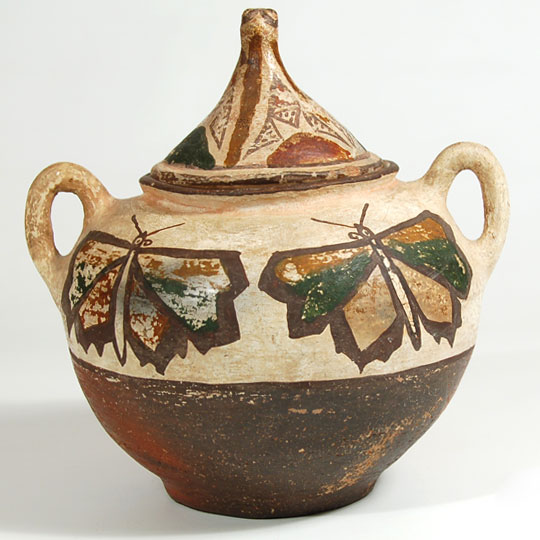
Posted by Adobe Gallery Team Member on Tue, Jan 19th 2016, 17:01

Historic Zuni Pottery - 25806The pottery classification "Zuni Polychrome" starts with a date of around 1850 and continues through today.  Polychrome vessels at Zuni have been made in probably the largest quantity of any pueblo and in the greatest variety of any pueblo.  James Stevenson and Frank Hamilton Cushing collected more than 1,000 ceramics at Zuni in 1879 and shipped them off to the Smithsonian.  In 1881, Stephenson again collected more, about 1,800 more, and three years later, another 2,250.  Stevenson's wife, Matilda Coxe Stevenson, collected rare examples in 1904.  Other museums also collected at Zuni during those times.  Batkin, 1987 [163]


Read More about this Zuni pottery here..

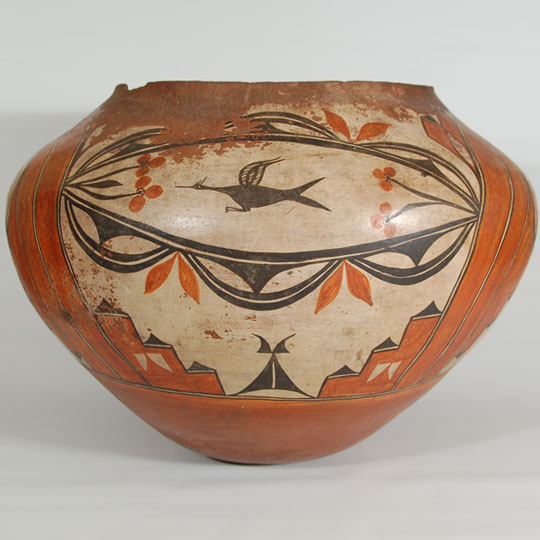
Historic Zia Pueblo Very Large Storage Jar - C3721
Posted by Adobe Gallery Team Member on Mon, Jan 18th 2016, 16:40

Historic Zia Pueblo Pottery - C3721As described by Harlow and Lanmon in The Pottery of Zia Pueblo (see Recommended Reading reference below), there was a period in Zia Southwest Indian Pottery production, beginning in the1880s, when two styles of arc designs were in use.  One they named Reflected Arcs appeared between 1880 and 1900 and the other Rainbow Arcs in use between 1880 and 1930.  Reflected arcs generally were designs within arcs that were connected at their ends.  The Rainbow arcs are familiar even today as the undulating arcs traversing over some design areas and under others.


Read more about this Zia Pueblo pot here..

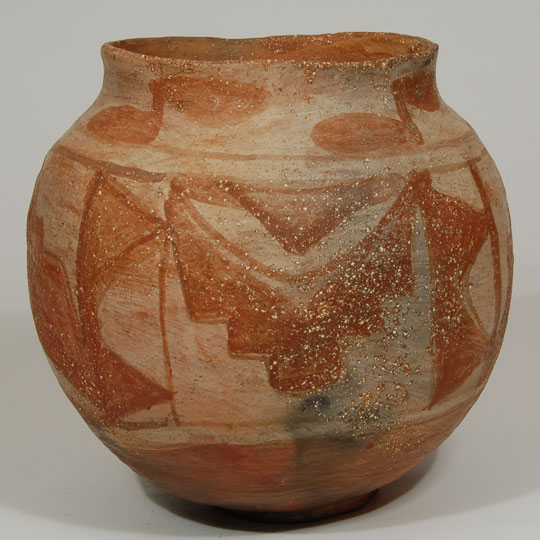
Historic Santa Ana Pueblo Footed Olla, circa 1930 - 24168
Posted by Adobe Gallery Team Member on Mon, Jan 18th 2016, 16:28

Historic Santa Ana Pueblo Pottery - 24168Historic Pottery from Santa Ana Pueblo is among the scarcest of all Pueblo pottery.  According to Batkin¹:  "As far as is known, all decorated pottery made at Santa Ana in the nineteenth century was polychrome. Reliable sources state that pottery was made in considerable quantities until 1900, although not much has survived. By the 1920s, the tradition had practically died out. Apparently no potters entered their work for judging at the Indian Fair between 1922 and 1924."

Read more about this pot here..

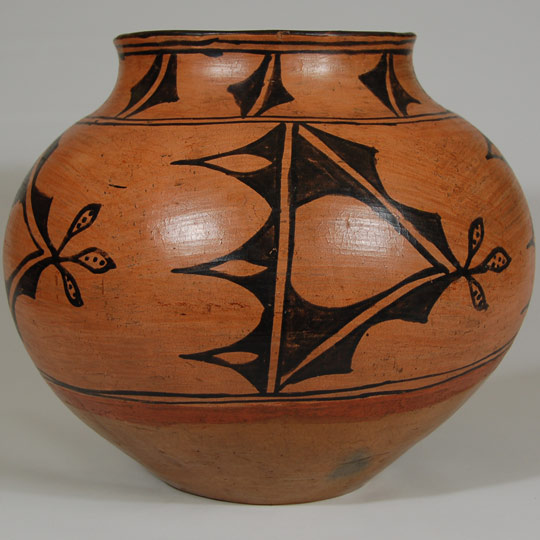
Historic San Ildefonso Pueblo Black-on-red Olla without Lid - C3443B
Posted by Adobe Gallery Team Member on Mon, Jan 18th 2016, 15:41

Historic San Ildefonso Pueblo Pottery C3443BSan Ildefonso pottery retained its traditional Tewa shape in the late 19th and early 20th centuries more so than the other Tewa pueblos, due primarily to its more isolated location than the others, according to Jonathan Batkin. There were so few potters at the pueblo at that time that tradition remained strong.

Read more about this pottery here..

75 | 76 | 77 | 78 | 79 | 80 | 81 | 82 | 83