



Hopi Small Bowl with Rim Design by Dextra Quotskuyva Nampeyo - C3868C
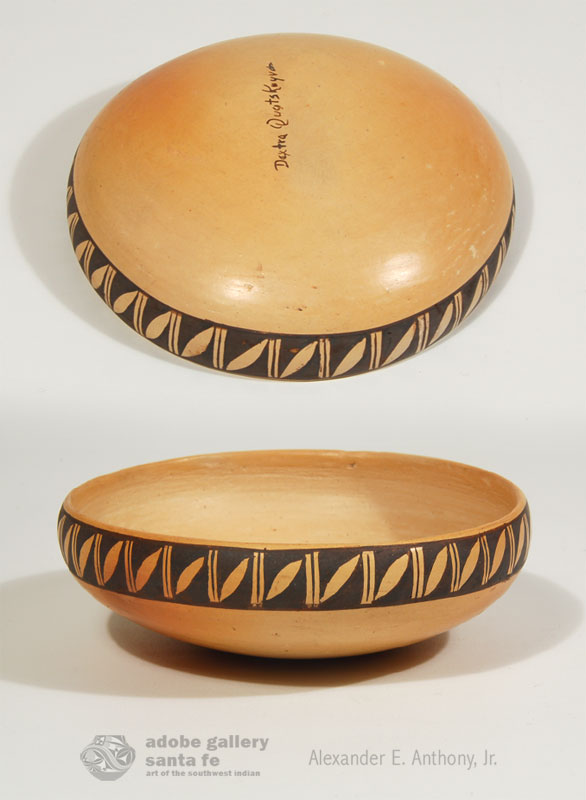 This Hopi Small Bowl with Rim Design was constructed with native clay and stone polished on the interior and exterior without addition of slip. The burnish is on the natural clay body. The design was painted on the exterior of the rim in a repetitive pattern in dark brown pigment.
The bowl is simple and elegant and a testament to the creative talent of Dextra Quotskuyva Nampeyo (1928- ) who could visualize the elegance of a simple design on an open bowl and apply the design with painted perfection. It is signed Dextra Quotskuyva on the underside.
Navajo Silver and Turquoise Floral Design Ring - C3864.36
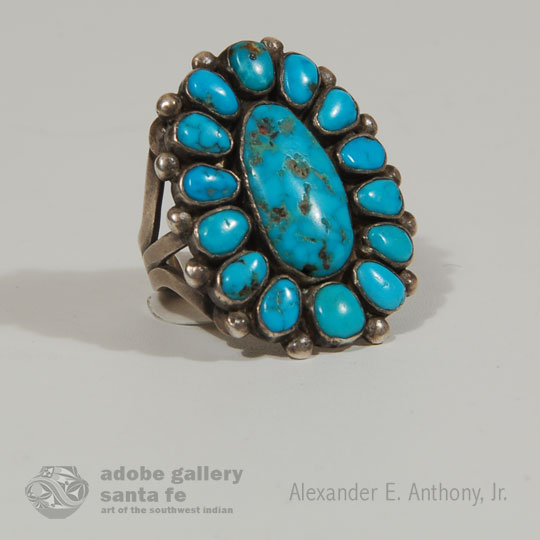 The turquoise in this ring is all natural with very little matrix. The individual cabs are beautiful sky blue in color and have imperfections that are natural. The Navajo Silver and Turquoise Floral Design Ring has a charming appeal as if made by and for its Navajo creator.
The silver shank branches out at the base of the ring into three sections. At the end of each of the branches is a silver dot, a little extra touch not normally applied by most artisans.
Untitled Painting Hair Washing with Yucca Root Shampoo by Gerald Nailor - 25934
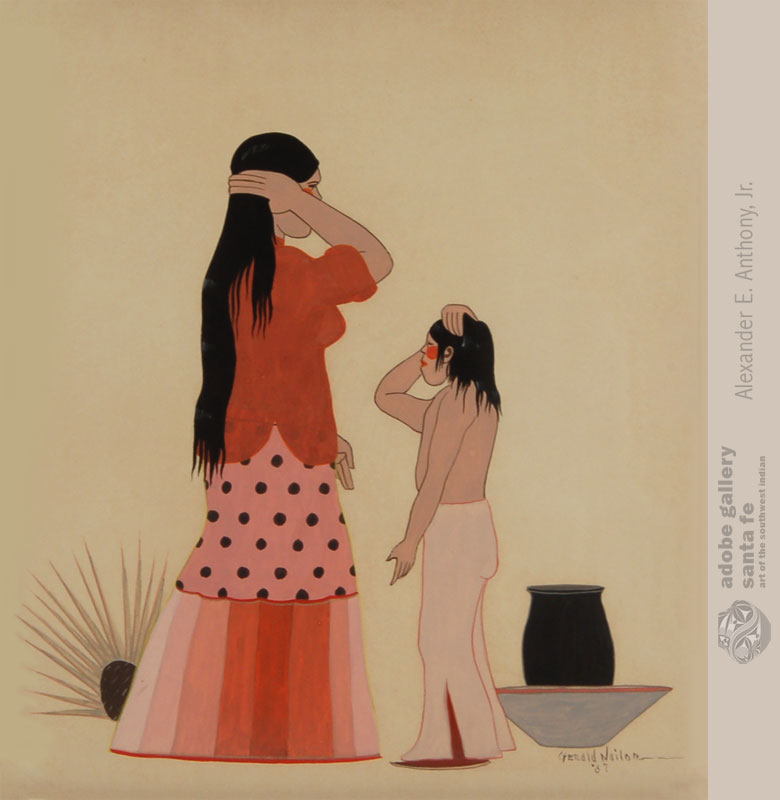 Gerald Nailor (1917-1952) painted in a decorative manner unlike any other Navajo artist. His style was unique and quite recognizable. He generally painted in soft matte colors.
Other than these images, there are no other sky or background images to distract from the main subject matter. The Untitled Painting Hair Washing with Yucca Root Shampoo is signed Gerald Nailor '37 in lower right.
Original Woodcut Tosca by T. C. Cannon Pai-doung-u-day - 25924
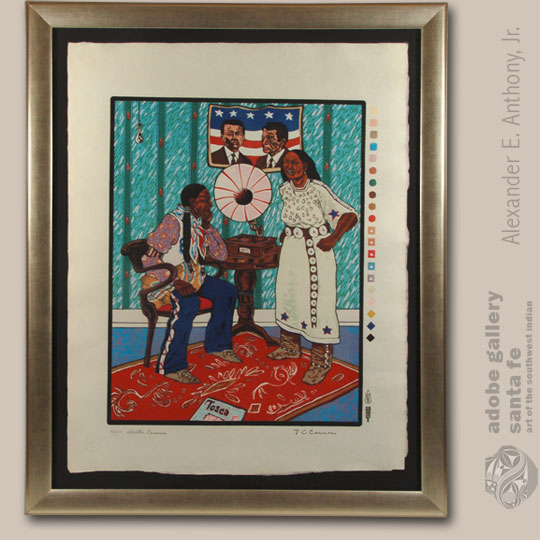 T. C. Cannon (1946-1978) Pai-doung-u-day "One Who Stands In The Sun" died young and left behind a beautiful, powerful oeuvre. He was born in 1946 in Lawton, Oklahoma, and died in an automobile accident in Santa Fe in 1978.
He had attended the Institute of American Indian Arts in Santa Fe, studying with Fritz Scholder. He seemed somewhat bitter and distrustful of authority. One of his teachers suggested to T. C. that they get in two rocking chairs facing each other and rock and frown until all the aggression was gone. He was away from home for the first time, so perhaps his quiet and reflective nature was misread as bitterness.
In 1975, T. C. Cannon began a collaboration with Japanese master woodcutter Maeda and master printer Uchikawa, a collaboration that continued until Cannon's untimely death in 1978. The result was the publication of the Memorial Woodcut Suite. In 1978, Cannon traveled to New York to sign the first two of the completed Japanese woodcuts. He returned to Santa Fe and died in an automobile accident on May 8th. Cannon's father, Walter, signed the remaining woodcut prints for his son.
Polacca Polychrome Inspired Contemporary Hopi Bowl by Mark Tahbo - 25930
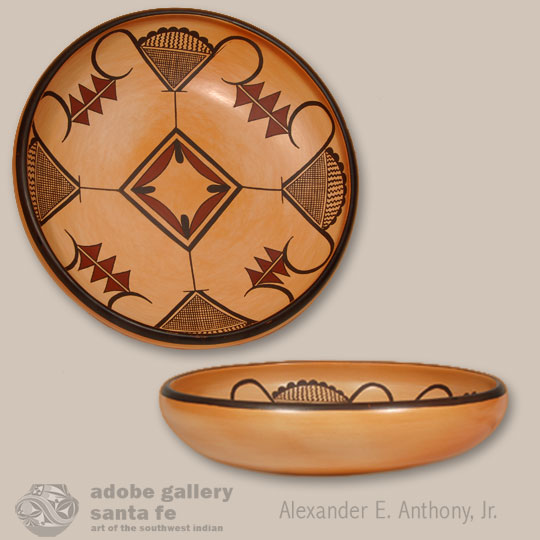 Today, Hopi Pueblo potter Mark Tahbo is mimicking those potters of more than a hundred years ago, who were mimicking those of almost a thousand years before their time. Just like the potters of the 1890s were reintroducing designs from the Sikyatki potters, Mark Tahbo is reintroducing designs from the potters of the 1890s. He is using designs from Polacca Polychrome pottery as his inspiration for some of his pottery today.
Hopi Pueblo Seated Koshare Clown with Watermelon by Fletcher Healing - C3868A
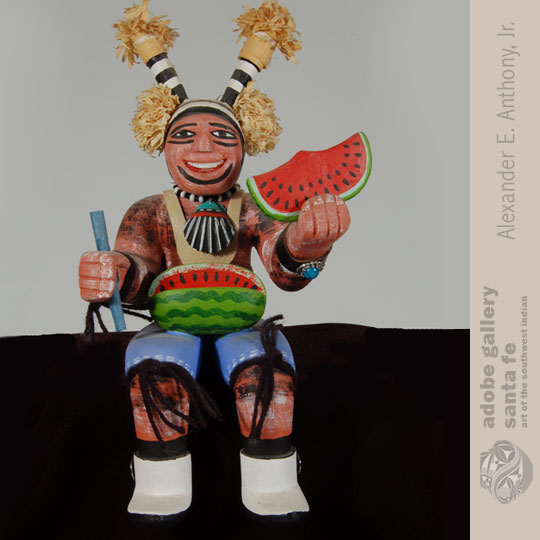 Fletcher Healing was the grandson of Annie Healing Nampeyo and great-grandson of Nampeyo of Hano. Unlike the rest of the Hopi Pueblo family members, he was not a potter but chose to carve Katsina dolls. He was known for making these seated clowns whose legs hang over from the shelf.
Kewa (Santo Domingo) Pueblo Three-strand Shell Hieshe Necklace - C3864.46
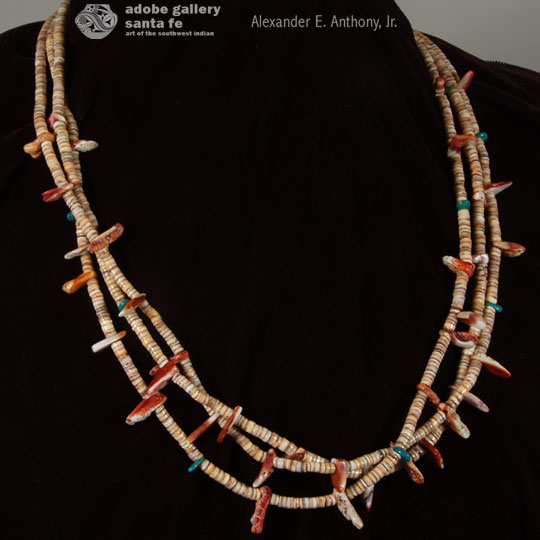 Kewa (formerly Santo Domingo) Pueblo artisans have been known for decades for the fine hieshe necklaces they produce. It is a style they have made for their own use for a thousand or more years, long before they started into silverwork. Hieshe is made from sea shells. The shells are first cut into small square sections, drilled in the center, strung on wire or string, then sanded by hand, in an up and down stroke, until each one is round. That sounds easy but is not. It is important to exert the same pressure on every stroke to achieve hieshe of the same diameter when finished.
Hopi Polychrome Open Bowl with Interior Design by Nampeyo of Hano - C3863D
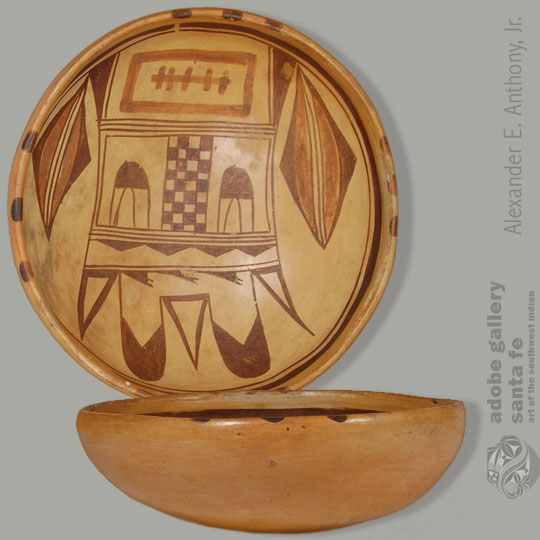 This exquisite small bowl is attributed to Nampeyo of Hano based on construction techniques, layout of design, and execution of design. One of the first items of consideration is the extra coil of clay Nampeyo placed at the interior rim of bowls, which is easily determined by rubbing one's hand along the rim interior. Such a coil is evident in this bowl. The bottom is rounded, not flattened, and shows evidence of long polishing strokes as was typical of Nampeyo. The layout of the design is very typical of her style.
Fred Harvey Style Bracelet with Silver Bars and Silver Button - C3864.16
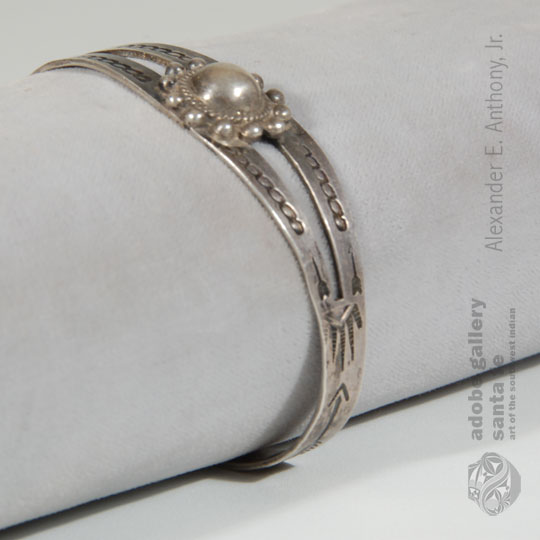 This Fred Harvey Style Bracelet with Silver Bars and Silver Button has a hand-formed silver button surrounded by smaller silver balls to create a characteristic Fred Harvey style bracelet. Arrow and cloud motifs adorn the sides and the split shank gives the bracelet a delicate, airy feel.
Fred Harvey Style Navajo Bracelet with One Stone - C3864.01
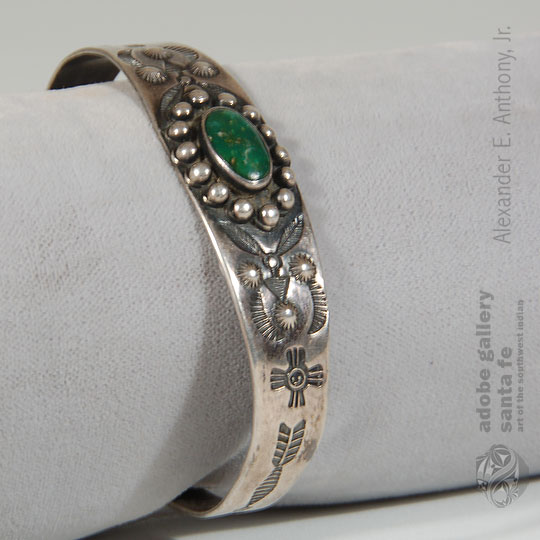 This Fred Harvey Style Navajo Bracelet with One Stone features diamonds, arrows, Zia Sun and crescent shaped stamps which are so characteristic to the Fred Harvey style. The stamps symmetrically surround a beautiful deep green turquoise stone, which is surrounded by silver dots.
Fred Harvey Style Navajo Bracelet with Single Stone and Stamping - C3864.12
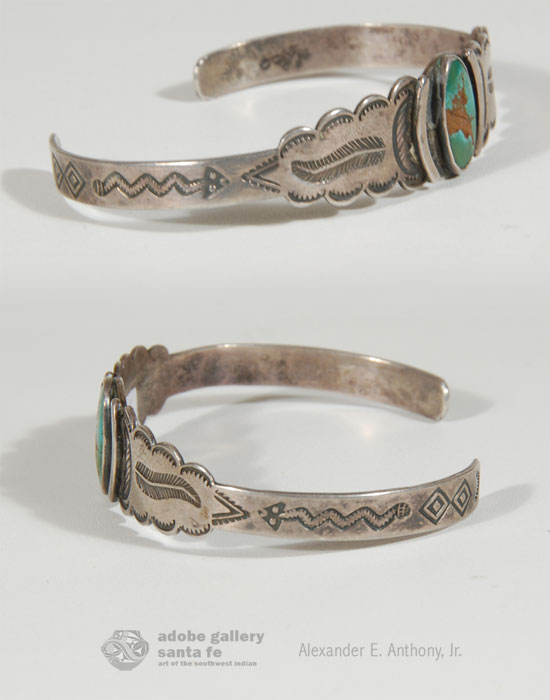 When Fred Harvey hired anthropologists to help him create and market designs for the travelers, one of the things the company determined was that the style needed to attract buyers. This lovely Fred Harvey Style Navajo Bracelet with Single Stone and Stamping features typical southwestern designs, feather and animal stamps and turquoise, but it also has the graceful scalloped edges and delicate feel that was intended to attract the attention of the tourist.
Fred Harvey Style Thin Silver Band with Repoussé - C3864.24
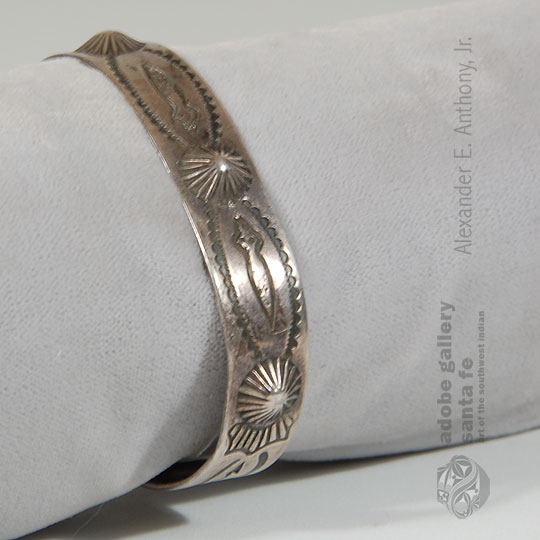 Jewelry made by Native American artists, working for the Fred Harvey Company, to be sold to travelers at the Fred Harvey hotels, was different from the jewelry they made for themselves. The esthetic was geared more towards what was more attractive for the tourists. Thus, a unique style was created, and marketed and has endured to this day. The style consists of stamp motifs with arrows, diamonds, animals and distinct geometric designs, that today we identify as the "Fred Harvey Style."
Navajo Silver and Turquoise Bracelet with Button and Repoussé - C3864.10
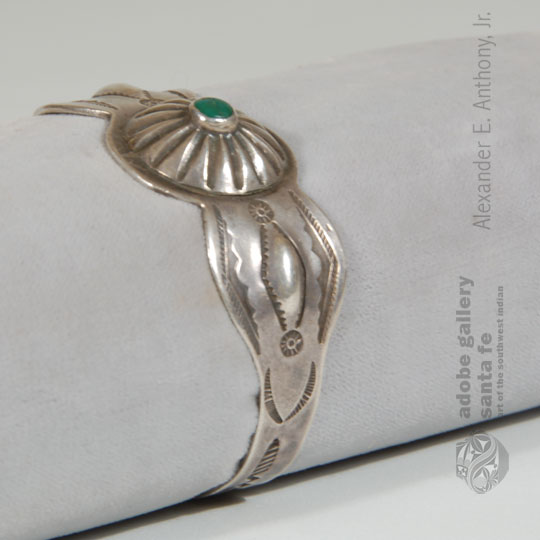 The unknown artist who created this Silver and Turquoise Bracelet with Button and Repoussé innovatively added a button to where a stone usually would be placed. Perhaps he wanted to repurpose a single button, or perhaps he had no more larger stones. Whatever the reason, this button bracelet is unique. The sides feature all the characteristics of Fred Harvey style jewelry; geometric stamping in addition to repoussé diamonds. It is the button which makes it exceptional. I like to think it is an early example of Native American repurposing.
The Fred Harvey Company had anthropologists on its staff to consult with Native American artists to design quality souvenirs and provide tourists with an "Authentic Southwest Experience." Perhaps this artisan expressed his individuality in the creation of this bracelet.
Kewa Pueblo Single Strand Nugget Necklace with Jaclas - C3864.48
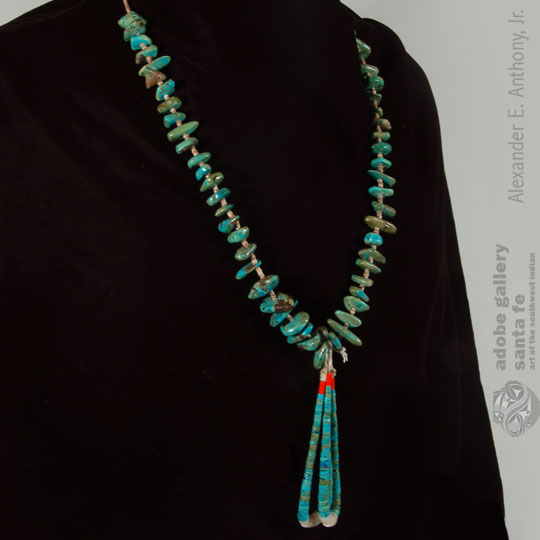 This Single Strand Nugget Necklace with Jaclas style is the most traditional of all necklaces that we associate with the pueblo people. Long before silver was introduced to them, the pueblos were making necklaces of turquoise, hieshe, shell, coral and other natural materials. This is the style they were wearing when the Spaniards arrived in the 16th century; and this is the style they wear today during their religious and social dances. If one goes to any pueblo feast day plaza dance, it is this style necklace one sees on all the dancers-male and female, adult and child. It possesses powers unrivaled by silver jewelry.
This Santo Domingo Pueblo necklace has the traditional pair of jaclas suspended from the bottom of the necklace. Jaclas were originally made and worn as earrings but eventually were added to the nugget necklaces in the manner shown here. The part of the necklace that is in the back of the neck is wrapped in cotton thread in what is known as a "pueblo wrap." It perhaps was intended to be removed and replaced when it became soiled.
Heavy Stock Sterling Silver and Turquoise Bracelet - C3864.03
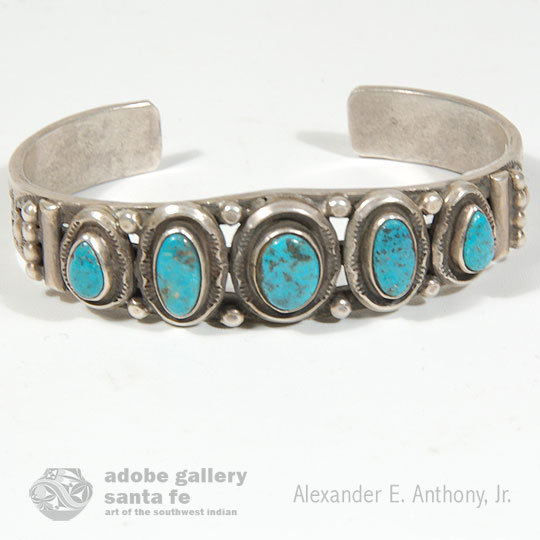 Five beautiful oval turquoise cabs grace the top of this heavy silver bracelet. The silver appears to be ingot as it is think and heavy. Each of the turquoise cabs is set is a silver bezel, surrounded by a silver cap and mounted on the bracelet shaft. The ends of the Heavy Stock Sterling Silver and Turquoise Bracelet are profusely stamped with traditional Navajo designs. The bracelet is stamped Sterling but there is no artist name.
Navajo Silver Bracelet with Five Turquoise Stones - C3864.22
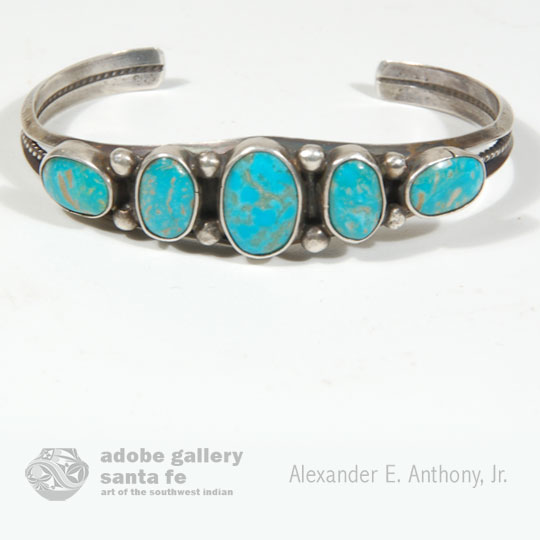 Five blue and copper turquoise stones are beautifully arranged as the center pieces of this silver bracelet. The three center stones are arranged with the maximum diameter in a vertical position and the outer two are arranged with the maximum diameter in a horizontal position.
The Navajo Silver Bracelet with Five Turquoise Stones was formed from two silver bars and a single silver twisted wire as the foundation. It appears to date from the mid-1950s.
Navajo Pyramidal Shaped Silver and Turquoise Earrings - C3864.43
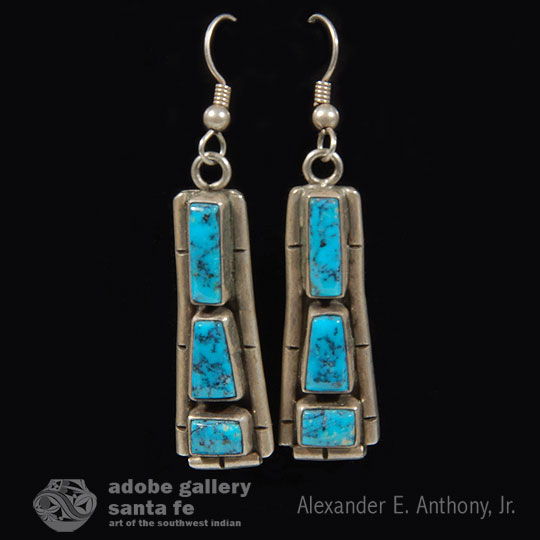 Three beautiful blue turquoise cabs with strong matrix have been placed in ascending order from the lowest one which is square to the next one which is trapezoidal to the top one which is rectangular. They are secured to a silver sheet backing with edges of tubular silver. They are equipped with wires for pierced ears. Each of the Navajo Pyramidal Shaped Silver and Turquoise Earrings is stamped sterling on verso. There is no artist name. These probably date to mid-20th century.
Zuni Pueblo Floral Style Silver and Turquoise Cluster Ring - C3864.37
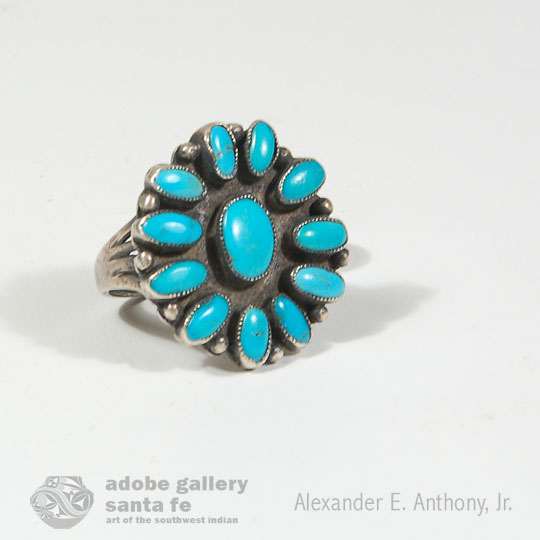 Cluster rings evoke a feeling of flowers. Generally, they are arranged with a center stone surrounded by a circle of stones. This ring is of that style. There are eleven perimeter turquoise cabs surrounding a center turquoise cab. The turquoise cabs are mounted in individual bezels and attached to a flat silver backing, which is attached to the silver shank.
This Zuni Pueblo Floral Style Cluster Ring is not signed with the name of the artisan nor is it dated, however, wear patterns of the silver edges would indicate an age of 50 or more years.
Zuni Pueblo Silver and Turquoise Petit Point Cascading Earrings - C3864.42
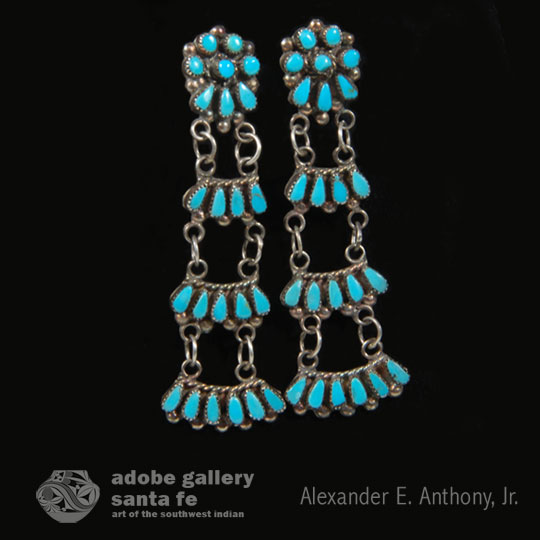 Very small round and tear drop turquoise stones are set in hand-made saw tooth bezels to create a jewelry masterpiece. This early pair of Zuni Pueblo Petit Point Cascading Earrings is a testament to the ability of Zuni Pueblo artisans to work with the smallest pieces of stone. Zuni petit point and needlepoint got their names from the fine embroidery work of the time. Just as women would spend hours sewing designs with small stitches of thread, the Zuni used small stones to create designs to wear as jewelry.