



Hopi Sterling Silver Buckle with Man-in-the-Maze Design by Jason Takala - C3852F
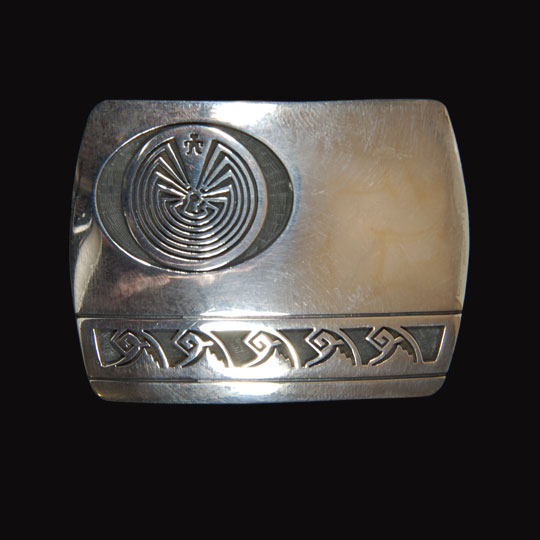 Hopi artisan Jason Takala has been an active jeweler since 1966. He is the nephew of Bernard Dawahoya and lives in the village of Shungopavi at Second Mesa. His favorite design is the Man-in-the-Maze, one of the most difficult because of the closeness of the cut-out design, a feat he does by hand. His more recent works are executed in both silver and gold
Navajo Sterling Silver Cast Buckle with Various Stones by Boyd Tsosie - C3852C
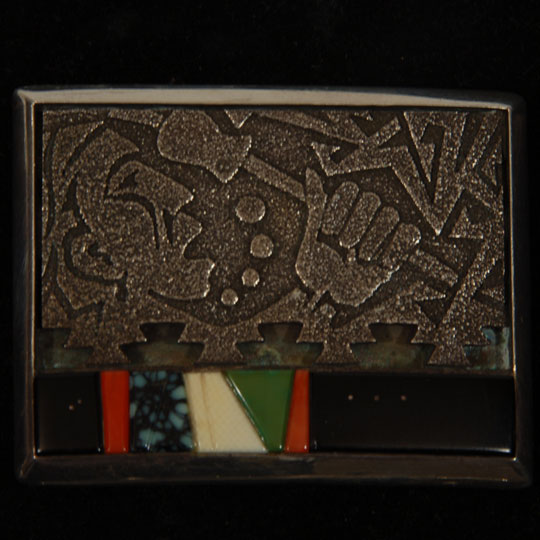 Navajo artisan Boyd Tsosie attended the Navajo Community College and studied under the tutelage of Kenneth Begay. He is considered a maker of fashion jewelry, departing from traditional styles of Navajo jewelry. He is an innovative designer and craftsman.
His jewelry creations were featured in "The New Look in Indian Jewelry" in Arizona Highways, April 1979. He was also included in the exhibit "Jewels of the Southwest" at the Museum of Indian Arts and Culture, Santa Fe.
San Ildefonso Pueblo Black-on-black Candle Holders by Maria Martinez - C3849A
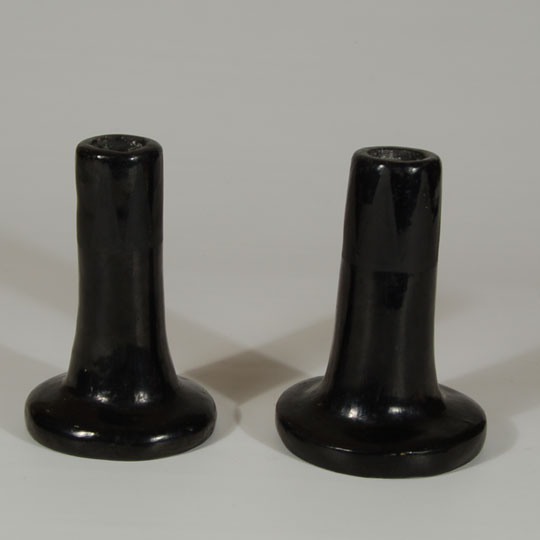 As published by Richard Spivey, Maria and Julian began producing plain polished black pottery around 1912 and Black-on-black pottery around 1919-1920. Julian continued to paint Maria's pottery until his untimely death in 1943. It was around 1925 that Julian's name began to appear alongside Maria's on their pottery. So, we see that there is only a period of about 18 years when the co-signed pottery was made.
Hopi Pueblo Overlay Silver Hair Barrette by Bernard Dawahoya - C3833C
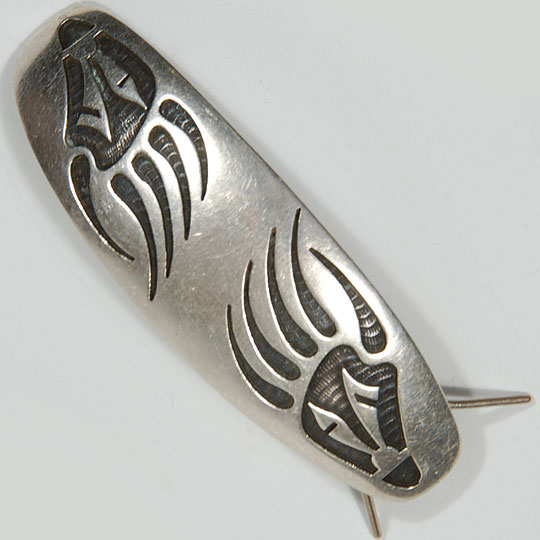 Bernard Dawahoya (b.1935-) Masqueva - Little Sun learned to make jewelry from his uncles, Washington Talayumptewa & Sidney Sekakuku. Bernard recalled that he was about 15 years old when he was working at his Uncle Sidney Sekakuku's sheep camp and was caught playing with his jewelry-making tools, so his uncle began teaching Bernard jewelry making at that time.
Original Zuni Pueblo Painting of “The Zuni Rain God” by Manuel Sandy - 25914
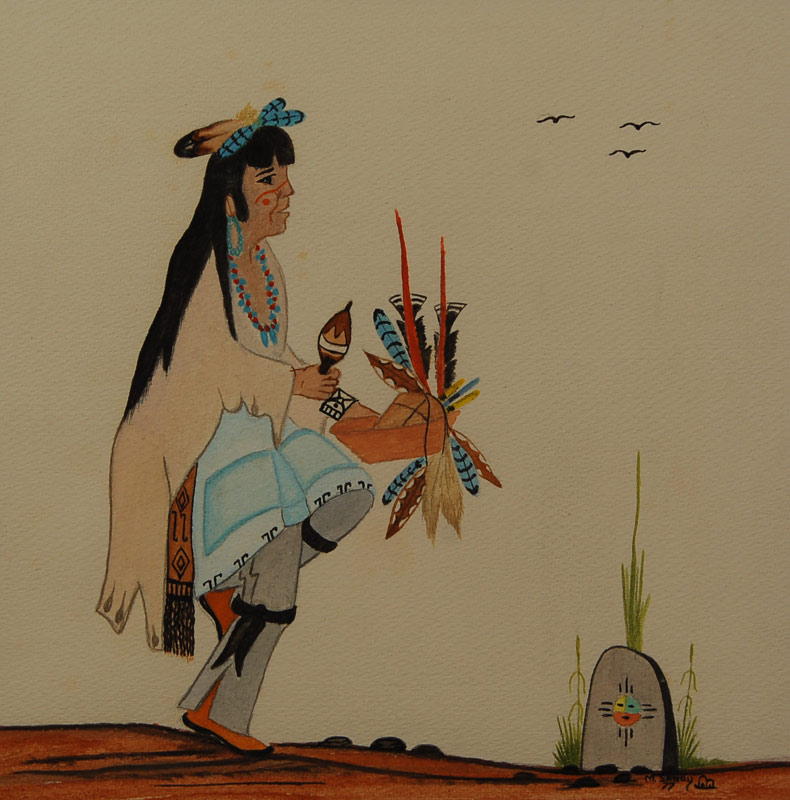 The painting is entitled "The Zuni Rain God" and is signed M. Sandy and dated 1977. It shows the Rain Priest with a medicine basket that holds a wrapped bundle with many colorful feathers. He is heading toward the religious shrine. Interestingly he is dressed in traditional Native clothing-the pants with the split up the side are traditional Hopi and Zuni cotton trousers that were made from hand woven cotton.
Large Hopi Pueblo Polished Red Wedding Vessel by Garnet Pavatea - 25913
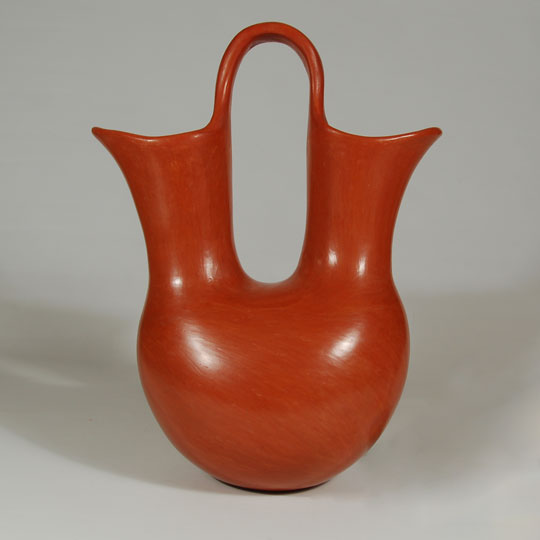 Garnet Pavatea (1915-1981) Flower Girl was a long-time entrant in the craft exhibit and won many awards by doing so. She also seemed to be a favorite of the Museum of Northern Arizona. She was often a demonstrator at the Craftsman Exhibition. For a number of years, Adobe Gallery had a standing order from the Museum of Northern Arizona for any Garnet Pavatea pottery available.
This large stone-polished red wedding vessel has a beautiful, smooth, highly-burnished finish. It is completely devoid of painted designs. She extended the polishing down into the interior of the vessel, a step that was not necessary but that demonstrates her attention to detail.
14 Piece Taos Pueblo Nacimiento Set by Alma Loretto Concha - 00230
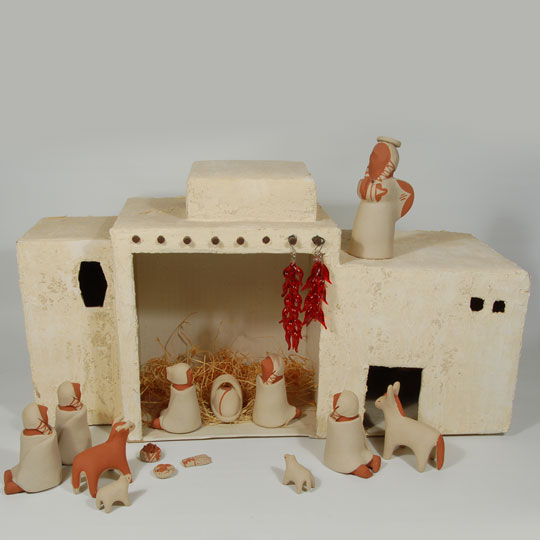 Alma Loretto Concha (1941 - ) was originally from Jemez Pueblo but moved to Taos Pueblo when she married. At the time that she made this nacimiento, in 1978, she was a resident of Taos Pueblo. This set includes the Holy Family, Three Kings with their gifts of corn, bread and chile, four animals and an angel.
Historic Hopi Pueblo Cylindrical Polychrome Jar with Avian Designs - 25407
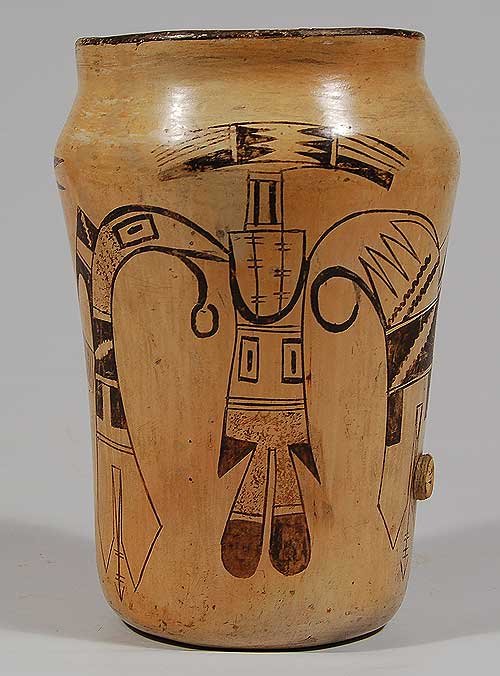 Frank Applegate conducted classes in the Hopi villages in 1922 at the request of the Indian Commission. It is quite possible that he re-introduced this shape to the Hopi potters at that time. The shape does have precedence from prehistoric times.
Recent studies of excavated prehistoric sites at Chaco Canyon have revealed specimens of cylindrical jars. Anthropologist Patricia Crown, from the University of New Mexico, and a colleague from the Hershey Center for Health and Nutrition, analyzed potsherds and found traces of a compound of cacao. From their research, they concluded that the cylindrical jars were used to hold chocolate in beverage form. Only a couple hundred complete jars have been found and most of them came from Pueblo Bonito, but many shards that would fit a cylindrical jar shape have been unearthed.
Very Large Ohkay Owingeh ( San Juan) Pueblo Black over Gray Storage Jar - C3215A
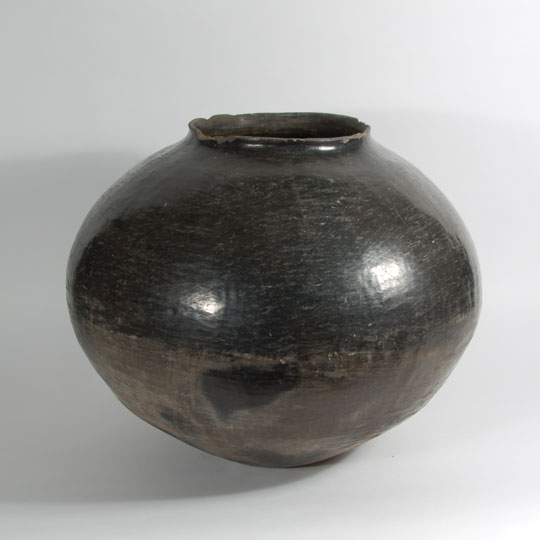 The pre-1900s vessels from Ohkay Owingeh were not as highly polished as today's blackware from the other Tewa pueblos, but the lack of severe polishing provided slight irregularities in the surface of a vessel from which the reflected light is pleasantly muted. Most vessels were slipped with a deep red slip on the upper 2/3rd of the body, leaving the lower 1/3rd without slip. The entire vessel was then polished, inside and out, to a hard finish. The red-over-tan finished product was then fired-either in an oxidizing or reduction firing-from which would be obtained a red-over-tan or black-over gray finished product.
Very Large Historic Kiua Polychrome-Cochiti Variety-Storage Jar - 22257
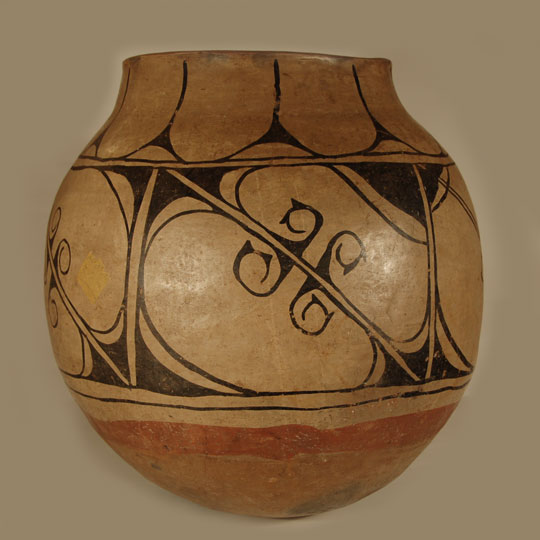 Cochiti Pueblo residents speak the Keresan language, along with their Northeast Keres neighbors, Kewa and San Felipe. The three pueblos are strongly religious in both the Roman Catholic and their own Native religion. Their association with non-native peoples is not as homogenous, however. Kewa is more conservative in protecting its beliefs and lifestyle that either Cochiti or San Felipe. Cochiti is more open about painting religious symbolism on secular pots whereas Kewa would not do so. San Felipe is located closer to Interstate 25 than Cochiti and operates a casino open to the public.
Cochiti Pueblo has been in its present location since before 1700. Its current population is around 1500. It has a long history of producing beautiful pottery for use at the pueblo and for producing large quantities of figurine pottery for sale to merchants in Santa Fe. The potters seem to be better known for the figurine pottery than for vessel-shape pottery, but the latter has always been produced for pueblo use as well as for sale.
Jar Inspired by Work of Grace Chapella by Mark Tahbo - 25912
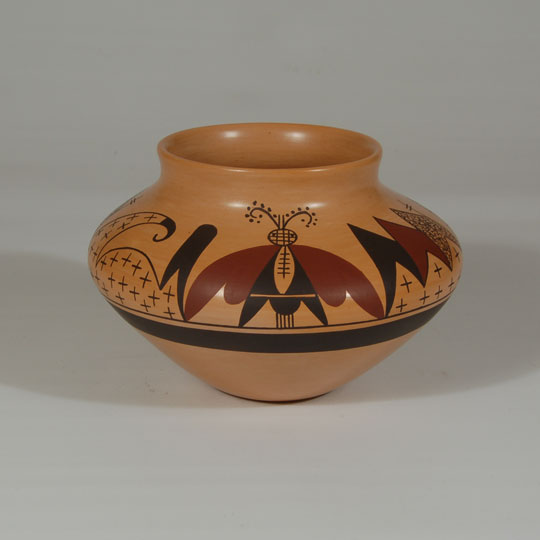 Mark Tahbo's great-grandmother was Grace Chapella and his grandmother was Alma Chapella Tahbo. Mark remembers Grace because she encouraged him to work with clay when he was a youngster. Mark was around 22 years old when Grace passed away at the age of 107 years. Mark reminisced about Grace when he brought us this jar. He said that when she was about 104 years she made a jar about the size of this one he brought us and it was the largest jar she had made in years and years, so her daughter, Alma hid it from Grace so she would not break it or ruin it by painting the design. Grace searched and searched for the jar and finally found it hidden behind a door in a stove. She took it out and held it while sitting in a chair and fell asleep with it in her lap. Of course, it fell to the floor and broke in many pieces. She awoke and said that Alma is going to be very angry at her, which, of course, was the case.
Historic Large Polychrome Acoma Pueblo Water Jar - 25136
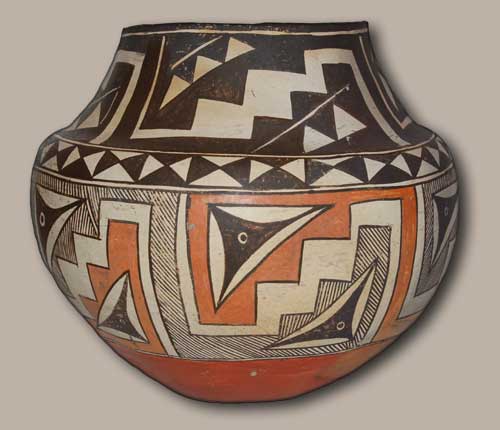 This polychrome olla qualifies as an exceptional work of art. The vessel shape is as near perfect as one would expect. The high shoulder provided room for a large area on the main body for the artist to express her artistic talent.
As is traditional at Acoma, the jar was formed in native clay with ground pottery shard temper, has a rag-wiped white slip, red neck interior, and red-slipped underbody with concave base. The point of maximum diameter is as near the equator of the jar as one could calculate.
Historic Acoma Pueblo Large Polychrome Olla - C3671F
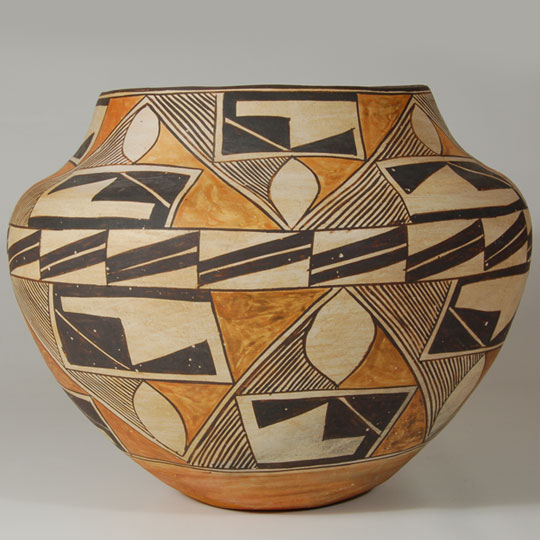 The high shoulder of this historic jar is emphasized by the split horizontal bars that are stacked on each other. The strong black of this design contrasts significantly with the polychrome designs on the neck and body of the Acoma Pueblo jar.
The neck design contains the same design elements as those on the body, just reduced in size to fit the smaller area. The design panels are divided by triangles alternating in an up and down position. In each triangle there is a white and black design in a horizontal rectangle. On one side of that is a design of fine black parallel lines and on the other side is a block of orange. This design within a triangle is repeated throughout the body and neck.
Nine-Piece Pottery Polychrome Nacimiento by Dorothy Loretto Trujillo - C3848
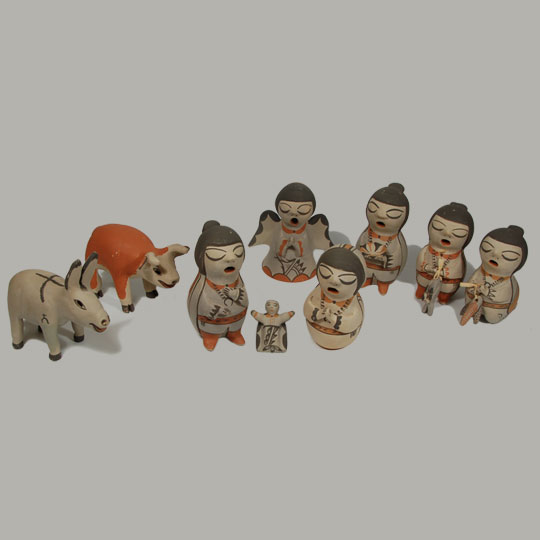 Dorothy Loretto Trujillo, who passed away in 1999, was an outstanding potter. She was originally from Jemez Pueblo, but moved to Cochiti following her marriage to Onofre Trujillo, and obtained permission to make pottery using Cochiti clay. After moving to Cochiti Pueblo, Dorothy started making pottery in the Cochiti style, abandoning her Jemez style.
Dorothy was one of the early potters to make storytellers. She was from a family of outstanding potters. Her sisters, Mary E. Toya, Marie Edna Coriz, Alma Concha Loretto, Fannie Wall Loretto, and Lenora Lupe Lucero, are famous potters as well. Interestingly, her sisters also married out of their native pueblo and moved to the pueblo of their spouses. Dorothy began making Storytellers before 1970. Two years later, she began making Nativities (Nacimientos). Dorothy shared her pottery-making knowledge with others. She had taught at least three people, including two of her own daughters. Her Storytellers may have only one or over 40 babies. One of her Storytellers is on exhibit at the Smithsonian Institution, Museum of Natural History, Washington, D.C.
Miniature Akimel O' Odham - Pima Basket with Turtle Design - C3353.03
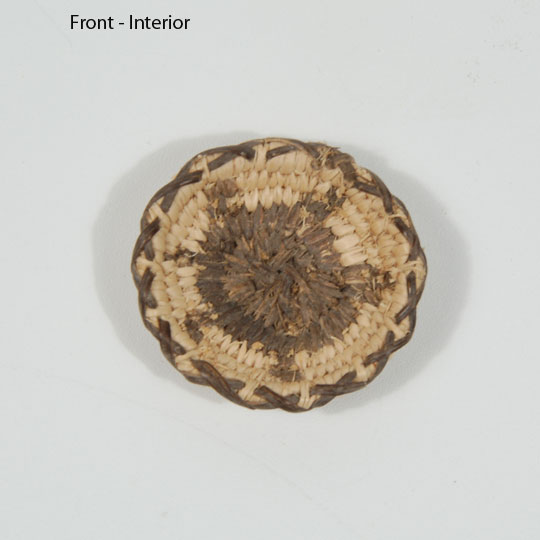 The Akimel O´odham River People (Pima) of Arizona were major basket makers in the late 19th century, primarily making them for their own use. At the turn of the century, basket weaving was being practiced in every home. This continued into the early 20th century, at which time Southwest Indian basketry became a collectible commodity. The problem was that the collectors and dealers only paid $1.00 to $3.00 for a basket. The women soon realized that it was not practical to spend weeks making a basket when they could pick cotton and earn $2.00 a day. By the 1920s, basket weaving all but disappeared. By 1960, they were not even making baskets for their own use. They had, by then, substituted commercially made pots and pans for utilitarian use.
Polacca Polychrome Inspiration for a Contemporary Jar by Mark Tahbo - 25911
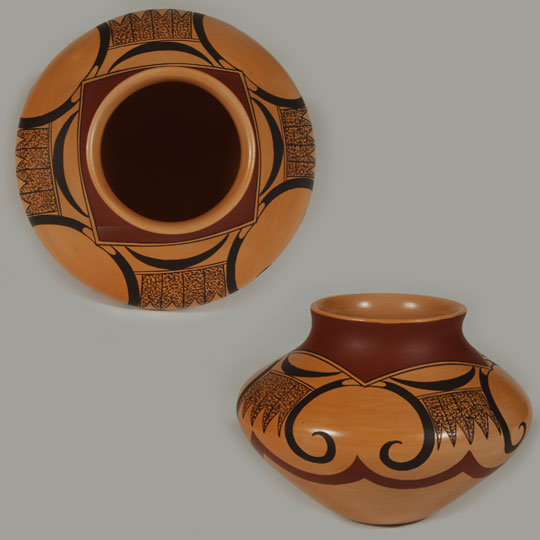 Mark Tahbo often uses historic and prehistoric examples of Hopi pottery as his inspiration when creating designs on new vessels. He, by doing this, keeps the continuity of Hopi ceramics alive and brings the older designs back to the attention of today's collectors.
This medium-size jar was inspired by a Hopi Polacca Polychrome jar (Sikyatki Revival), dating from 1890-1900, that was in the Thomas Keam collection and now resides at the Peabody Museum at Harvard University. At the time that Alexander M. Stephen cataloged the Keam collection, he categorized Polacca Polychrome as "modern" pottery because it was being made at the time he was working with Keam on documenting his collection. Modern pottery of that time (1890-1900) is now considered historic pottery.
Hopi Pueblo Pictorial Tile with Crow Mother Image by Gwen Setalla - C3843N
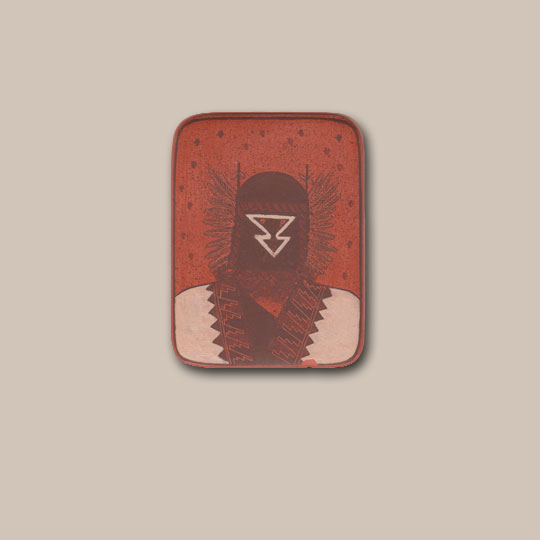 Gwen Sharon Setalla (b.1964-) Aȁs-kữ-Mana is a Hopi from the village of Mishongnovi on Second Mesa. Her mother is Pauline Setalla from Mishongnovi. They are of the Frog Woman and Feather Woman families. The family lived on a ranch not far from Keams Canyon and Gwen spent her early childhood there. She learned pottery making from her mother, starting as early as age 5 and began to take it seriously by age 21.
Very Large Hopi Polychrome Seed Jar by Debbie Clashin - 25862
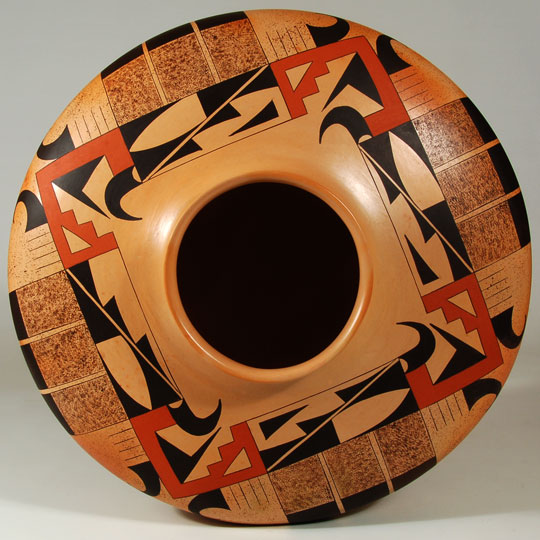 This very large Hopi Pueblo seed jar was made by Debbie Clashin, a potter we met through Hopi potter Mark Tahbo. Mark's mother and Debbie's mother were sisters. Debbie credits Mark's sister, Diana Tahbo, with teaching her how to become a potter and now Debbie produces amazing large Hopi seed jars. This jar is over a foot in diameter.
Original Etching and Drypoint “Taos” by Edward Borein - C3827H
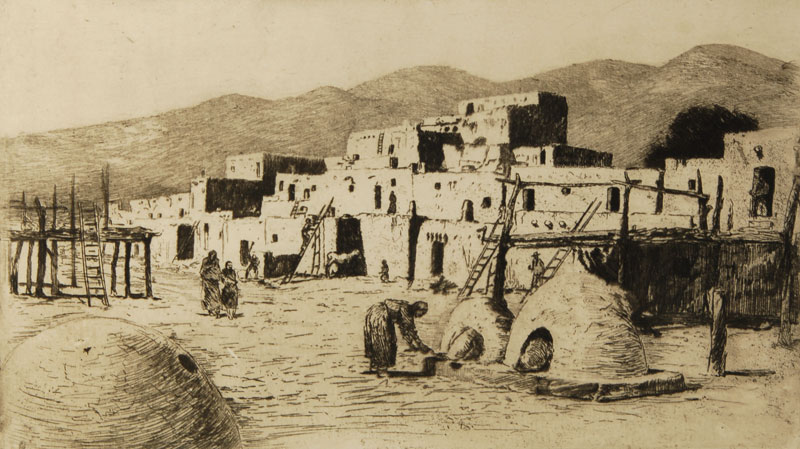 Like almost every artist who has visited New Mexico, Edward Borein (1873-1945) provides us with his rendition of Taos Pueblo. A Taos woman tends to her bread that is baking in the horno, a Taos Indian is climbing a ladder to get to the second level of the terrace house, a couple of people are walking, one is standing in a doorway on the right, and a horse is standing near a building.
Original Etching and Drypoint “The Antelope Kiva, Walpi” by Edward Borein - C3827G
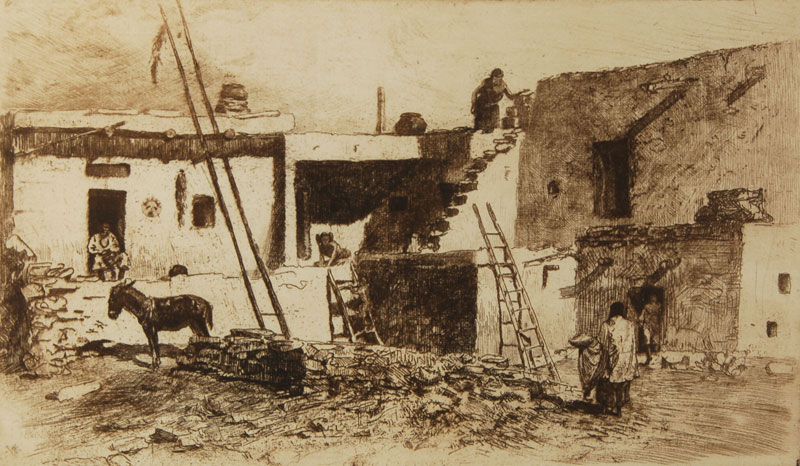 Edward Borein was born at San Leandro, California, not far from San Francisco, in 1873. He began to work as a cowboy at the age of seventeen, and sold his first drawing when he was twenty-one. From that time onward, irrespective of location as he travelled all over the Southwestern United States and as far south as Guatemala, he was an artist. He remained ever devoted to the practice of his professional skill, and at the same time kept up his interest in cowboy life, to the very end.
Borein also knew the Pueblo Indians and drew them and their villages. It is not known what years Borein visited the Pueblo villages and put his thoughts on paper in the etching process but it would have been in the late 1800s or early 1900s.