



Zuni Pueblo Triple Row Turquoise and Silver Bracelet - C3864.13
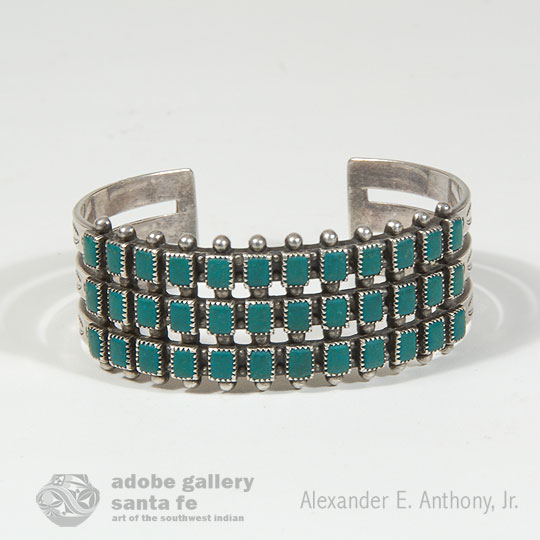 The idea for this style bracelet probably began with a single silver narrow band bracelet. Some ingenious jeweler envisioned putting several narrow-band bracelets together to make a wider one. The idea blossomed into a wide bracelet but one not made by connecting three narrow ones together. This one was fashioned as a single bracelet from the beginning.
The Zuni Pueblo Triple Row Turquoise and Silver Bracelet is topped with three rows each containing 12 small square cut turquoise cabs, each cab set into a silver bezel. The sides of the bracelet are stamped with traditional Zuni stamping.
Modern Twist of Traditional Pottery - Mark Tahbo
Mark Tahbo of Hopi Pueblo in Arizona talks about his modern twist to Hopi traditional pottery designs #25931.
Small Black Carved Storage Jar with Avanyu Design by Toni Roller - C3860G
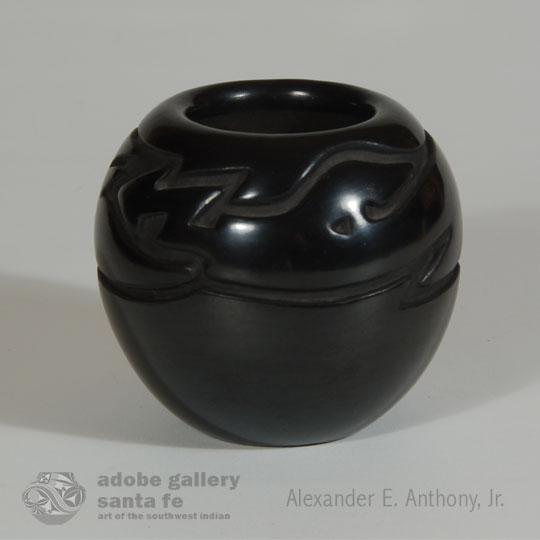 Toni Roller began her career as a pueblo potter at age six by making clay marbles and throwing them into the fire when her mother, Margaret Tafoya, was firing pottery. From there she blossomed into one of the finest potters at Santa Clara Pueblo. This jar, from 1985, is truly an exceptional example of her attention to detail-vessel shape, burnishing and firing. It is a beautiful example of an outstanding carved-design jar.
Small Round Sgraffito Turtle Design Seed Pot by Elya Naranjo Smith - C3771N
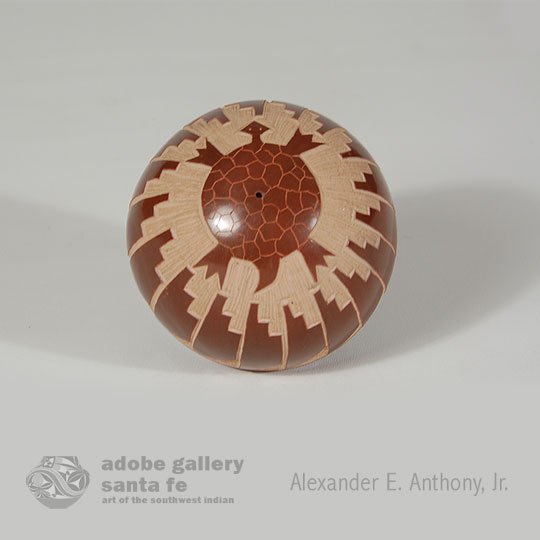 This round seed jar is beautifully designed in the sgraffito style. The center design element is a turtle. Surrounding the turtle is a series of parallel feather elements. The remainder of the jar is stone polished and fired to a burnished brown.
Elya Naranjo Smith, a potter from Santa Clara Pueblo. We have seen small seed jars with sgraffito designs on them. Otherwise, we cannot find any additional information on this artist.
Navajo Silver and Coral Floral Design Ring - C3864.35
 Coral was introduced to the Southwest by the Spaniards but was not used extensively until the late 1930s, when traders imported it to Zuni Pueblo. Most coral used in the Southwest came from the Mediterranean. Both Pueblo and Navajo artisans have worked with coral.
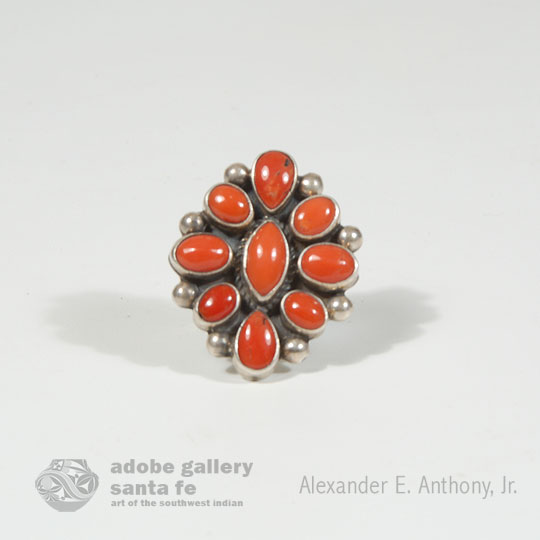
This Navajo Silver and Coral Floral Design Ring has nine coral cabs mounted in silver bezels and arranged in a flower design. It is stamped Sterling on the back and has the initial S. If there was another initial, it has been covered up with the shank.
Navajo Silver and Coral Single Stone Bracelet - C3864.15
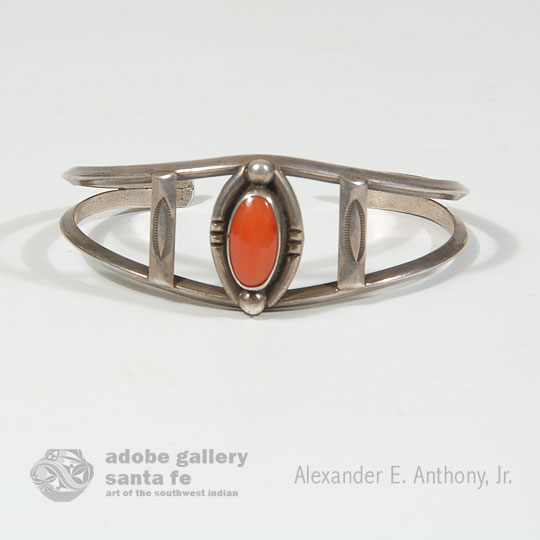 This Navajo Silver and Coral Single Stone Bracelet was constructed from a pair of silver wires separated in the middle by silver bar wedges and soldered together at their ends. A beautiful coral stone, mounted in a silver bezel is attached to a silver backing and mounted in the center of the bracelet.
Sterling Silver Bracelet with Eight Coral Cabs by Paylee and Darlene Coonsis - C3864.18
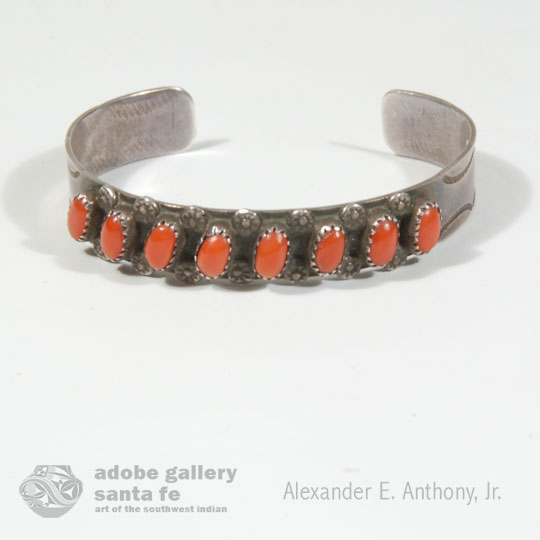 The eight oval and rectangular coral cabs are mounted at a slight angle on the wide silver band. Each cab is set in a serrated silver bezel and separated by floral design silver dots. The ends of the bracelet are stamped with simple arches.
Paylee and Darlene Coonsis, Zuni Pueblo jewelry designers, make lovely vintage style silver and turquoise jewelry. Their hallmark signature on this Sterling Silver Bracelet with Eight Coral Cabs is PD COONSIS
Historic Cochiti Pueblo Large Serving Bowl - C3862H
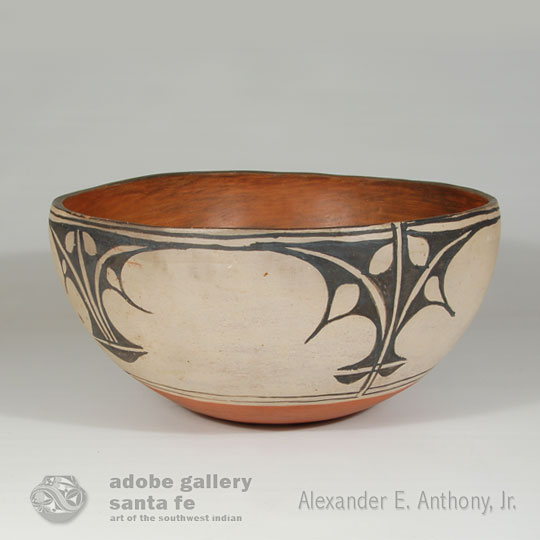 If you were ever invited to share a meal at a pueblo home, you would have seen vegetables or red chile or green chile stew served in a bowl like this. Such bowls grace the table at all pueblo meals. This historic bowl, however, shows no evidence of use so you could be the first to put it to use on your table. Bowls of this size are also used when making small amounts of loaf bread.
This Cochiti Pueblo Large Serving Bowl has a beautiful shape. The wall curves inward as it rises from the mid-body. The rim is painted black and exhibits a ceremonial line break which extends downward breaking the continuity of the design chain.
Large Historic Chile Serving Bowl from Kewa (Santo Domingo) Pueblo - C3862C
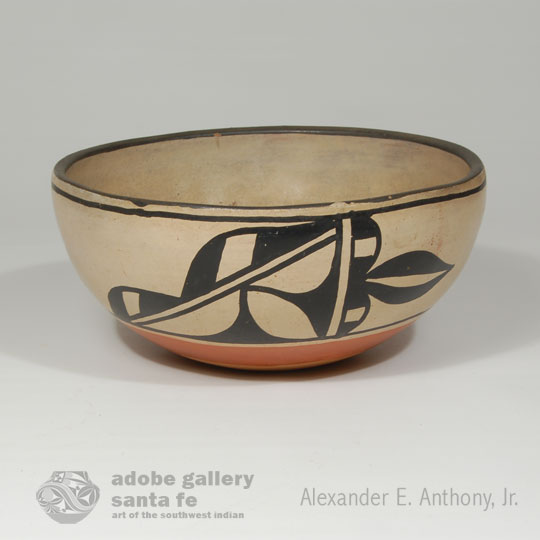 This Kewa (Santo Domingo) Pueblo polychrome serving bowl probably dates to pre-1940s. It has the traditional rag-wiped bentonite slip, black rim around the top, a red band wiped below the decorated section, and stone polished cream slip on the interior. The main body is decorated in two separate extremely bold design panels. Each panel is comprised of a triangular element on the left and a floral element on its right. This design is repeated only twice on the Large Chile Serving Bowl from Kewa Pueblo. There is a large area of cream slip devoid of decoration, a concept that enhances the bold black designs.
Small Historic Dough Bowl from Kewa (Santo Domingo) Pueblo - C3862B
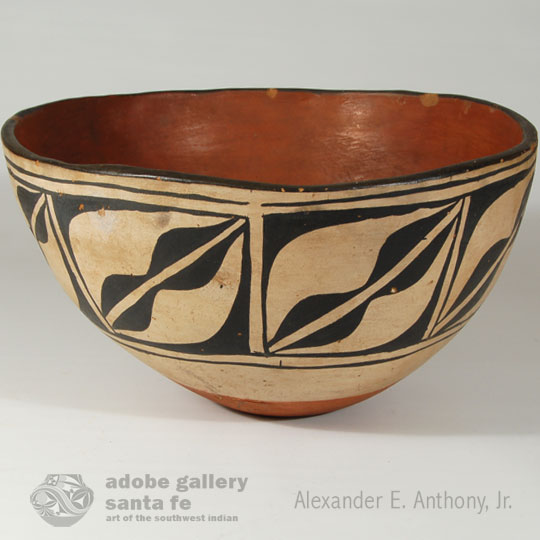 Kewa (Santo Domingo) Pueblo is associated with strong black on cream very bold designs. The design on this Small Dough Bowl from Kewa Pueblo was achieved by painting two corners of the square panel black and painting black semicircles diagonally across the box. The remaining cream slip of the ovoid becomes part of the design concept. The bottom of the bowl was slipped with red pigment. The interior of the bowl is completely slipped in red clay that has been stone polished to seal the finish. A 1-1/2-inch wide red band was wiped over the red of the interior at the rim. I do not recall seeing this on any other Kewa pottery bowl.
Historic Zia Pueblo Very Large Dough Bowl - C3862G
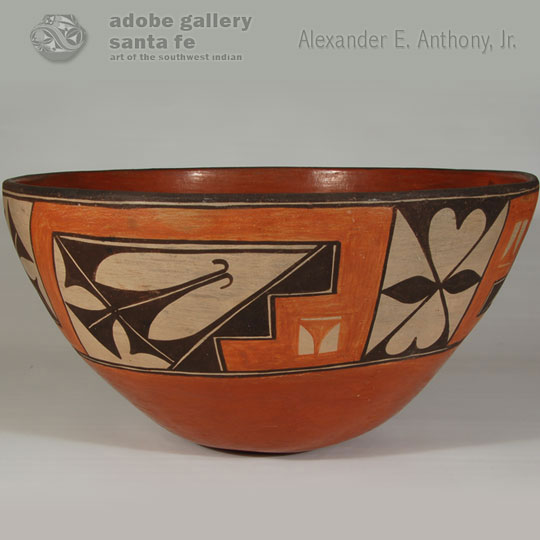 Dough bowls were not made at Zia Pueblo before the late 1700s. Dough bowls did not materialize until the arrival of the Spaniards and their introduction of flour to the Natives. Prior to the introduction of flour for making baked bread, there was no need for dough bowls. Many of the pueblos did not accept the Spanish bread for a hundred years or more. Zia seems to be one of those that did not make loaf bread until later.
The experience gained in making large storage jars for storage of dried foods and other necessities eventually paved the way for potters to experiment making dough bowls. The design elements on dough bowls have persisted almost without change since the first ones were made. This design was first developed on water jars during the San Pablo Polychrome period (1760-1820) and then used in dough bowls even into the present Zia Polychrome period.
Cochiti Pueblo Black Bear Storyteller with Five Cubs by Louis Naranjo - C3688.37
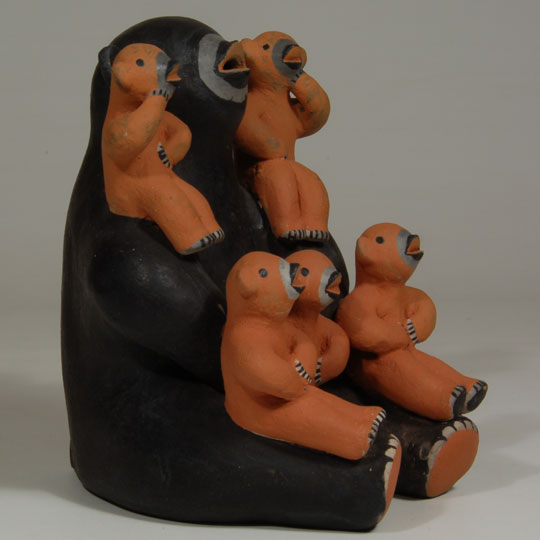 I believe Louis Naranjo was the first to make bear storytellers. He once explained why he began making them. He was hunting one day and came across a female bear with two cubs. He watched the cubs playing and their antics inspired him to create the bear storyteller figurines.
Cochiti Pueblo Male Storyteller with Six Children by Ada Cordero Suina - C3600A
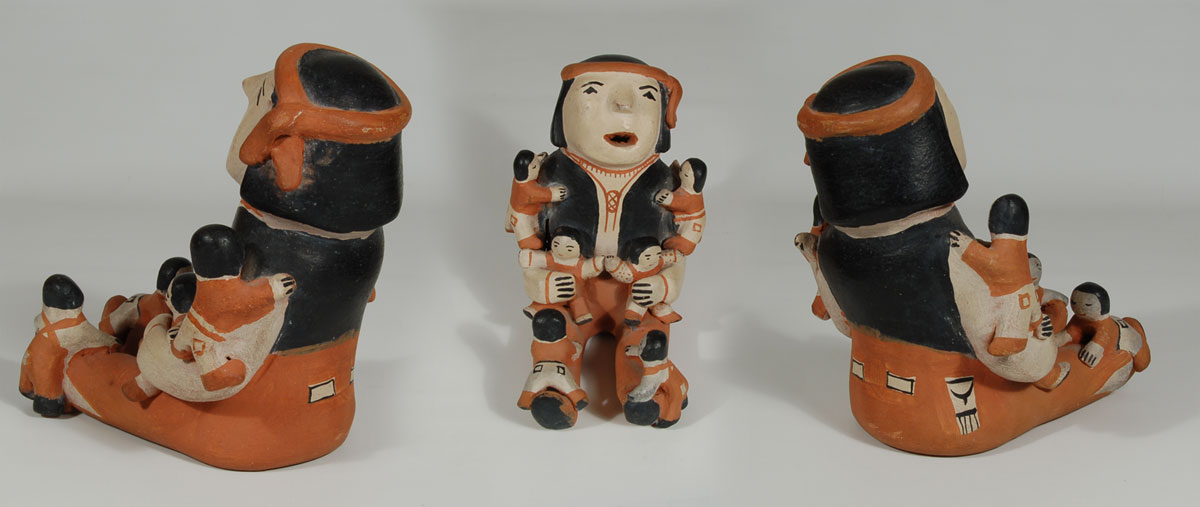
Ada Suina has always been recognized as one of the premier Cochiti Pueblo storyteller figurine potters. Her male figurines, such as this one, have a strong, chiseled face, and the children have happy carefree expressions. She uses all natural materials and fires the figurines outdoors in the traditional manner.
Cochiti Pueblo Female Storyteller With Two Female Kids by Maria Laweka - C3688.15
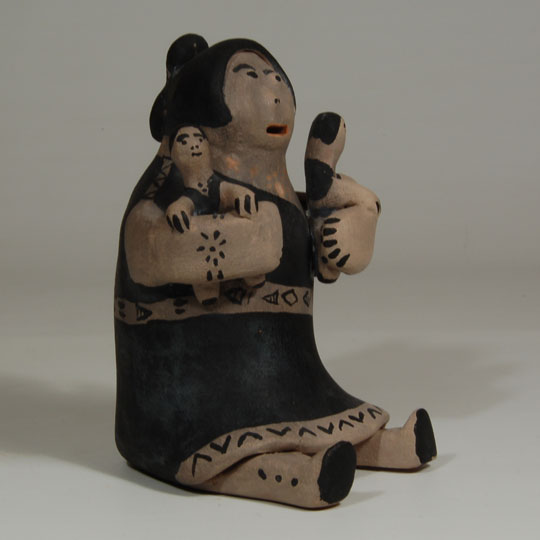 Maria Laweka was a daughter of Damacia Cordero, the famous figurine potter from Cochiti Pueblo, and sister to Martha Arquero and Josephine Arquero, both of whom were potters of note. It is not known if she is still making pottery figurines.
Cochiti Pueblo Male and Female Storyteller Figurine Pair by Senaida Pecos - C3688.10
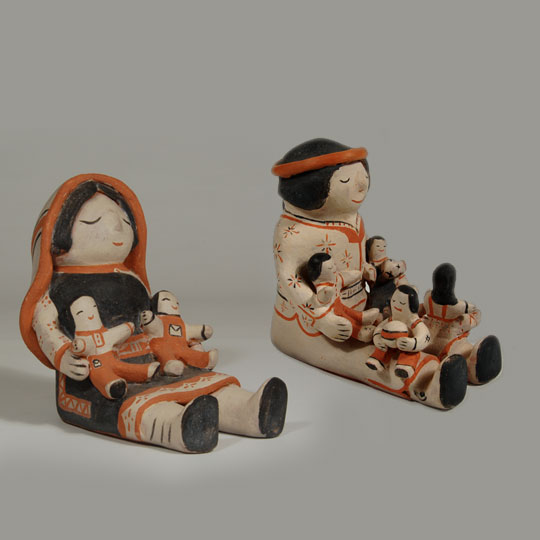 Senaida Pecos is not recorded in any of the published documentation of which I am aware. I will continue searching for background information on her. This Male and Female Storyteller Figurine Pair set was made as a pair and is being offered as a pair.
Cochiti Pueblo Storyteller with Three Kids by Josephine Arquero - C3688.36
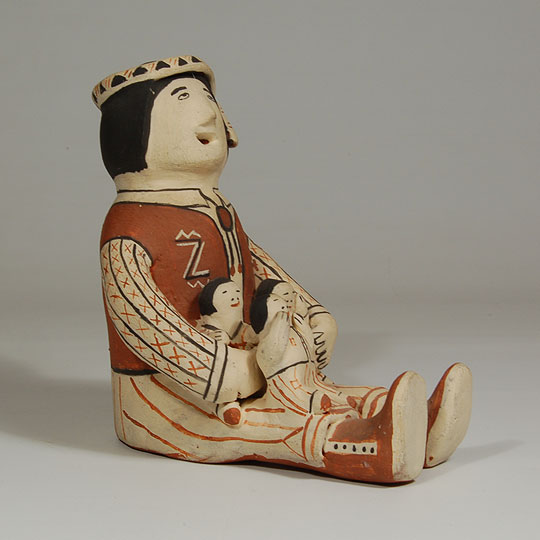 Josephine Arquero dressed this Male Storyteller Seated and Holding Three Kids in fancy clothing-a pattern shirt, decorated vest, stripe pants, colorful headband, and a bola and moccasins. The three children are equally well dressed. Josephine Arquero is a daughter of Damacia Cordero and sister to Martha Arquero, Marie Laweka and Gloria Herrera.
Cochiti Pueblo Male Storyteller with 7 Kids by Mary and Leonard Trujillo - C3688.20
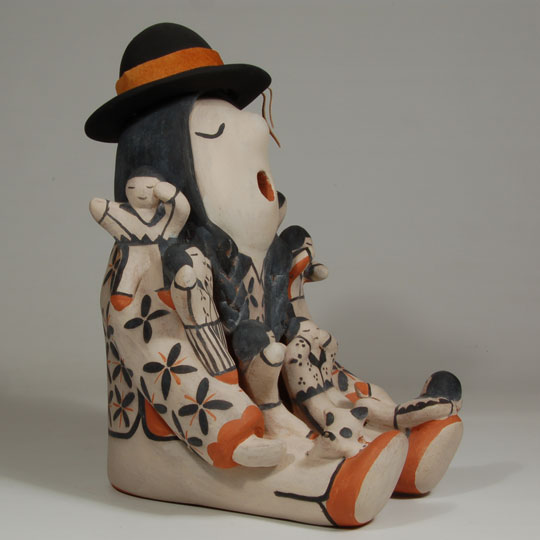 Mary and Leonard Trujillo are among the premier figurine potters at Cochiti Pueblo. Very few potters attempt large figurines anymore, but the Trujillos do and they do a fine job at it. Mary learned to make storytellers from Helen Cordero, her mother-in-law. Mary is one of the most accomplished potters at Cochiti. Leonard, her husband, has helped Mary since the 1980s.
Cochiti Pueblo Female Storyteller With Two Kids Joyce Ortiz Lewis - C3688.43
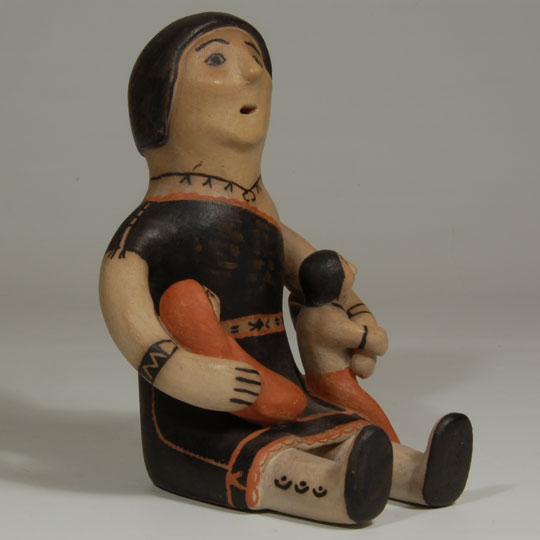 This Seated Female Storyteller Holding an Infant and a Toddler is signed as J. Ortiz. This signature is by Joyce Ortiz Lewis, who is a daughter of Guadalupe and Seferina Ortiz and sister of Virgil Ortiz, all from Cochiti Pueblo. It is a beautifully made figurine with an exquisite polished finish and well-painted design. The adult holds one infant wrapped in a blanket and a young boy in her other arm.
Cochiti Pueblo Female Storyteller with 14 Kids by Seferina Ortiz - C3688.22
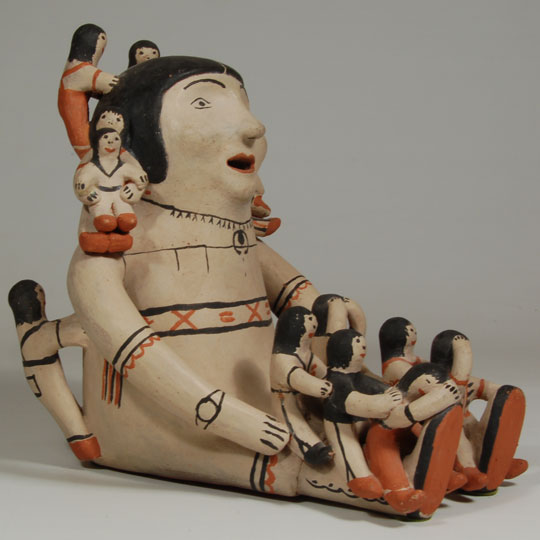 This is an early Seated Female Storyteller with 14 Kids by Seferina Ortiz, probably made in the early 1970s as it resembles the style of those known to have been made around 1972. There are 14 children on the storyteller.
The adult female wears her hair in the traditional chonga, she has a squash blossom necklace and bracelets on each wrist. The children are dressed in different clothing from each other.
Traditional Kewa (Santo Domingo) Pueblo Chile Serving Bowl - C3862D
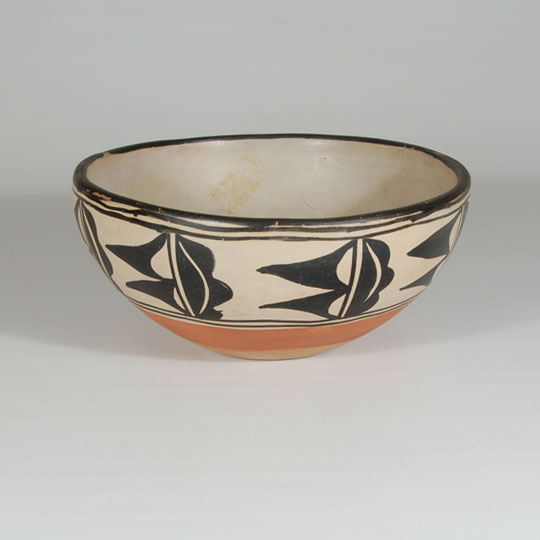 This Traditional Kewa Pueblo Chile Serving Bowl, like many chile bowls, is decorated on the exterior with black painted designs that face back-to-back and would overlay one another if one was laid over another one. The interior is a beautiful cream color, stone-polished, highly burnished finish. The rim is painted black and features a ceremonial line break. There is a pair of black framing line at the rim and a pair of them below the design. The ceremonial line break at the rim continues through the framing lines and design panel.