



Pair of Kewa Pueblo Turquoise and Shell Jaclas by Tina Montoya - 25814.3
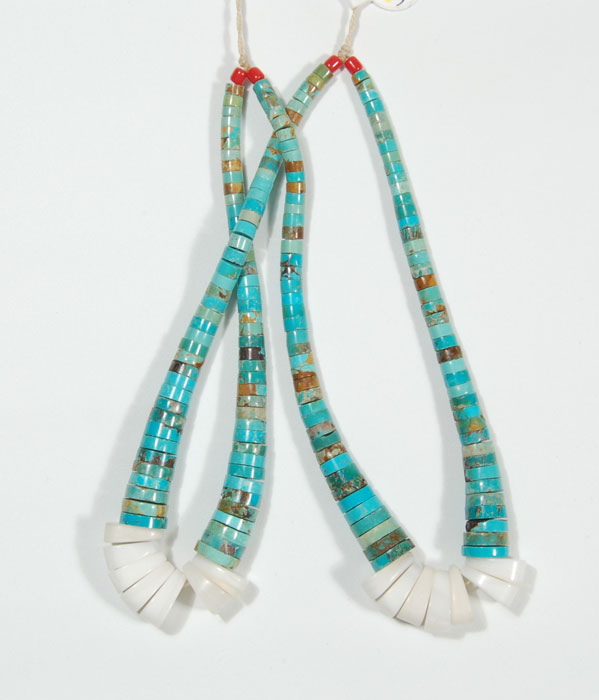 Jaclas are comprised of two loops of turquoise and shell strung individually and then tied together in a fashion by which they can be hung from a nugget necklace. Originally, in the 19th century, each of the units was made for use as earrings. When not being worn, they were hung on a nugget necklace for storage. Eventually, their use as earrings ceased and their use as a pendant on a necklace became permanent.
Young Navajo Girl with her Colt and Dog Painting by Harrison Begay - 25926
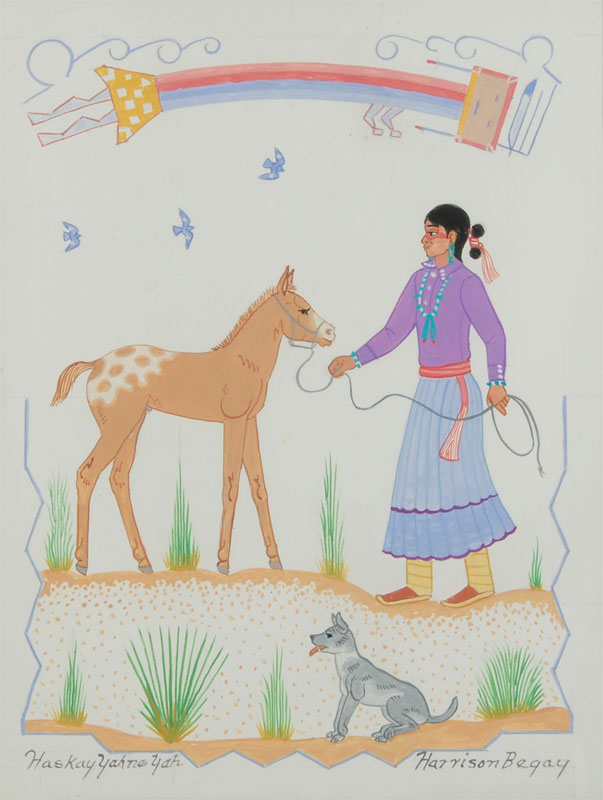 Harrison Begay is probably the most famous of the Navajo artists. He had a long and distinguished career. He started painting while attending the Santa Fe Indian School and began to paint full time after returning from service in World War II.
This painting depicts a young Navajo girl tending her colt while accompanied by her faithful dog companion. A guardian rainbow Yei provides protection for the trio.
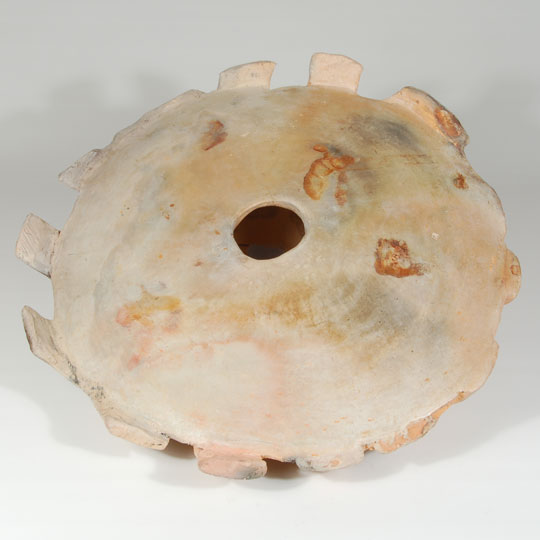
Large Wide Flat Top Pottery Vessel by Rick Dillingham - C3862F
 Rick Dillingham built his vessels in the traditional pueblo fashion of coils, not using a potter's wheel. He chose this most elemental form of construction, perhaps, because of his absolute love of pueblo pottery. His palette of colors soothes the visual senses without a shock to the system. One cannot simply look at his pottery, it demands to be held and caressed as the sensual object that it is.
The top of the vessel is glazed with color highlights of shades of light green, in an arrangement that produces a striking balance in asymmetry. The jar is typical of Dillingham's early works while he was attending the University of New Mexico. The top layer is a round relatively flat slab with a hole in the center. The underside is comprised of strips of clay crisscrossed in an apple pie crust arrangement.
Traditional Kewa (Santo Domingo) Pueblo Chile Stew Serving Bowl - C3862E
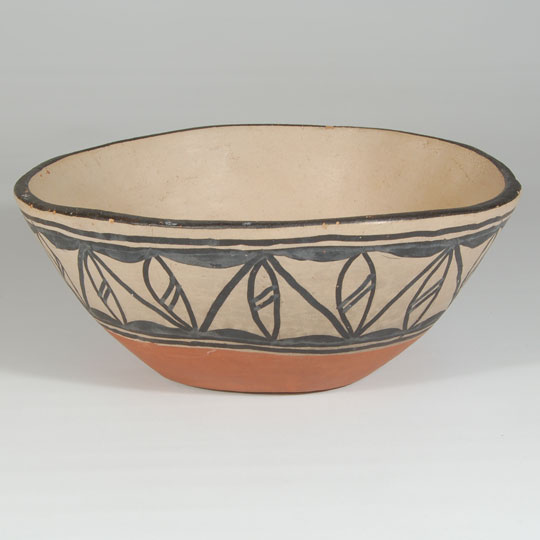 This Traditional Kewa Pueblo (Santo Domingo) Chile Stew Serving Bowl, like many chile bowls, is decorated on the exterior with black painted designs that are outlined in black triangles that alternate facing up and down. The interior is a beautiful cream color, rag-wiped finish. The rim is painted black and in devoid of a ceremonial line break. Perhaps the artist did not want to deface her design with a line break passing through it. There is a single black framing line just below the rim and just below the design panel
Bowls like this one are used for serving food at home and for serving food during ceremonies. Residents take bowls of food to the plaza during dance ceremonies.
Triple Copper Plate Etching “Deerslayer’s Dream” by Helen Hardin - 25922
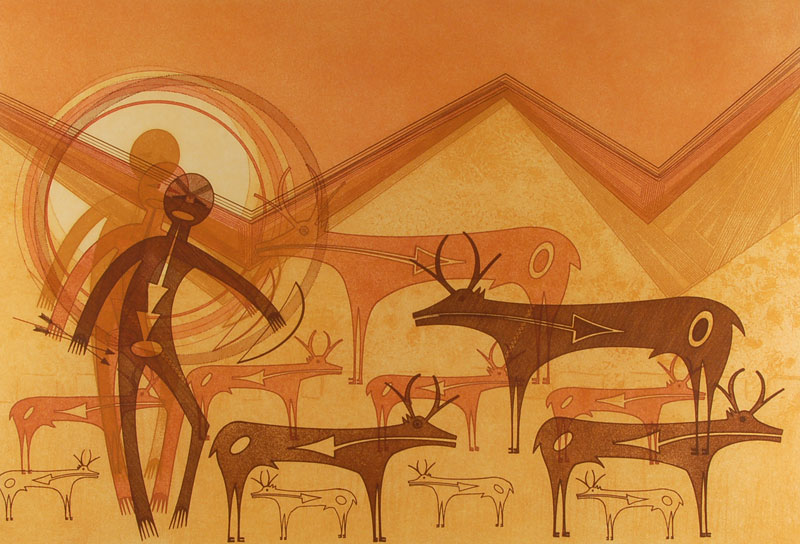 Deerslayer's Dream is obviously a pleasant dream in which the hunter sees an almost unlimited number of deer. Helen provided a ceremonial connection between the deer hunter and the deer by putting a "heartline" on both, a symbol of life often seen on pottery imagery but never on human imagery.
Helen Hardin had only begun working with the etching process in 1980 and, by 1981, when she completed Deerslayer's Dream, she had most certainly mastered the technique. The is a multi-colored hand-printed etching executed on three copper plates-to achieve colors red, ochre, and brown.
Santa Clara Pueblo Large Black Carved Jar by Daryl Duane Whitegeese - C3860B
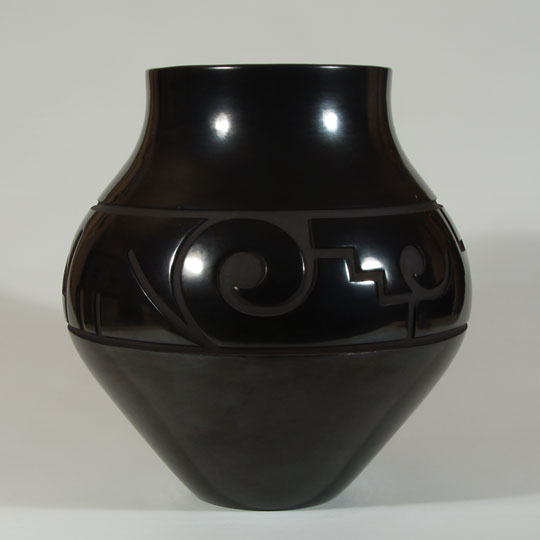 Daryl Duane Whitegeese is the son of LuAnn Tafoya. Growing up in the Tafoya family of potters, it was inevitable that Daryl would eventually be tempted to work with clay. He said he made his first complete pot when he was 32 years old. He learned the techniques from his mother, LuAnn, and his grandmother, Margaret Tafoya. He could not have found better teachers. He has been making pottery about 20 years now and has mastered all the techniques to perfection.
Elegant Santa Clara Polished Red Carved Design Jar by LuAnn Tafoya - C3860A
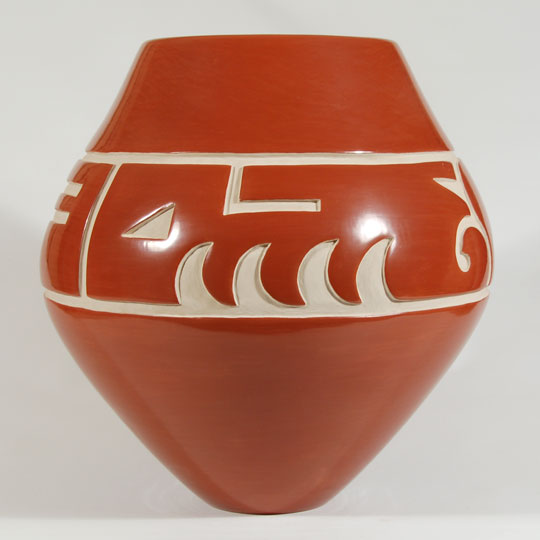 LuAnn Tafoya, a daughter of Margaret Tafoya, certainly inherited the talent to produce beautifully sculpted jars with outrageously burnished surfaces. She has made jars almost three feet tall, a feat not easily accomplished. Her grandmother, Sara Fina Tafoya, was a masterful potter, as was her mother, Margaret, who, in turn, passed on this artistic gene to nine children and numerous grandchildren.
Large Black Carved Jar with Five Design Bands by Linda Tafoya-Sanchez - C3860D
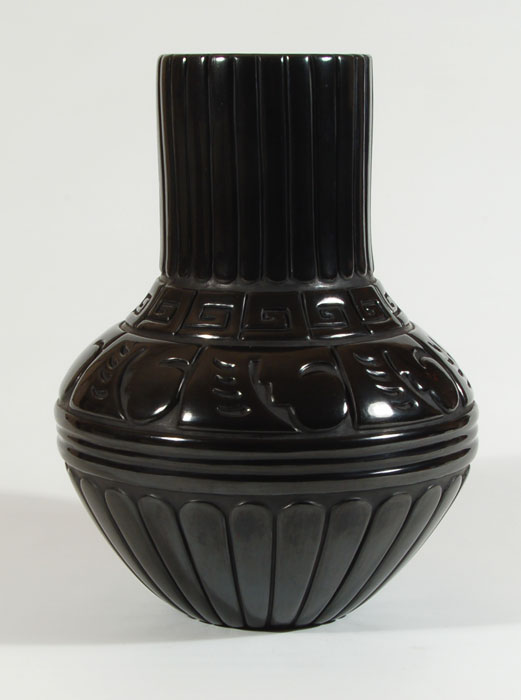 Linda Tafoya formerly signed her pottery Linda Tafoya Oyenque, now she signs as Linda Tafoya-Sanchez. Same person, same beautiful pottery. She is a daughter of Lee and Betty Tafoya and granddaughter of Margaret Tafoya. She credits her aunt Mary Ester Archuleta for training her to be a potter. Sara Fina Tafoya seems to have set the standard for members of her family and their output of black pottery. All the family members produce magnificent pottery.
Modernist Landscape Painting by Navajo artist Tony Abeyta - C3861
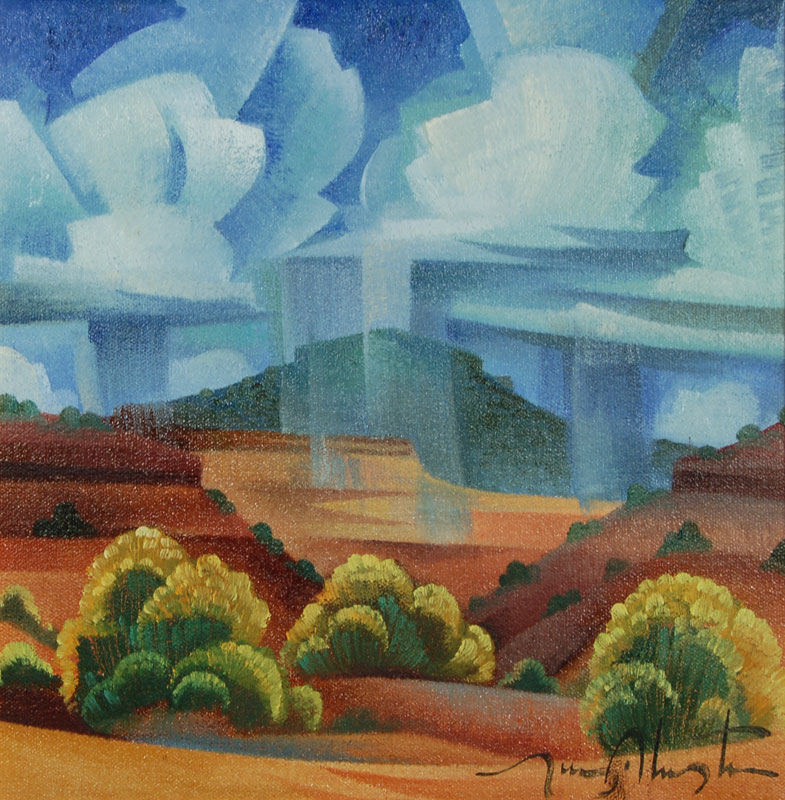 Tony Abeyta is a very versatile artist. He is unquestionably one of the most talented and celebrated young artists of today. He has continued to expand his area of interest in painting and constantly has enlarged his field of expertise. He is one of today's most collectible young Native artists.
The painting is framed in a handmade wood frame of gold wash. The artist's signature appears in lower right and the artist signed and titled the painting "Modernist Landscape" on verso.
Tapestry Weave Two Grey Hills Navajo Textile by Rachel Curle - C3860E
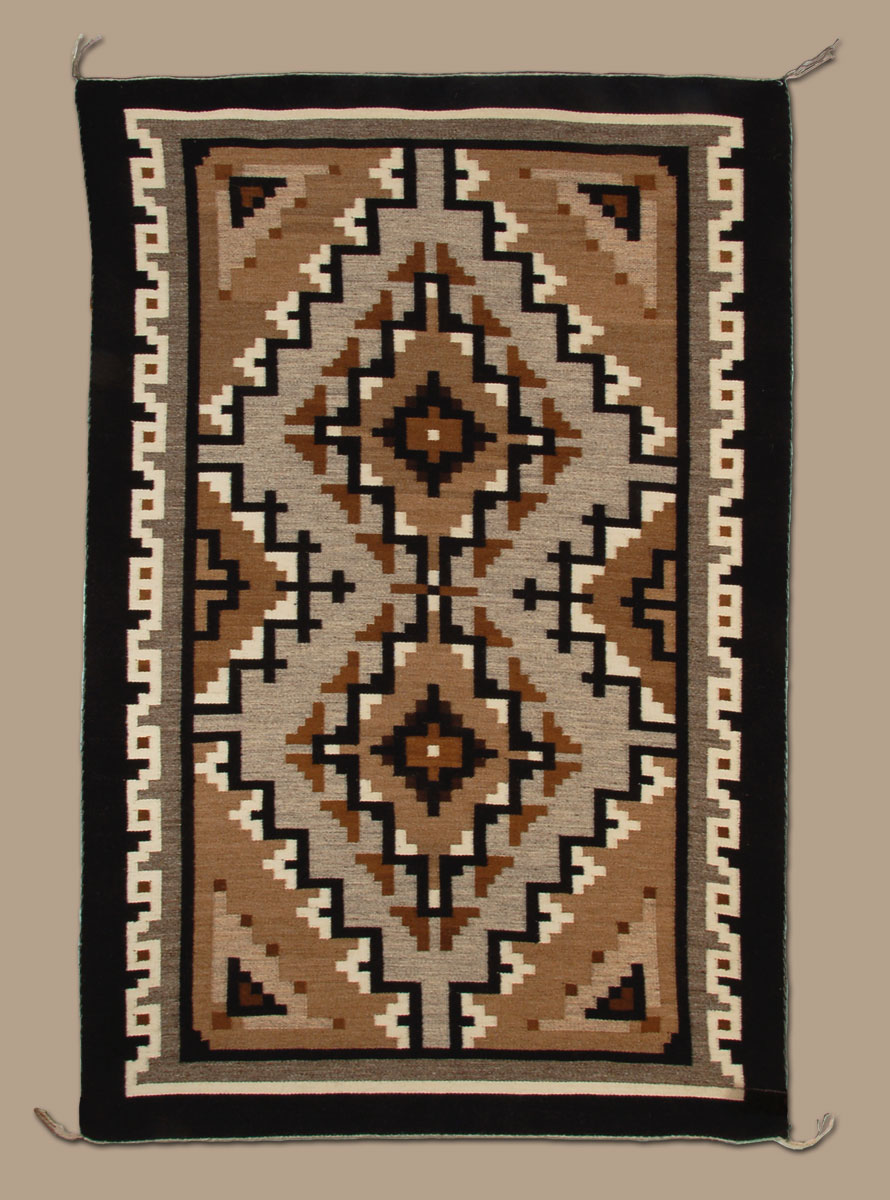 Tapestries from Two Grey Hills on the Navajo Reservation are celebrated as the finest textiles woven on the reservation. Weavers at Two Grey Hills use wool from their own stock of sheep, they clean the wool, card it into yarn, and then card mixtures of brown, white and black wool together to achieve the colors and shades the weaver wishes to use. For instance, the grey seen in these tapestries is carded from white and black wool, and shades of brown are achieved by carding white and brown wool in various mixtures. Typically, there is no dye used in Two Grey Hills rugs. Only occasionally do weavers over-dye black wool to achieve a darker black.
Hopi Pueblo Kokopelli - Flute Player Katsina Doll by Kevin Pochoema - 25921
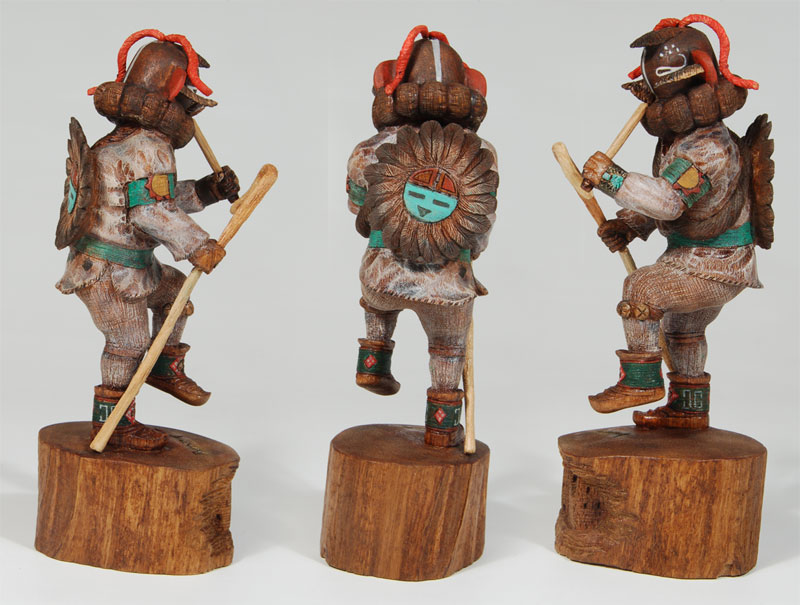 Kevin Pochoema, born in 1965, is of the Greasewood Clan and is from the Hopi village of Bacavi on Third Mesa, Hopi Pueblo in Arizona. He is a top prizewinning carver, receiving prestigious awards from the O'odham Tash, Gallup Inter-tribal Indian Ceremonial, Museum of Northern Arizona, and many other venues. His concentration on detail, proper body proportions, flow of clothing, and preciseness of painting have been recognized by judges at such prestigious venues.
"Among the Hopi he is a Flute Player only when he borrows a flute to dance. Usually he appears in the Mixed Kachina Dances or sometimes in a Night Dance. Despite these relatively minor appearances, he is thought of as a seducer of girls, a bringer of babies, a tutelary of hunting, and an excellent subject for the carving of tihus or kachina dolls." Wright, 1973
San Ildefonso Buff-on-Red Jar with Avanyu Design by Helen Gutierrez - C3860F
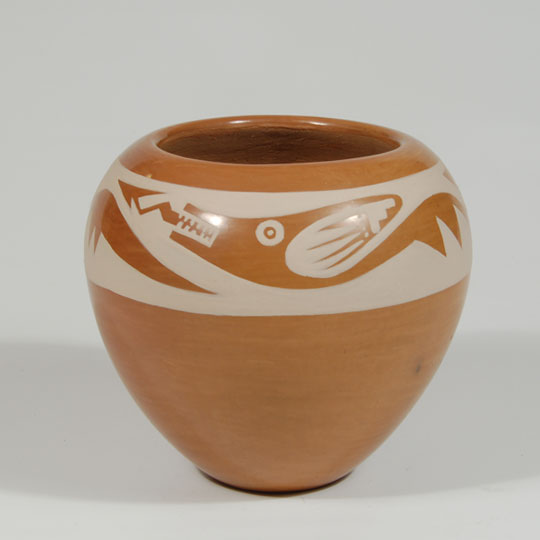 Helen Gutierrez was from a famous family of artists. Her brother, Gilbert Atencio, was one of the most honored painters. Helen was the granddaughter of Nicolasa Peña Montoya and Juan Cruz Montoya; daughter of Isabel Atencio and Benjamin Atencio; sister of Gilbert Atencio, Tony Atencio, Pat Atencio, Angelita Atencio Sanchez; and wife of Frankie Gutierrez. She was the mother of artist Geraldine Gutierrez.
San Ildefonso Pueblo Painting Eagle Capturing a Rabbit by Richard Martinez - C3827A
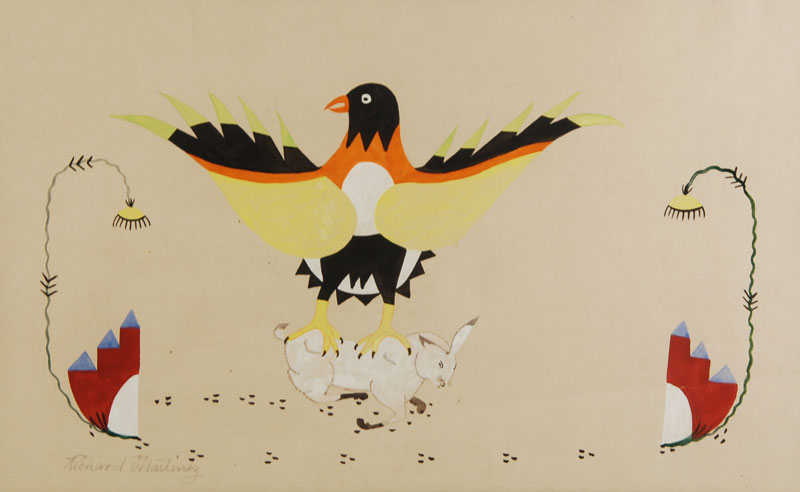 Richard Martinez was one of the earlier painters from San Ildefonso Pueblo, painting as early as 1920. He was well established as an artist before The Studio at the Santa Fe Indian School was begun in 1932 under the tutelage of Dorothy Dunn. He was one of the original students at Santa Fe Indian School and was commissioned to paint a mural in the student dining room in 1936. The mural was destroyed a few years ago, when the All Pueblo Council demolished all the old buildings at the Indian School. None of the murals in any of the buildings were saved.
Cochiti Pueblo Santa Claus Figurine with Two Boys by Louis and Virginia Naranjo - C3088B
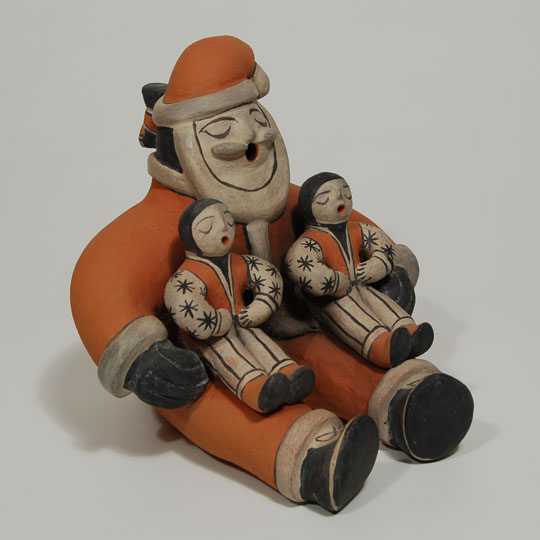 Louis Naranjo and his wife, Virginia, were true innovators of the figurative pottery tradition of Cochiti Pueblo. They crafted their figurines at the kitchen table in their comfortable adobe home at the pueblo. They worked almost every day crafting their art with great care, joking and exchanging the gossip of the day as they went along, accompanied by television, children and grandchildren. Their art provided a good life for them and it provided a legacy that will be with us for another century or more.
Hopi Pueblo Silkafragoingtaqa - Bean Dance Katsina Doll - C3535.30
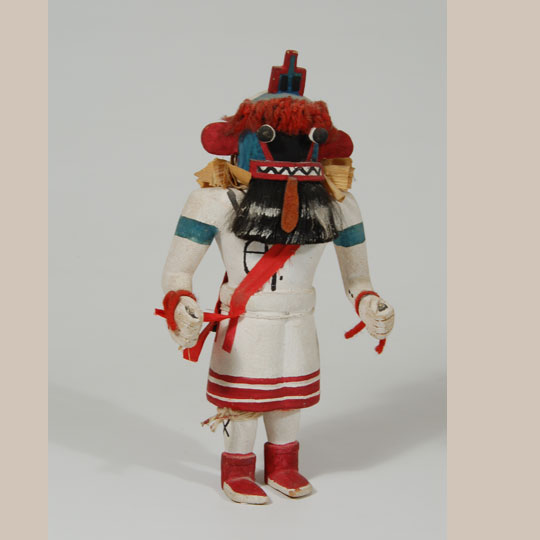 The Bean Dance is properly called the Powamu and it is one of the most important of the Hopi ceremonies. Powamu occurs in February each year in most of the Hopi villages. A most important aspect of this ceremony is the anticipation of the coming growing season, with ritual designed to promote fertility and germination. To accomplish this the Powamu chief appears as Muyingwa, the principal deity of germination, and every male who has been initiated into the katsina cult is expected to grow beans in the kivas. Growing bean sprouts gives the ceremony its popular name, and offers omens for the success of the coming growing season. The procession of the Pachavumanas carrying these bean sprouts and the presentation of ritual bundles of them to the women and children during the heights of the winter are tangible evidence of the presence of Muyingwa. Wright, 1973, p17.
Kewa Pueblo Sterling Silver Belt Buckle by Roderick and Marilyn Tenorio - C3852i
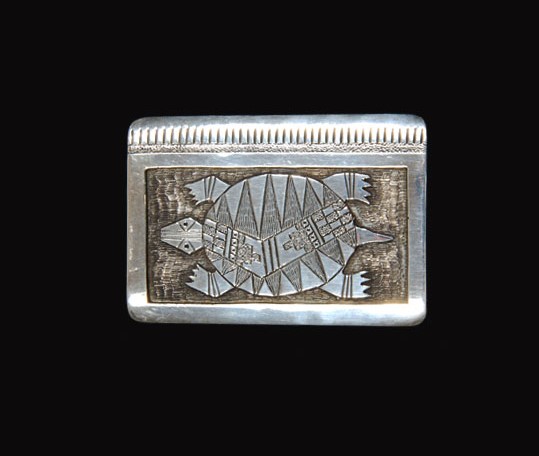 Roderick Tenorio and his wife, Marilyn, often collaborate on making jewelry and each also works separately. This buckle is a collaborative effort. It features a turtle overlaid on a darkened background in a typical overlay technique.
Roderick graduated from Albuquerque High School in 1981, then attended the Institute of American Indian Arts in Santa Fe. He served time in the U. S. Army. He is a top prizewinning artist. Marilyn Tenorio is a Navajo and works in mosaic inlay as well as silver and gold jewelry.
Aquatint Etching “Changing Woman” by Helen Hardin Tsa-Sah-Wee-Eh - 25918
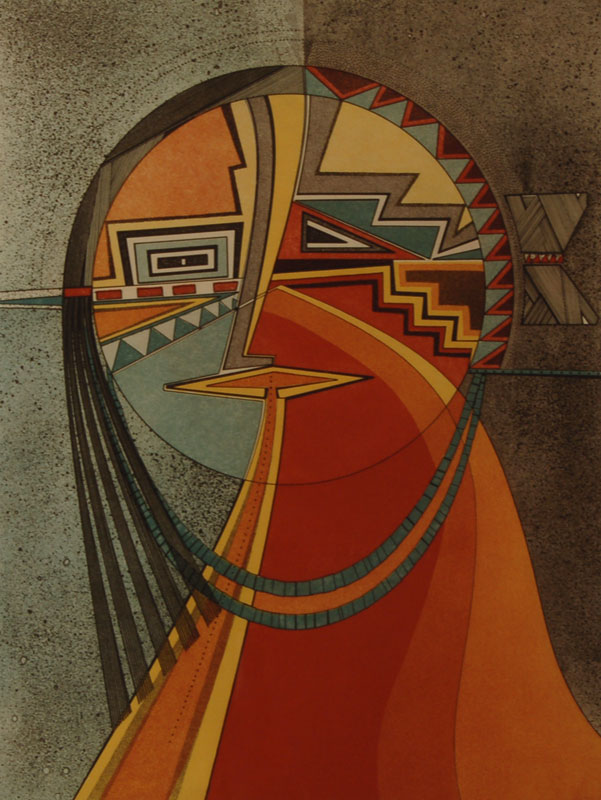 Sue Di Maio, an art dealer from California, Arizona, and Santa Fe, made it her mission to talk Helen Hardin into supplementing her acrylic painting with carefully controlled prints. She felt that Helen could not keep up with the demand for her art if she only produced original paintings. At first, Helen was not in agreement. Helen agreed to meet with Richard Ximinez of El Cerro Graphics in Los Lunas, New Mexico, for a primer in printmaking. Helen agreed to give printmaking a try. Fortunately, she loved it and collectors love her prints too.
Aquatint Etching entitled “Medicine Woman” by Helen Hardin Tsa-Sah-Wee-Eh - 25917
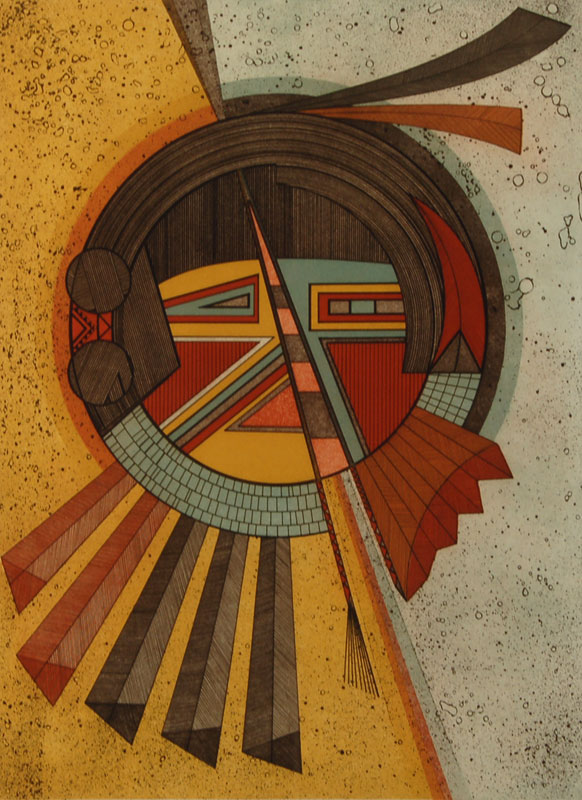
Exactly a year later, she made Medicine Woman, and the following year, Listening Woman. In this series, Hardin concentrated on attributes of women-self-sufficiency, active anguish, covert ecstasy, acceptance of grief, and the virtue of endurance. She focused on the heads of the women to emphasize the strength of the head because women are emotional and sensitive.
Polished Black Domed Jar with Spider Design by Tahn Moo Whe - 25920
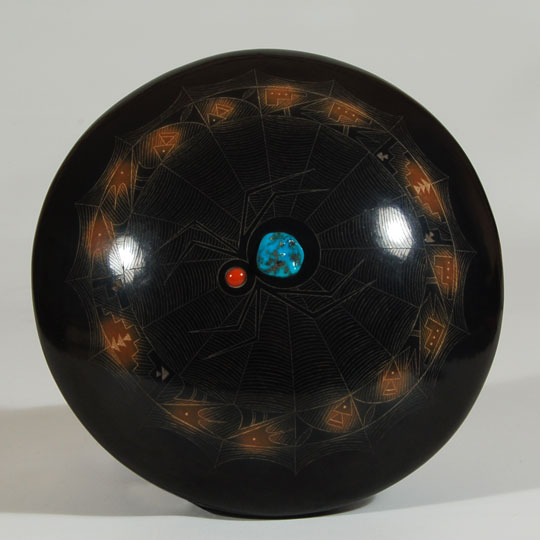 Barbara Gonzales is an excellent potter and an extension of her famous great-grandmother, Maria Martinez, and her grandparents, Adam and Santana Martinez. Her mother, Anita Martinez, was also a potter. Drawing on the traditions of her family, she expanded this tradition by personalizing her pottery with inlaid coral and turquoise on etched black and sienna wares-often inlaid on spider designs which she created in 1973. Early in her career she occasionally made plain black polished pottery, but no longer does so, nor does any other potter from San Ildefonso Pueblo.
Original Hopi Pueblo Painting of “Shotoknanguh” signed Seekyesva - C3098D
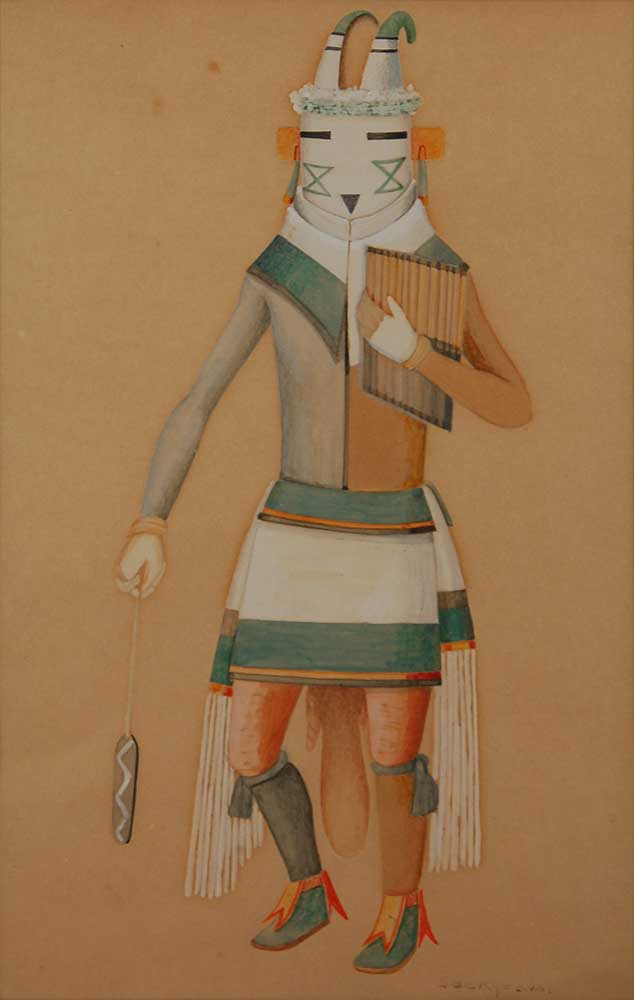 According to Colton in Hopi Kachina Dolls with a Key to their Identification,"Sotuqnang-U is the god of the sky, the clouds, and the rain, and is good, dignified and powerful." Colton lists him as one of 36 Hopi Deities-some of whom are represented as Katsinas and others not. When represented, he wears a white case mask with cloud designs on the cheeks. In his left hand, he carries a lightning frame and in his right hand, a bull roarer. The lightning frame is expandable and used to imitate the appearance of summer lightning. The bull roarer simulates the sound of thunder.