



Historic Acoma Pueblo Polychrome Jar with Unusual Birds - 25898
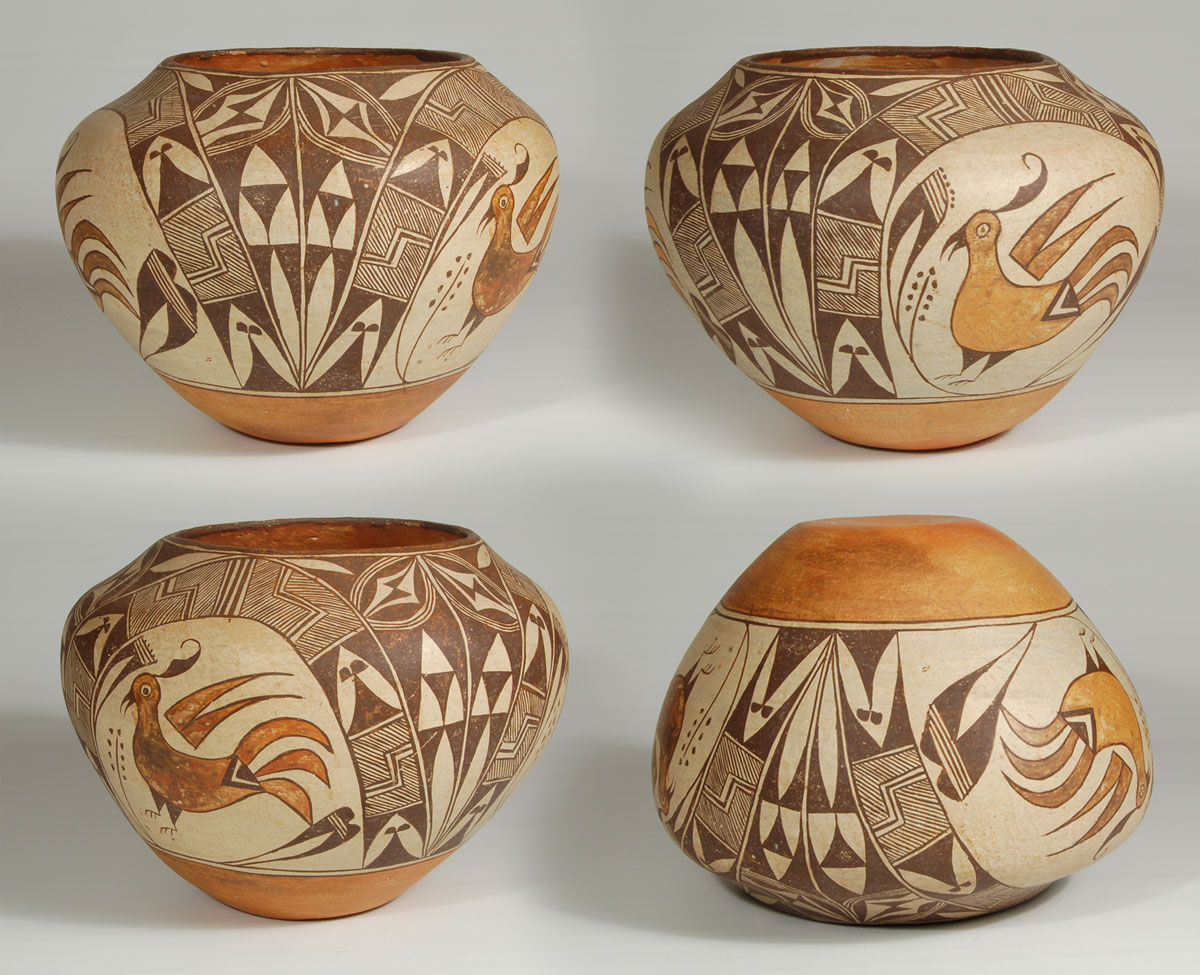 Acoma potters generally present a design in one of two different manners. One is to use the entire vessel as a single canvas with no distinction between the rim, shoulder and body of the vessel, that is, the design expands over the shoulder and to the rim without divination. The other manner is to draw a framing line at the shoulder and then treat the neck design and body design as separate entities.
This jar has a design covering the entire surface with no division at the shoulder. There are basically two design styles to this jar. All of the elements in brown constitute the design in geometric terms-triangles, scrolls, rectangles, circles and lines. The other design features birds presented in orange slip, outlined in brown. Most often, Acoma birds used on pottery are parrots, but this potter chose a beaked bird with a fancy top knot on its head and wings that are separated completely from the body. If one searched thoroughly it might be possible to find documented examples of a bird of this style but I have not before seen one with the wings completely separated from the body.
Navajo Double Bar Silver and Five Turquoise Cabs Bracelet - C3864.04
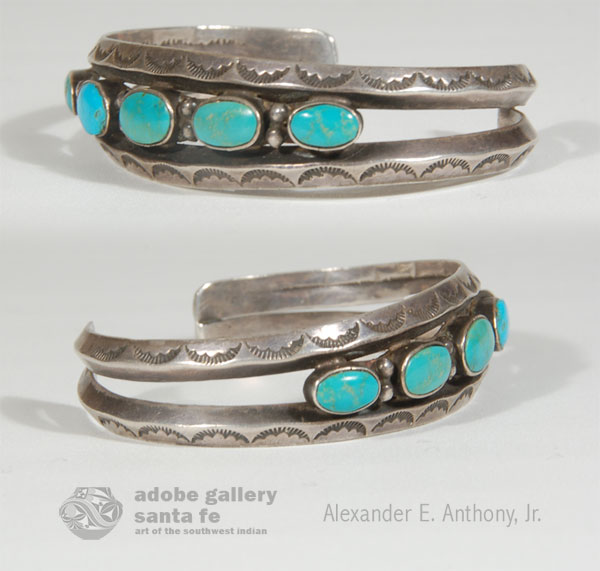 The foundation of this bracelet is made from a pair of triangular-shaped silver bars, spaced apart, connected at the ends, and stamped with traditional images. At the top center of the bracelet are five oval shaped natural turquoise cabs, varying from blue to slightly green in color. Each cab is set in a handmade silver bezel. The five settings are separated by pairs of silver dots.
The bracelet is inscribed with the name J. Chee, but I have not located an artisan with that name, presented in that arrangement, in any of the published references.
Acoma Pueblo Polychrome Canteen with Corncob Stopper by Eva Histia - 24718
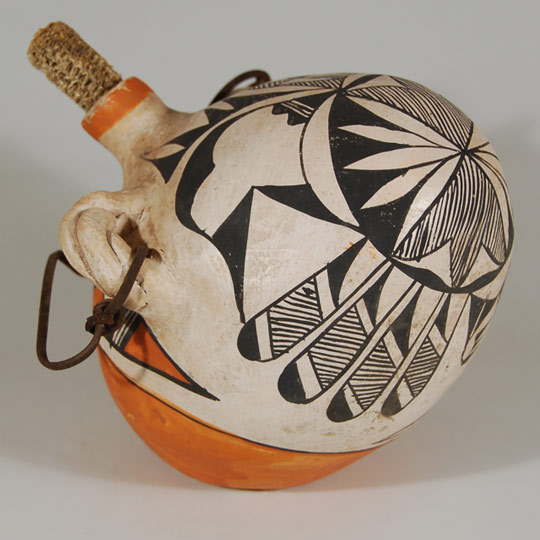 This is a most unusual and most spectacular canteen, built, I believe, for actual use by its owner while working in the fields. It is very difficult to date this piece of pottery because I have never seen a documented one of the same vessel shape. Seen from profile, this one has an egg-like shape. I would estimate it to be from the early 20th century.
The traditional Acoma features are all present: coarse, white paste of a distinctly chunky texture, pottery shards for temper, orange-red underbody paint and rag-wiped white slip. The decoration is a full version of a bird. Notice the head on the upper right, the legs at lower right, and tail feathers at lower left, all executed in black-on-white. The body is the medallion-like element at the apex of the canteen.
#adobegallery #SouthwestIndianPottery #AcomaPueblo #AcomaPottery #PuebloPottery #SouthwestIndianArt #SantaFePottery #FinePuebloPottery #ContemporaryPottery
Historic Kewa (Santo Domingo) Pueblo Polychrome Storage Jar with Birds - 23850
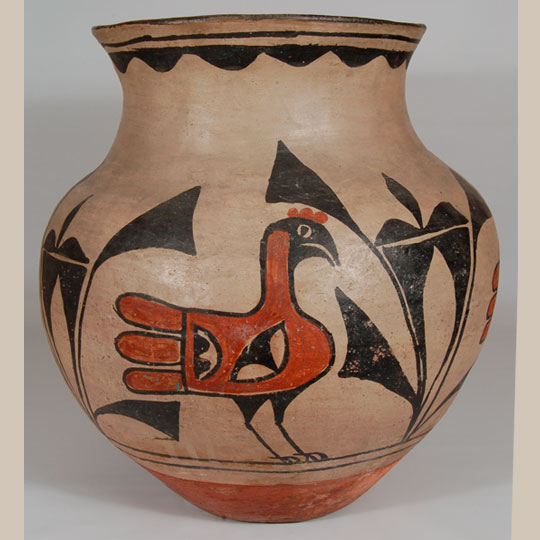 Made circa 1920, this vessel exhibits the classic traits of late Santo Domingo Polychrome. The neck interior is red-slipped, with a black rim top. The under body is stone-polished bare paste with a one-inch rag-wiped red band. The cream/off-white is rag-wiped bentonite slip with black vegetal designs, all of which are broken with one vertically oriented ceremonial break.
Most storage jars were made in the 19th Century. Rarely were ones this large made in the 20th Century. Four birds in polychrome design rest on the lower framing lines, and four floral elements complete the design. Below the single framing line at the rim are cloud elements.
Ceremonial Dance with a Deer Dancer and Drummer Painting by Quah Ah - C3868J
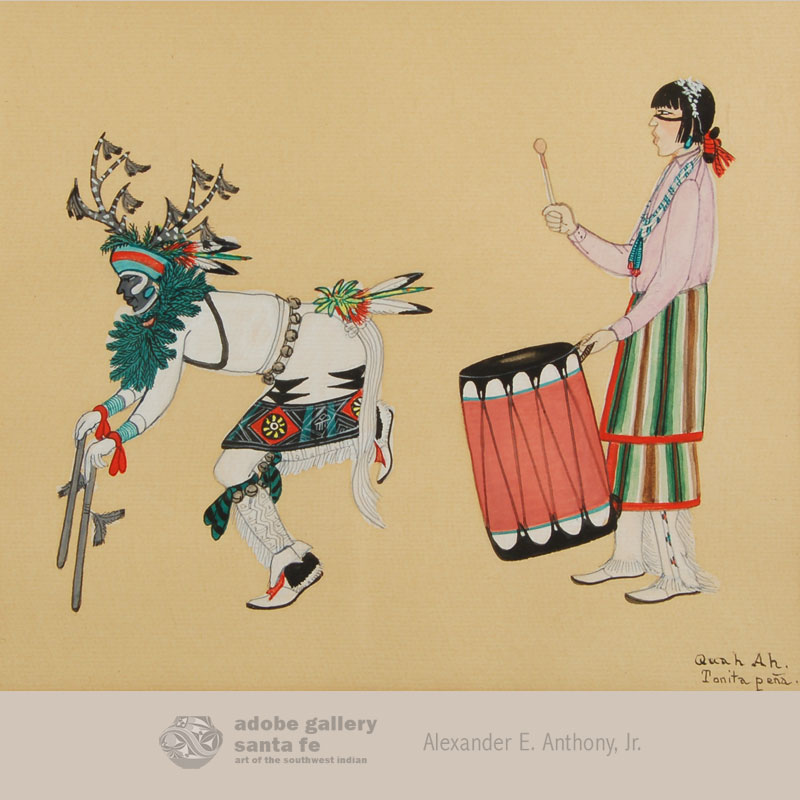 This original painting by Tonita Peña (Quah Ah) of San Ildefonso Pueblo was probably painted in the first two years of the 1920s. Over her career, Tonita used a variety of signatures on her paintings. (A complete description of the signatures and corresponding dates used may be seen in the biographical information provided by clicking here or on her name above.)
In this painting, Peña presents a beautiful image of a Deer Dancer in active dance position with his right leg raised in a movement of dance. His deer antler head dress is elaborate with feathers in motion on the antlers. A beautiful green ruff hangs from his neck, eagle feathers bundled together hang from the white rain sash on his back. He wears a beautifully embroidered kilt, white shirt, leggings with yarn ties just below the knees and white moccasin with skunk tied to the backs. In his hands, he carries two sticks that take the place of the deer's front legs.
Keres Pueblo Large Pottery Serving Bowl - C3870B
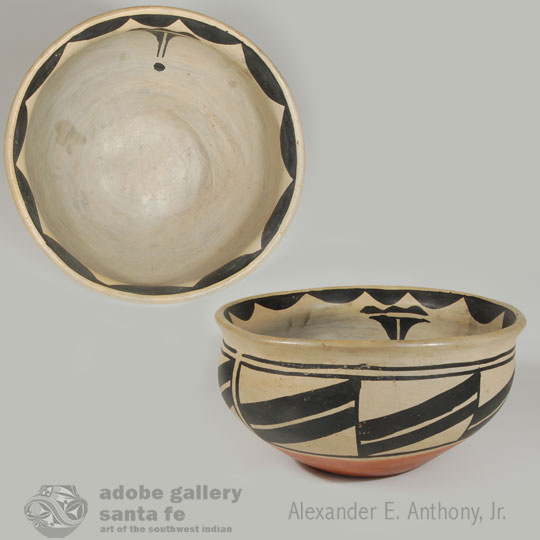 The hesitation in defining the origin of this bowl in the above title is because it is one that could have originated at Cochiti or Kewa Pueblo, therefore we designated it as Keres-the language of both pueblos. The outturned rim is more a feature of Cochiti Pueblo but the strong black on the exterior is more like that from Kewa Pueblo. The single rain cloud on the interior is something that is generally not seen on any Kewa pottery, another fact leaning toward an origin of Cochiti.
The Keres Pueblo Large Pottery Serving Bowl is most interesting with the outturned rim, something that sets it above most serving bowls from the Keres Pueblos. The single rain cloud design on the interior is also a unique design not generally seen on such bowls. The potter of this bowl was creative, artistic, and expressive.
Sterling Silver and Turquoise Navajo Bracelet by Stewart Billie - C3864.02
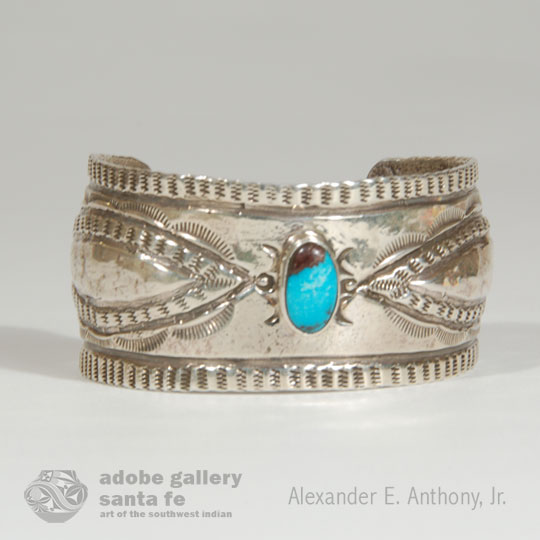 There are several Navajo jewelers with the last name Billie documented in the literature but not one with the first name of Stewart. Most likely, he is a relatively newcomer in the craft.
The bracelet was beautifully crafted in wide, heavy stock sterling silver. A sky blue turquoise stone is set in the top center and flanked by two long oval designs that were executed in repoussé. The edges of the silver were stamped in wave-like form. The bracelet is beautiful and well crafted.
Navajo Silver and Composite Coral Bracelet - C3864.19
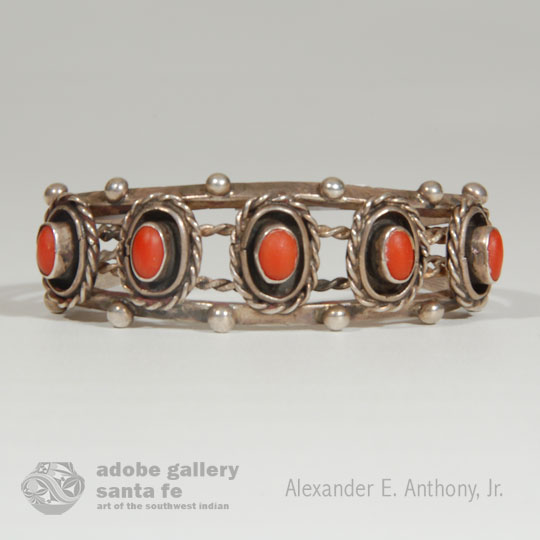 This Navajo bracelet appears to be of the style often made in the 1970s where the jewels were set in a shadow box arrangement. Additionally, the coral appears to be comprised of a mixture of powdered coral and a binding agent. The result is a coral-color setting with a matte finish.
Prehistoric New Mexico Kotyiti Glaze on Yellow Bowl - 25939
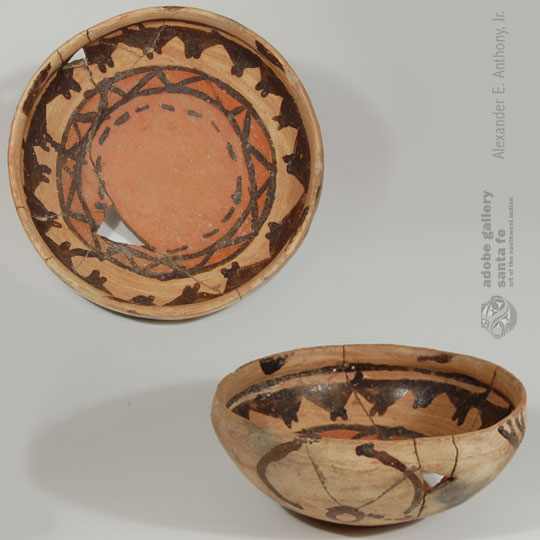 The Galisteo Basin was once home to the Tano Pueblo Indians who were the Southern Tewa. Originally, the Tano lived in the area around Santa Fe. Around 1250 to 1325, they moved further away to the area of the Galisteo Basin, settling in the region at the base of La Bajada, the long descent just south of Santa Fe on Interstate 25. Their new homeland was near Kewa and Cochiti Pueblos.
The Tano were producing the regular vegetal paint tradition until they switched to the glaze-paint tradition and it, then, became the design of choice. The essential ingredient in glaze paint is lead and the Tano found a ready source of lead near Cerrillos, a short distance from Santa Fe.
The Tano glaze-paint was generally painted on a creamy yellow slip. The glaze paint was not stable and often ran when applied to the surface. It did produce a beautiful shiny black finish which was probably its admirable trait.
Original San Ildefonso Pueblo Painting of a Horse by Oqwa Pi - 25936
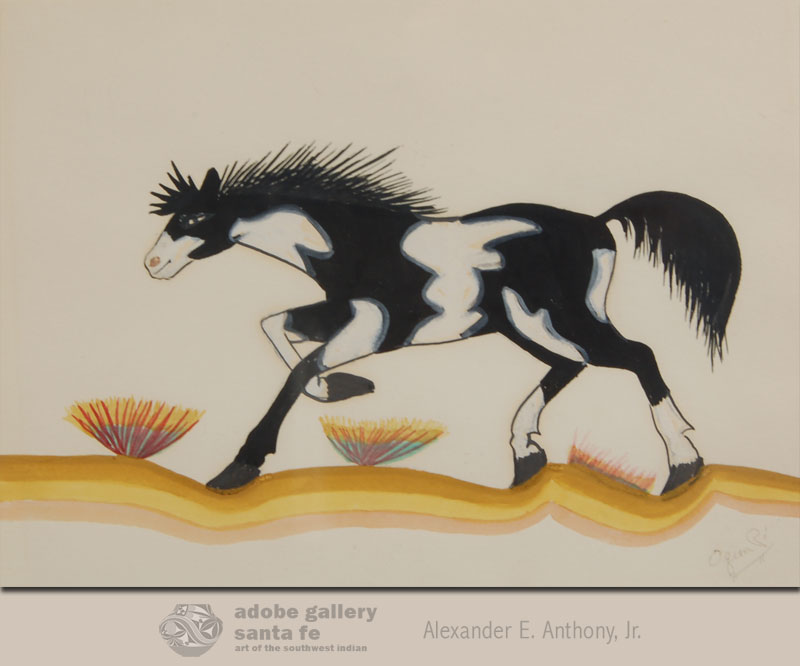 Abel Sanchez was known as Oqwa Pi in the Tewa language. He was the grandfather of San Ildefonso potter Russell Sanchez. Except for what little instruction he received at the Santa Fe Indian School, he had no other formal training. To quote the artist: "I, Oqwa Pi, have been painting since the early 1920s. As I found that painting was the best among my talents, I decided to do my best to win me fame as an Indian artist....as an artist, I have raised a big, healthy family for my painting brought in good income...." Artist's letter to Philbrook Art Center
Characteristic of Oqwa Pi's style, there are no backgrounds, foregrounds, and minimal ground lines. This tends to make his art charming and true to the folk-art style and certainly true to the Santa Fe Indian School style. The fresh color and action and the great simplicity of his paintings made the works of his well-received in exhibits at the Milwaukee Art Institute, Yale University, Museum of Modern Art in New York City, Stanford University and the Gallery of Fine Arts in Muskegon, Michigan.
Contemporary San Ildefonso Pueblo Black-on-black Dish by Rose Gonzales - C3868H
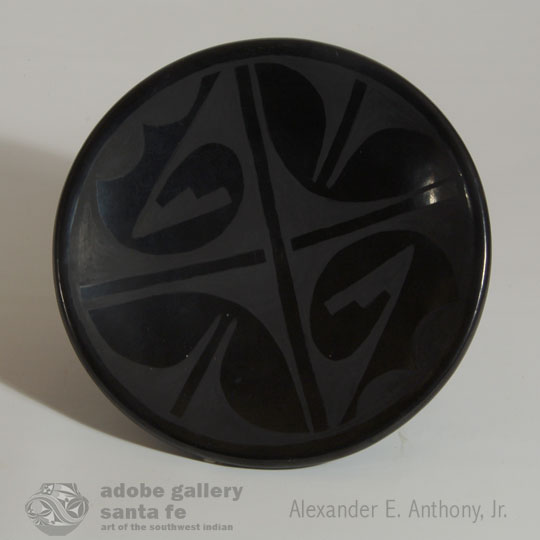 Rose Cata Gonzales was originally from Ohkay Owingeh (San Juan) Pueblo. She married Robert Gonzales of San Ildefonso Pueblo and moved there with him. Rose was a sister of Pomasena Sanchez. She was the mother of Jose H. Rainbird Gonzales, Tse-Pé Gonzales, and Marie Gonzales Yazzie. Rose learned pottery making from Ramona Sanchez Gonzales, her mother-in-law. Rose's parents died from the swine flu epidemic of 1918, leaving Rose and her sister Pomasena orphaned. The girls survived by staying at the Santa Fe Indian School. Mary Cata, a relative, adopted and cared for the girls.
In the 1920s, Rose learned first how to make polished blackware. She then learned the new technique of black-on-black pottery, using a matte black paint for designs. Rose also learned the older technique of black-on-red pottery, most often associated with Tonita Martinez Roybal (1892-1945) and her mother. Rose was credited as the innovator of deep carved pottery around 1930 at San Ildefonso. She sometimes collaborated with her son, Tse-Pé, especially in duotones. She was active as a potter from 1929 to 1989.
San Juan Pueblo Revival Polychrome Carved Jar by Rosita De Herrera - C3870A
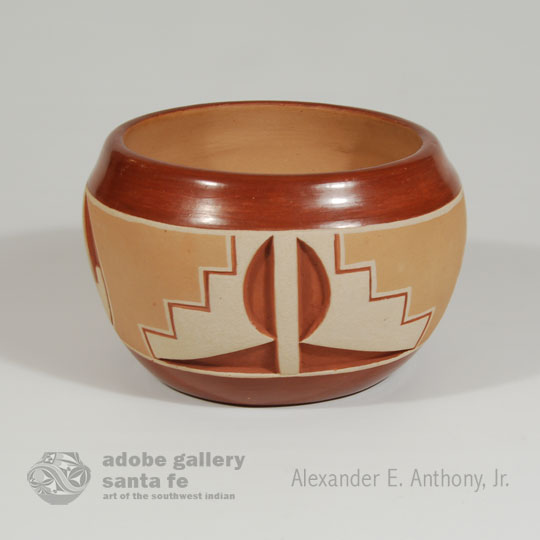 This San Juan Revival Polychrome Carved Jar is an excellent example of the mid-20th century revival style of San Juan pottery. The potter chose rain and cloud designs as her motif for the band surrounding the vessel body.
Rosita De Herrera and her sister, Dominguita Naranjo, along with their mother, Tomasita Montoya, were the predominant potters producing both styles of revival pottery at the pueblo in the last half of the 20th century. Their pottery was in demand by collectors and dealers.
Happy Katsina Koshare Clown with Watermelon by Fletcher Healing Jr. - C3868B
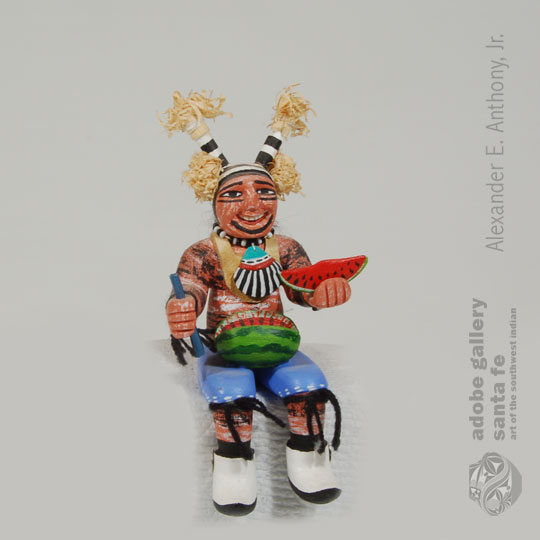 Fletcher Healing, Jr. Hopi-Tewa, Fletcher is the great-grandson of Nampeyo and grandson of Annie Healing Nampeyo. Unlike the rest of the family members, he was not a potter but chose to carve Katsina dolls. He was known for making these seated clowns whose legs hang over from the shelf.
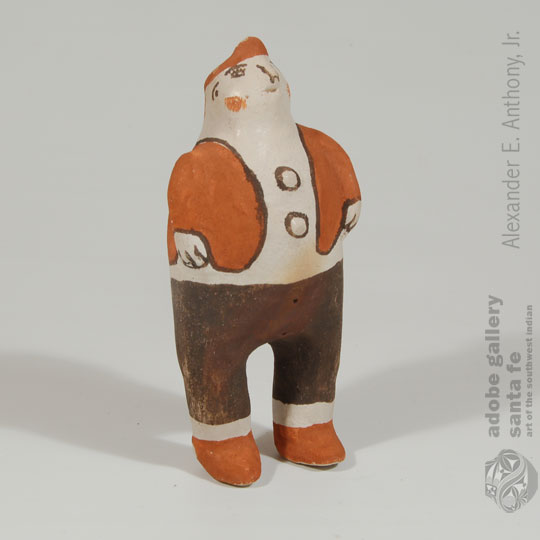
Zuni Pueblo Polychrome Standing Male Figurine - C3868F
 Tourists have always been fascinated with pueblo pottery, but the large, traditional bowls and jars that were in use in the pueblos in the late 19th century were too cumbersome for travel, so the pueblo potters began making small souvenir pieces. Cochiti Pueblo was by far the most prolific in making figurative pottery for the tourists, but Zuni did make some, although not nearly the quantity or the variety. Mostly, Zuni potters made owl figurines.
This figurine is a fat male, presumably a Zuni Pueblo man. He wears an open vest, has two buttons on his shirt, wears traditional moccasins and has his hair tied in a chonga in the back of his head and wears a head band. He appears to be circa 1940s. He stands unaided but is a little shaky in doing so. The Zuni Pueblo Polychrome Standing Male Figurine is not signed by the maker.
Original Painting of a Ceremonial Drummer by Tonita Vigil Peña - C3868K
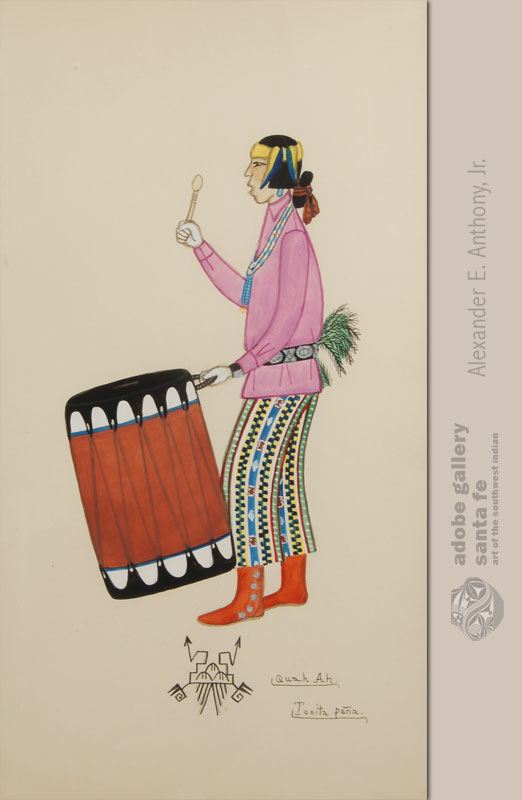 Tonita Peña began painting when she was seven years old. She was the only woman painter in her generation and was part of the original group who participated in the contemporary watercolor movement.
In this Original Painting of a Ceremonial Drummer, Tonita presents a drummer during a San Ildefonso Pueblo ceremony. He is shown with his mouth open indicating he is chanting while drumming. The early pueblo style of painting, which has no ground plane and no background, was meticulously carried out in this piece.
Navajo Silver and Turquoise Squash Blossom Necklace with Tufa Cast Naja - C3864.47
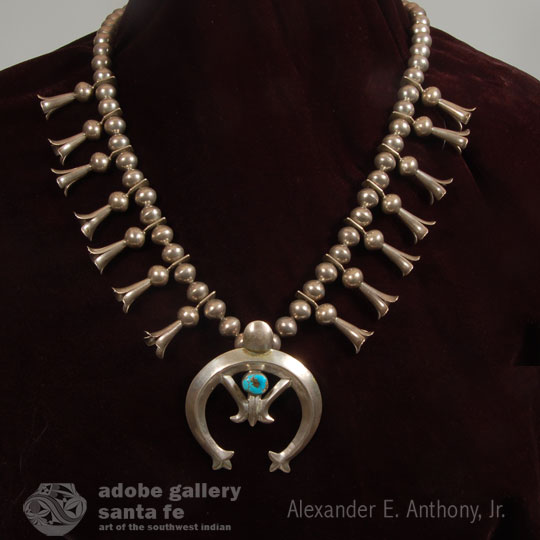 The Navajo incorporated the naja in their jewelry as a pendant dangling on silver necklaces, commonly called squash blossom necklaces. In this instance, a beautiful cast silver naja with a pair of blossoms curving around a fleur de lis and capped with a beautiful blue turquoise cab is suspended from a string of handmade silver beads. The naja was formed by tufa casting, then the turquoise cab was added.
There are 14 silver blossoms and 60 silver beads that were formed as hemispheres and then soldered together to form spheres (see below for detail image). The necklace has silver cones at each end and each of the cones has a saguaro cactus stamped into the silver (see above for detail image). This could be the hallmark of the maker or could be just a decorative touch.
Turn of the Century Western Apache Basket Olla - C3869
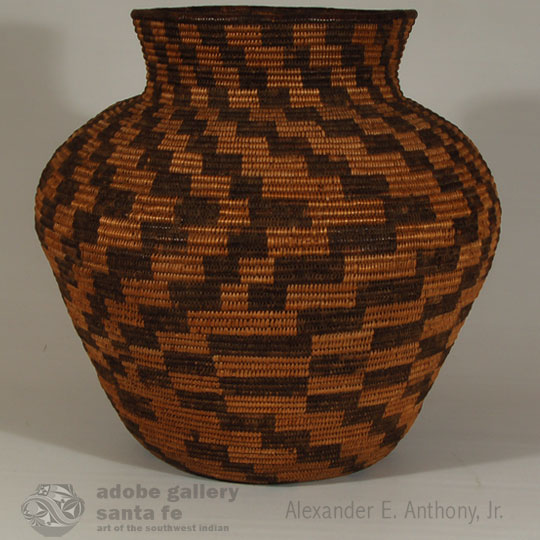 The members of the Yavapai-Apache Nation, a sovereign Native American tribe from the Verde Valley, Arizona, have two culturally distinct backgrounds and speak two indigenous languages. The Yavapai originate from Yuman-speaking peoples known as the Pai and the Apache descend from an Athapaskan background like other Apache groups to the East.
Originally, the Yavapai and Apache tribes were separate and distinct tribes who coexisted peacefully for several hundred years. They have existed as one tribal nation since 1934. The Yavapai-Apache Tribal Reservation is located at Camp Verde, about 90 miles north of Phoenix and 50 miles south of Flagstaff, along Interstate 17. They are generally referred to as Western Apache.
San Ildefonso Pueblo Black Carved Jar by Rose Gonzales - C3868i
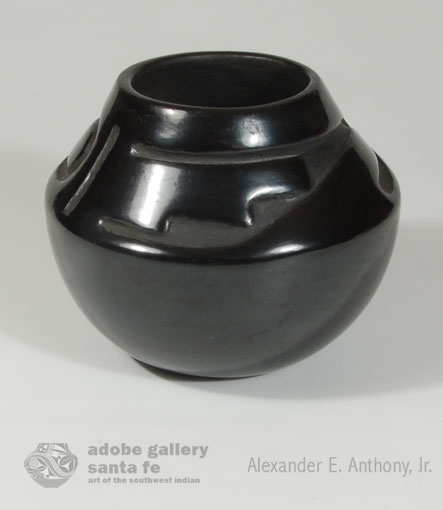 This jar was originally purchased from the Popovi Da Studio at San Ildefonso Pueblo. The Popovi Da Studio was originally opened to display and sell pottery by Maria Martinez and family members. Popovi eventually added pottery and paintings by other local artists to his inventory. After Popovi died in 1972, his widow Anita Da continued operating the studio for several years and finally closed it sometime in the late 1990s or early 2000s. Popovi's personal collection of Martinez family pottery that was displayed at the Studio was then sold to the Millicent Rogers Museum in Taos.
Rose Gonzales was one of the potters featured at Popovi's Studio. She was originally from Ohkay Owingeh (San Juan) Pueblo. After she married Robert Gonzales of San Ildefonso Pueblo she moved there with him. Rose was a sister of Pomasena Sanchez. She was the mother of Jose H. Rainbird Gonzales, Tse-Pé Gonzales, and Marie Gonzales Yazzie. Rose learned pottery making from Ramona Sanchez Gonzales, her mother-in-law. Rose's parents died from the swine flu epidemic of 1918, leaving Rose and her sister Pomasena orphaned. The girls survived by staying at the Santa Fe Indian School. Mary Cata, a relative, adopted and cared for the girls. Rose lived at San Ildefosno for the remainder of her life.
Matte and Polished Red Pottery Basketry Bowl by Sue Tapia - C3868D
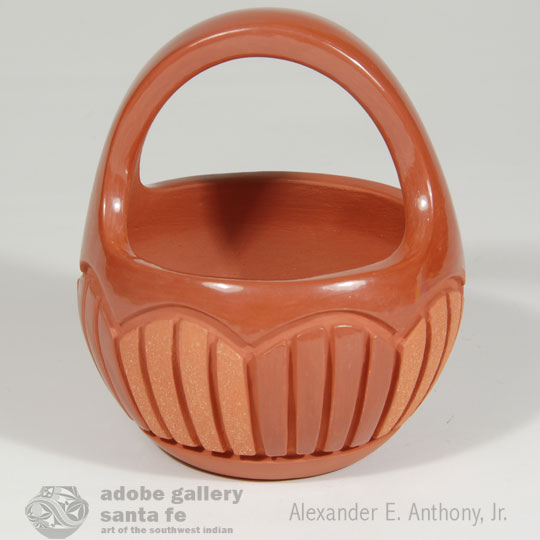 Sue Poncho Tapia is a potter originally from Laguna Pueblo, who married Tom Tapia from Ohkay Owingeh Pueblo. She and her husband make Ohkay Owingeh style pottery. This small bowl with a handle was beautifully carved with vertical ribs. Each group of four vertical ribs alternates with polished red finish and micaceous finish. The arched handle and area of the rim are finished in a polished state. The underside of the bowl is matte finish.
Santa Clara Pueblo Small Red Melon Jar by Angela Baca - C3868E
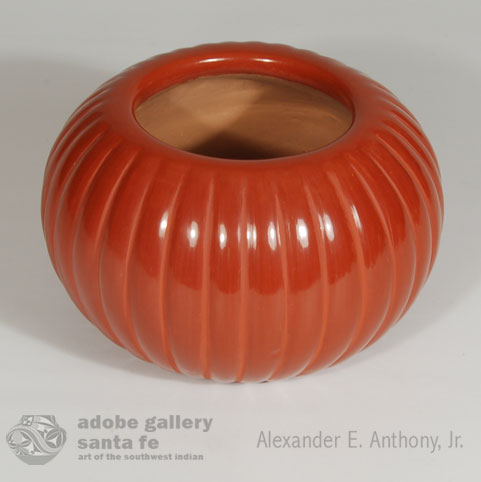 Contemporary melon jars had their start at Santa Clara Pueblo sometime in the 1960s. It is not known who was the first to make them but we know that Severa Tafoya (1890-1973), mother of Angela Baca, made them. Angela Baca (1927-2014) also made them and was probably the best known at the time for both black and red melon jars. Later, Helen Shupla (1928-1985) made them. Many other potters are now making versions of melon jars.
Angela Baca is still probably the best known for melon jars of the original style. Helen Shupla's melon jars were of a different style. This small red melon jar is very traditionally an Angela Baca one. The ribs are stone polished and the lines between ribs are in matte finish. The melon ribs extend from the rim to the base. The jar is signed Angela Baca on the underside.