



Santa Clara Pueblo Black Carved Bowl with Avanyu Design by Teresita Naranjo - C3681B
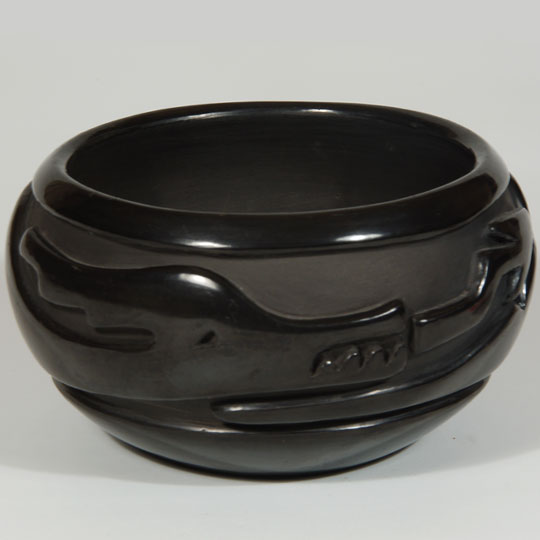 Teresita Tafoya Naranjo (1919-1999) Apple Blossom - Bay-Po-Vi was the daughter of Christina Naranjo and granddaughter of Sara Fina Tafoya. She has been acknowledged as one of the finest 20th century potters at Santa Clara Pueblo. Her unexpected death in 1999 was a loss to all pottery collectors. She was active from 1935 to 1999 and was known for her black and redware carved works in the Santa Clara style. After her husband passed away in 1950, she supported her family solely through sales of her pottery.
Navajo Sterling Silver Double Pen Holder Desk Accessory - C3856G
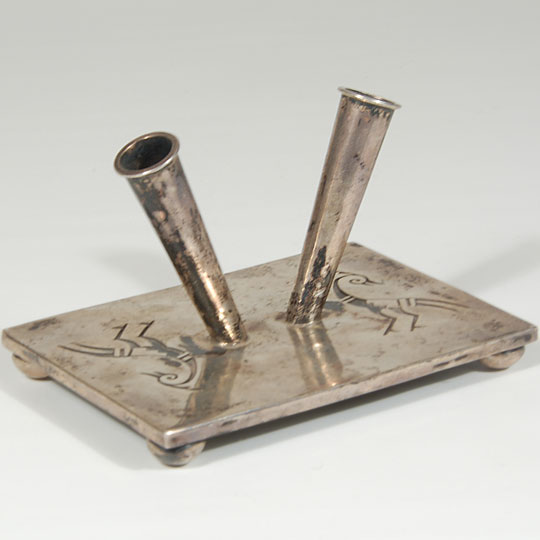 Navajos learned the art of silversmithing from the Mexicans in the mid-19th Century. Atsidi Sani "Old Smith" (1828-1918) is considered to be one of the first Navajo smiths to work with silver. Initially, silver was hammered into the desired shape and designs were chiseled into the piece. Later pieces featured stamp work and turquoise stones. As the demand for tourist pieces increased, more artists could make a living as jewelers. In addition to jewelry, silver objects such as boxes, bookmarks and letter openers were made.
Very Large Magnificent Black Carved Santa Clara Jar by Margaret Tafoya - C3853A
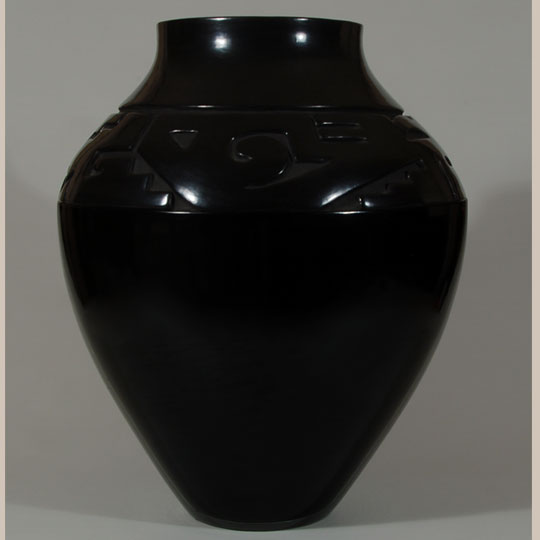 Occasionally a black polished jar just takes one's breath away. That was the effect this jar had on staff at the gallery and has had on clients who walk in to the gallery and see it. We all know that Margaret Tafoya was an amazing potter who produced large and magnificent wares, but, even so, it is still an emotional shock to see a jar that is so commanding of one's attention because it is so visually magnificent and so elegant and regal. Those may be adjectives not normally ascribed to pottery but they are appropriate for this jar.
Small Polychrome Pottery Mudhead Figurine by Margaret Gutierrez - C3855D
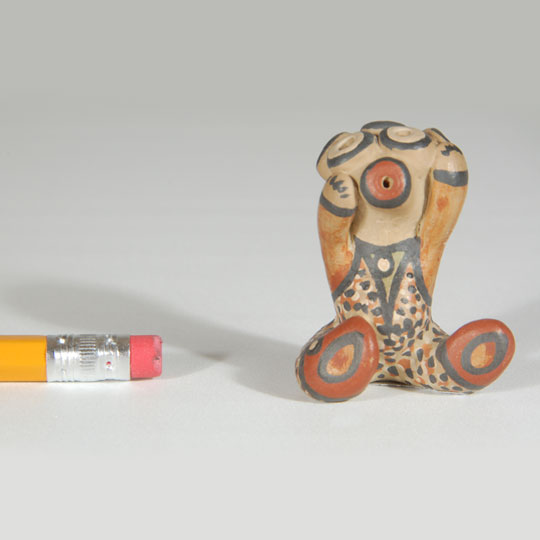 Margaret Gutierrez was the daughter of potters Lela and Van Gutierrez. Lela and Van developed one of the most distinctive and recognizable styles of pueblo pottery. Their use of multicolored pigments to decorate pottery is unique. Margaret and her brother Luther continued painting in this style, and began to create animals and small whimsical figurines. After Luther passed away, Margaret carried on the tradition on her own.
Santa Clara Pueblo Aquatint Etching “Acoma Rooster” by Helen Hardin - 25919
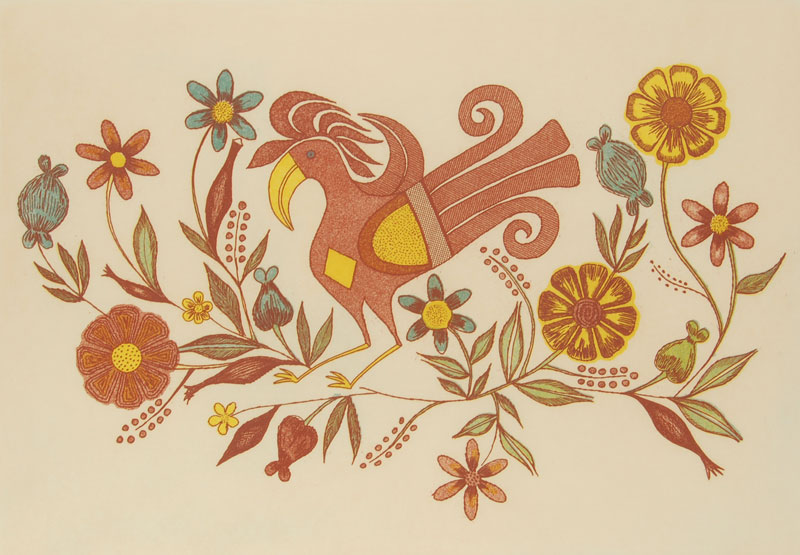 The etching was begun on June 1, 1981 and completed on July 15, 1981. The master printer was Ricardo C. Ximinez at El Cerro Graphics in Los Lunas, New Mexico. The shop mark is on lower left, the printer's mark is on lower right and the artist name, Helen Hardin (1943-1984) Tsa-Sah-Wee-Eh - Little Standing Spruce, is signed in lower right with her hallmark tree image. There were 65 Arabic numbered in the edition and 8 in the Roman numbered edition. This is number III of VIII in the Roman edition, which are the 8 copies allocated to the print shop for its records and distribution. Helen Hardin was from Santa Clara Pueblo.
Canyon Road ArtCrawl Is Tonight Starting at 4PM
December is a truly wonderful time to come to Canyon Road. The historic adobes and sculpture gardens are beautifully lit for the holidays, the air is crisp and fresh, and there are dozens of places that invite exploration.
It is also the perfect place to find one-of-a kind gifts, ranging from artwork and designer jewelry to hand-crafted furniture and wearable art, stationery and ceramics. Most of the iconic road's 100 fine art galleries, specialty shops, and restaurants will be open 7 days a week during December.
On Friday, December 9th, between 4 and 7pm, you are invited to experience the fusion of the visual and cinematic arts at the Canyon Road ArtCrawl, which takes place at 40 venues on historic Canyon Road.
The Art Crawl is a feature event of the Santa Fe Film Festival and includes a red carpet, a mariachi march down Canyon Road, and art openings at many of the road's 100 galleries and artist studios. The event is organized for the filmmakers, actors, and visitors from around the globe who come to Santa Fe for the festival. The public is welcome. More information
Ink Drawing of Two Warriors on Horseback by Edward Borein - C3827J
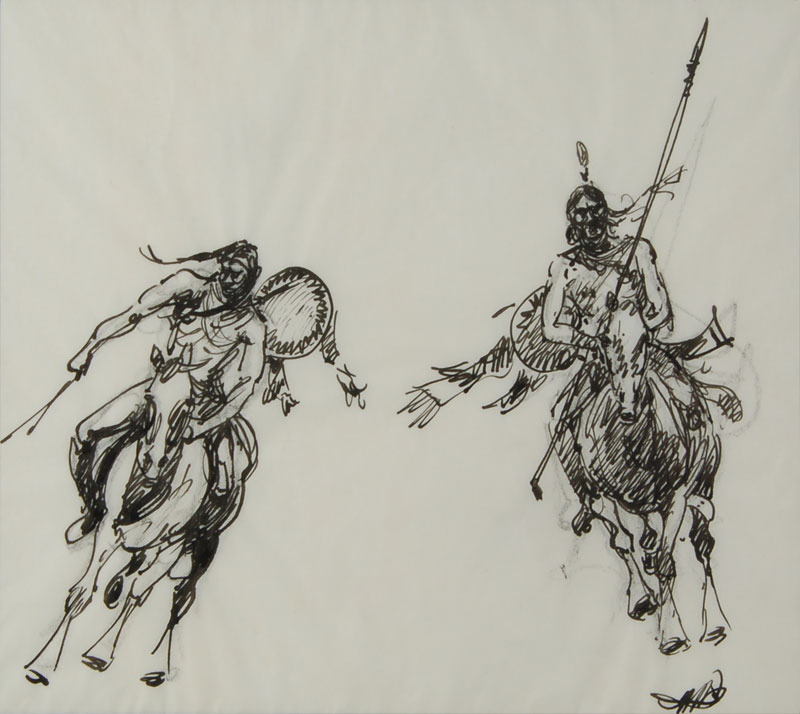 Edward Borein was born at San Leandro, California, not far from San Francisco, in 1873. He began to work as a cowboy at the age of seventeen, and sold his first drawing when he was twenty-one. From that time, onward, irrespective of location as he travelled all over the Southwestern United States and as far south as Guatemala, he was an artist. He remained ever devoted to the practice of his professional skill, and at the same time kept up his interest in cowboy life, to the very end.
Navajo Sterling Silver Squash Blossom Necklace - C3856E
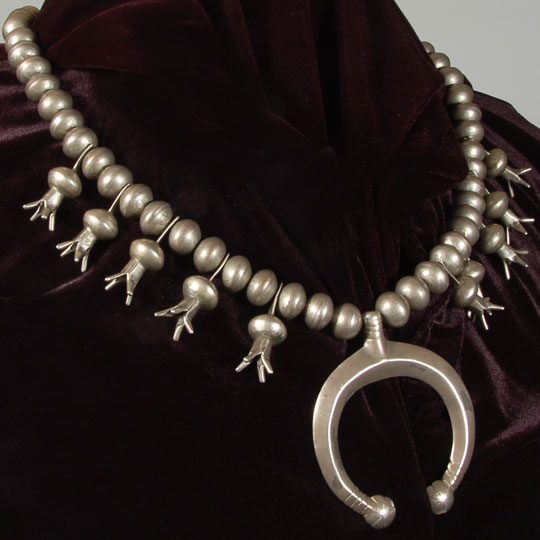 There are 54 silver beads, 10 silver squash blossoms and a naja, all of which are silver. It is strung on rawhide. Early Navajo jewelry contained elements borrowed directly from Spanish colonial and Mexican ornament. The naja is one of these elements, a crescent form of Moorish origin. The Spanish conquerors in the Southwest outfitted their horses with elaborate silver ornaments-one of which was the naja that hung directly on the forehead of the horse as a part of the bridle. The Navajo incorporated the naja in their jewelry as a pendant dangling on silver necklaces, commonly called "squash blossom necklaces." The blossoms are modeled from the pomegranate but have been known as squash blossoms for over a hundred years, so that is not likely to change.
Hopi Cylindrical Jar with Butterfly or Moth Designs by Grace Chapella - C3856B
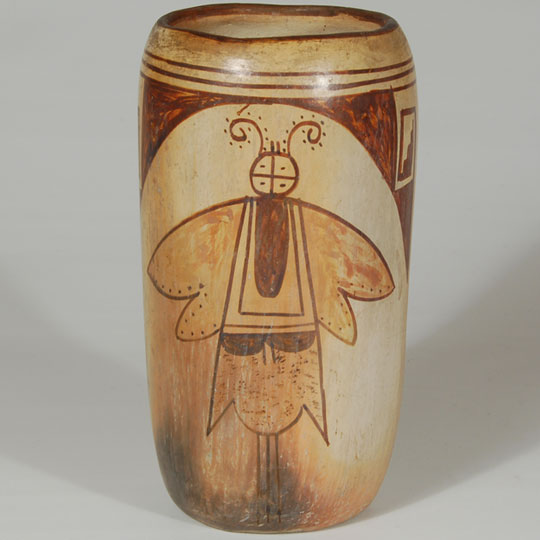 Grace Chapella was born in the Tewa village of Hano at First Mesa on the Hopi Reservation in 1874, eight years before the Reservation was established as such, and before Custer's Last Stand at the Battle of the Little Big Horn. She witnessed the first "horseless carriage" arrive on the Reservation and recalled how frightening it was. In 1927, she became the first person from the Hopi Reservation to fly in an airplane, going from Grand Canyon to Long Beach for a pottery demonstration.
Pictographs in Canyon de Chelly #3 Navajo Painting by Robert Draper - C3827B
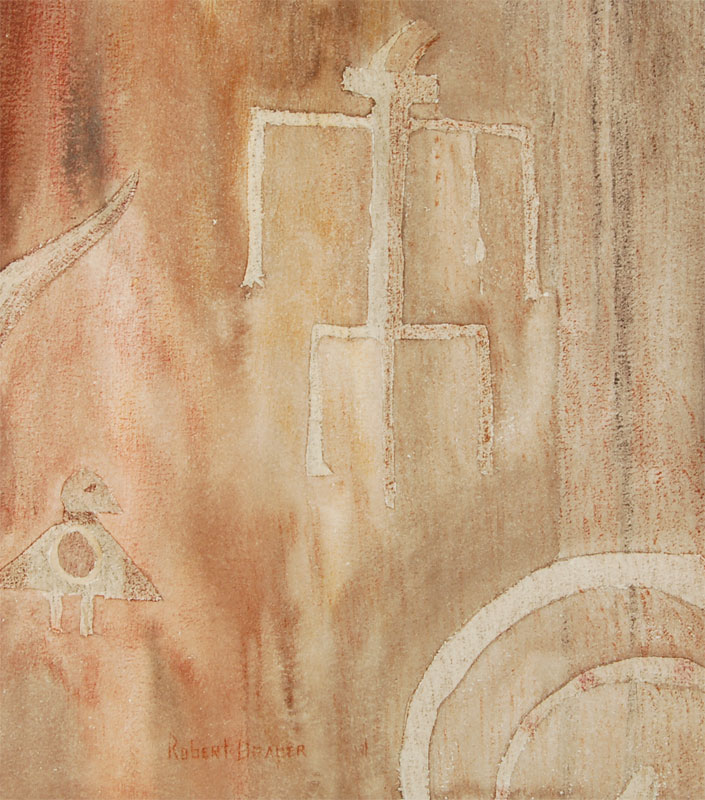 Navajo artist Robert Draper was the child of a Navajo mother and a Hopi-Laguna father. Raised by his grandparents on the Navajo Reservation, he attended-and eventually became an instructor at- the Chinle Boarding School. He was also educated at the Inter-Mountain Indian School in Utah and the Institute of America Indian Arts in Santa Fe. Draper mostly painted realistic landscapes, focusing on everyday life on the Navajo Reservation.
Thinking of hiring an art appraiser?
 Art appraisals are an important part of assessing value for an artwork. This is needed for selling art, donating art, and for some tax and financial purposes. Due to the shifting nature of the market, it’s best to appraise art every 2-5 years. There are several factors to consider when hiring an art appraiser. An improper or biased evaluation could misrepresent the overall value of the piece and could negatively affect future resell. By taking the time to find the proper appraiser, collectors can better maintain their investments.
Traditional Hopi Pueblo Chusona or Snake Dance Doll - C3843D
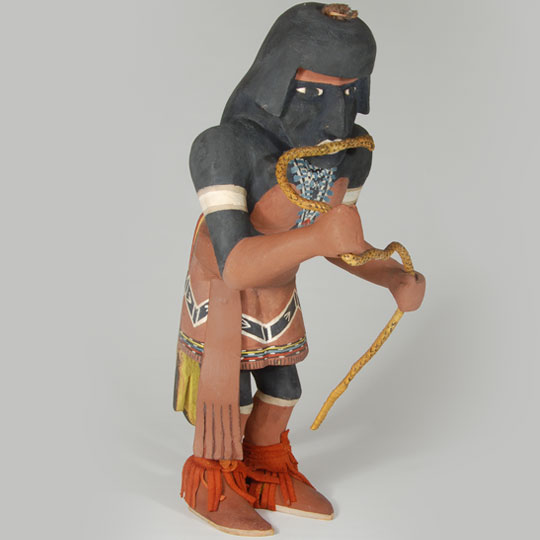 At the end of the nineteenth century, very few tourists had ever seen the Hopi Snake Dance; however, many had heard tales of a dramatic ritual that only occurred every other year in isolated Indian villages in Arizona. This religious ceremony that Victorian society found so horrifying-and so fascinating-soon grew into a symbolic representation of "Indian Country" in the Southwest. The Passenger Department of the Santa Fe Railway played upon sensationalist, tourist visions of American Indians when it published Walter Hough's travel guide The Moki Snake Dance. It was described as A popular account of that unparalleled dramatic pagan ceremony of the Pueblo Indians of Tusayan, Arizona, with incidental mention of their life and customs.
Very Large Seed Jar with Corn Relief Design by Iris Youvella Nampeyo - C3853D
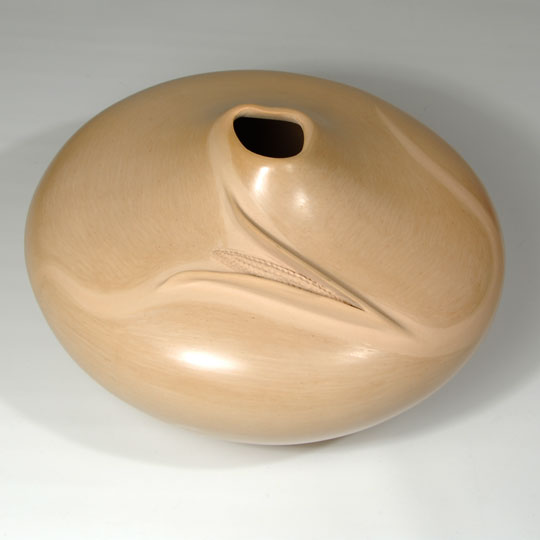 Iris Youvella Nampeyo (1944 -) is known for her sculptural design pottery that she has mastered to the finest detail. This style of sculpture was first made by Elizabeth White (Polingaysi) and further refined by her nephew Al Colton (Qöyawayma). Colton has evolved from the simple corn design to carving cliff dwellings on his pottery.
Acoma Pueblo Black-on-white Mimbres Design Jar by Lucy Lewis - C3853F
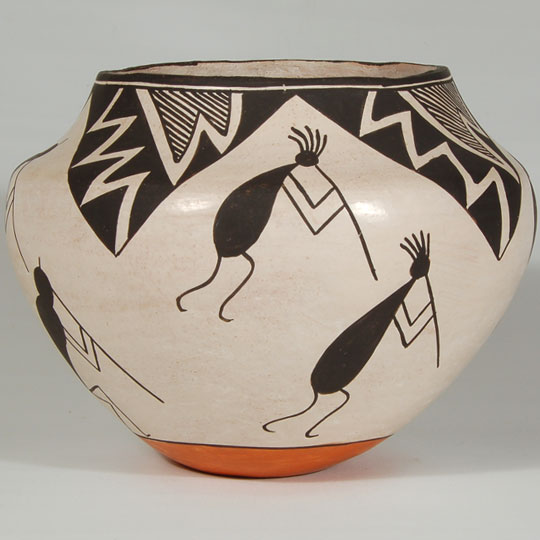 Lucy M. Lewis continued throughout her life to make pottery in the traditional way; digging and preparing clay, grinding potshards for temper; coiling the clay into a vessel shape, making her paints from plant and mineral elements, and firing the finished vessels in an open outdoor handmade kiln.
Frog Woman Hopi-Tewa Tall Cylindrical Jar (Paqua Naha) - C3853E
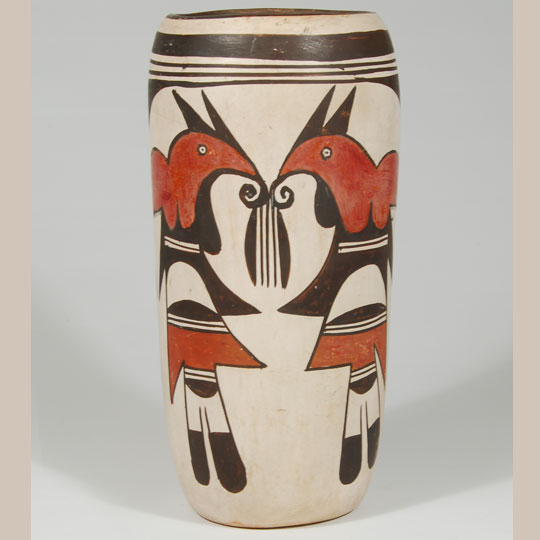 Frank Applegate conducted classes in the Hopi villages in 1922 at the request of the Indian Commission. It is quite possible that he re-introduced this shape to the Hopi potters at that time. The shape does have precedence from prehistoric times.
Recent studies of excavated prehistoric sites at Chaco Canyon have revealed specimens of cylindrical jars. Anthropologist Patricia Crown, from the University of New Mexico, and a colleague from the Hershey Center for Health and Nutrition, analyzed potsherds and found traces of a compound of cacao. From their research, they concluded that the cylindrical jars were used to hold chocolate in beverage form. Only a couple hundred complete jars have been found and most of them came from Pueblo Bonito, but many shards that would fit a cylindrical jar shape have been unearthed.
Mimbres Animals and Human Figures Painting by Tony Da - C3854
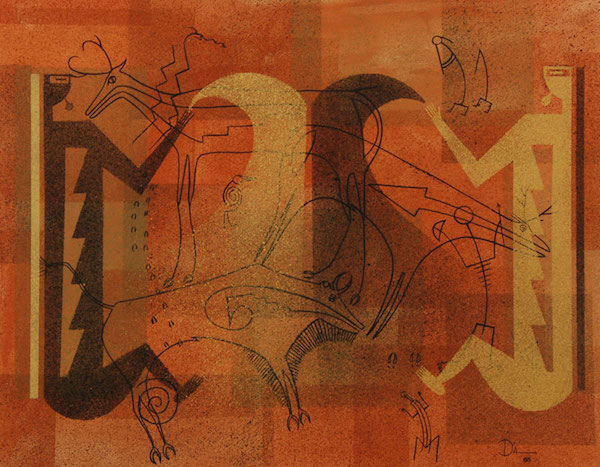 Tony Da was first a painter before becoming a potter. He began using casein paints in the 1950s and painted until he apprenticed to his grandmother, Maria Martinez, in the late 1960s. After 1972, he did very little painting and became a famous potter. Tony was enchanted with the art of the Mimbres Indians of New Mexico and many of his paintings reflect that interest.
10-piece Santa Clara Pueblo Nacimiento Set by Margaret and Luther Gutierrez - C3855A
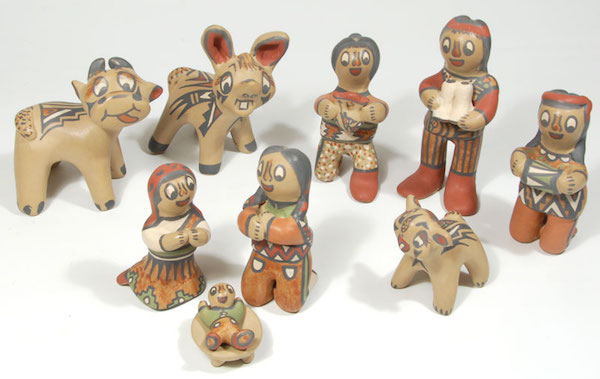 Whimsical, charming and delightful are just a few adjectives that could be used to describe this 10-piece nacimiento. Margaret and Luther Gutierrez were the children of Lela and Van Gutierrez, who continued the distinctive family style of making pottery using a variety of colors including red, tan, gold, blue, black, white and green pigments, all obtained from natural sources. It is only natural that they would have created a nacimiento because the family has long been known for the creation of figurines.
Original Painting “Zuni Fire Maker” by Kai-Sa (Percy Sandy) - C3851
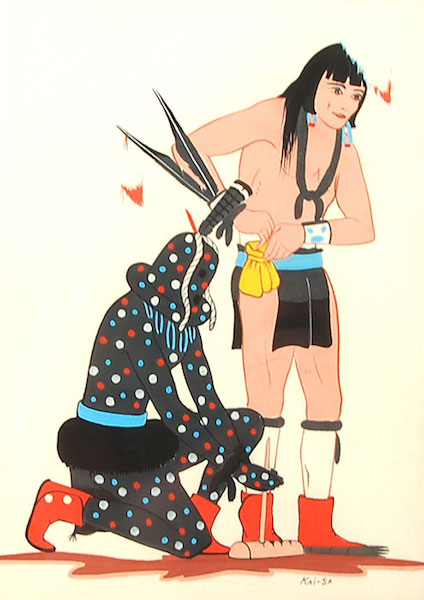 The Zuni Shulawitsi Katsina is almost an exact duplicate of the Hopi Kokosori, but he is not related to Kokosori. A young boy who is innocent and pure of heart usually performs him. He carries a fire stick, signifying his responsibility as caretaker of one of the important physical elements of the universe: fire. He is responsible for lighting fires before the Shalako ceremony prior to the winter solstice. The lighting of these fires is the signal for the Shalako to begin their ritual.
The Fire God is the black Katsina with colorful polka dots. I do not know the name of the assistant. The detail achieved by Kai-Sa is well beyond most paintings of this style. Each polka dot is precise. The skin tone of the assistant is smooth and evenly applied. This is certainly among the finest paintings by Kai-Sa
Large Santa Clara Pueblo Globular Black Bear Paw Jar by Toni Roller - C3853C
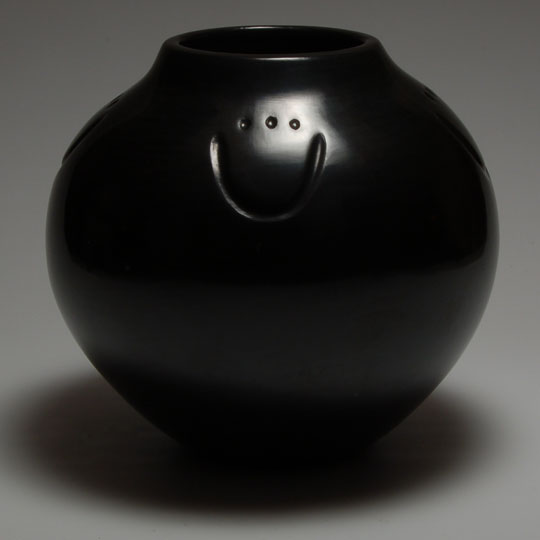 Toni Roller has always been a very traditionalist potter, following the strictest meaning of the word. She uses only traditional designs taught her by her mother, Margaret Tafoya. She also uses only traditional materials and firing techniques. This jar was constructed using coils and burnished with polishing stones. The design consists of four bear paw impressions near the rim.
The burnishing of the entire Large Globular Black Bear Paw Jar is most exceptional and flawless. The firing produced a beautiful even black coloration. The jar is signed with the artist's name, pueblo name and is dated March 1997.
Original Tesuque Painting of a Forest Scene with Animals by Tim Vigil - C3823B
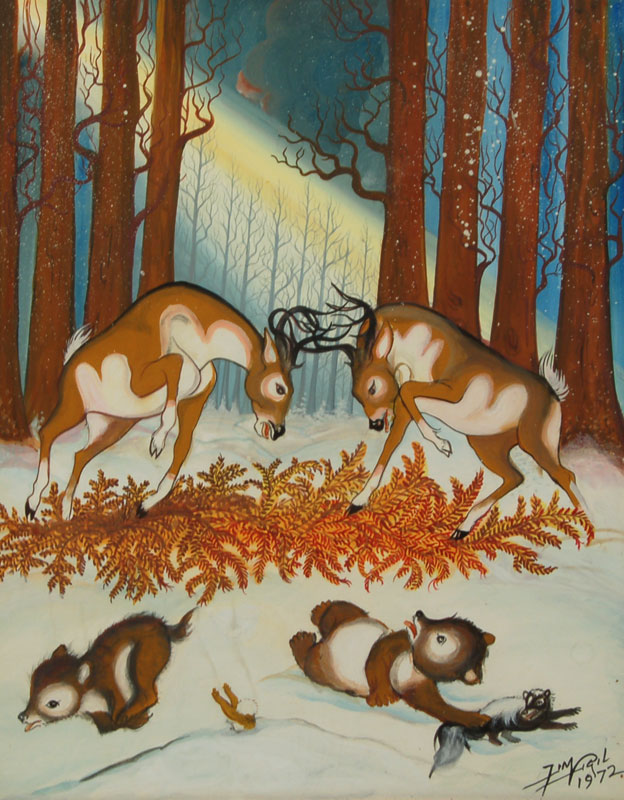 Tesuque Pueblo painter Tim Vigil passed away in 1972, but his age is not known at that time. He was the son of Thomas Vigil (c1889-1960), one of the earliest 20th century Pueblo painters, and the brother of Paul Vigil. Tim was not a prolific painter as he was employed full-time at Los Alamos National Laboratory.