



Cochiti Pueblo 13-piece Polychrome Pottery Nacimiento by Josie Hand - C3688.63
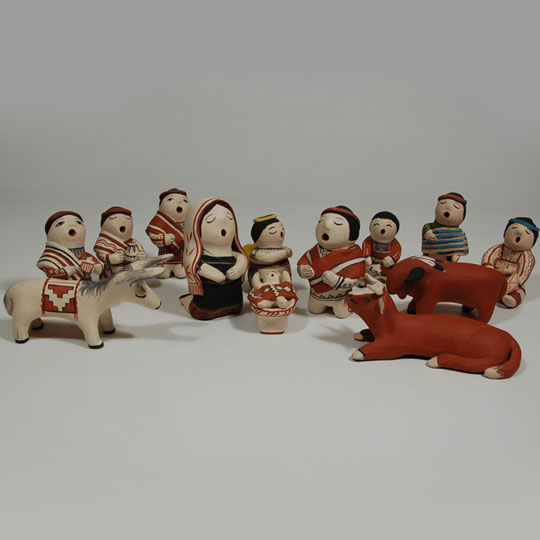 The set is a wonderful representation by a Cochiti Pueblo potter named Josie Hand. Josephine "Josie" Hand was born on September 17, 1932 in Cochiti Pueblo to her parents Paul and Felipa Trujillo. She married George Hand from the state of Texas. She was known for making pottery figurines - to include storytellers, nacimientos - or Nativity scenes. Josie Hand passed away on January 3, 2013.
Cochiti Pueblo Unsigned Storyteller with 2 Kids - C3688.16
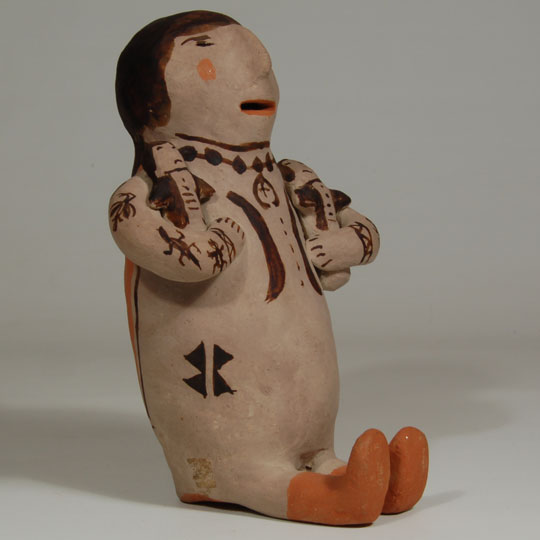 This storyteller figurine is signed on the bottom Cochet[i] Pueblo N.M. in what appears to be paint before firing. There is no artist name. I do not recognize the facial feature extensively enough to hazard a guess as to who the artist might have been so we will accept it on its own merits without the benefit of knowing the name of the potter.
Cochiti Pueblo Female Storyteller with 4 kids by Josephine Arquero - C3688.11
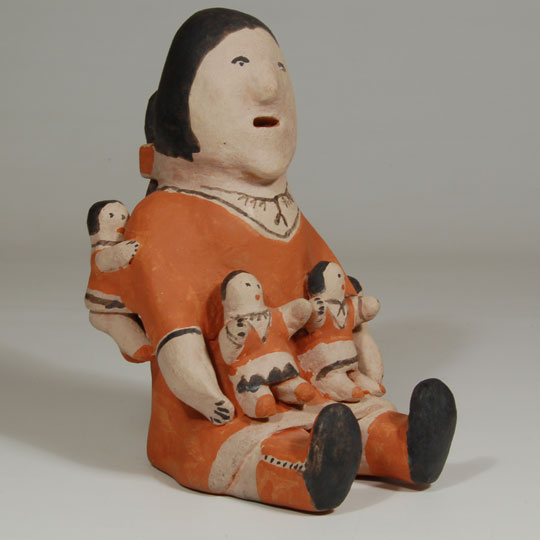 Josephine Arquero is a daughter of Damacia Cordero and sister to Martha Arquero, Marie Laweka and Gloria Herrera, all of whom are recognized potters. Josephine specializes in figurative pottery-mostly storytellers, nacimientos, and animals. She dresses her human figures in traditional clothing. Based on the features of this figurine.
Cochiti Pueblo Male Storyteller with 8 Kids by Elizabeth Trujillo - C3688.47
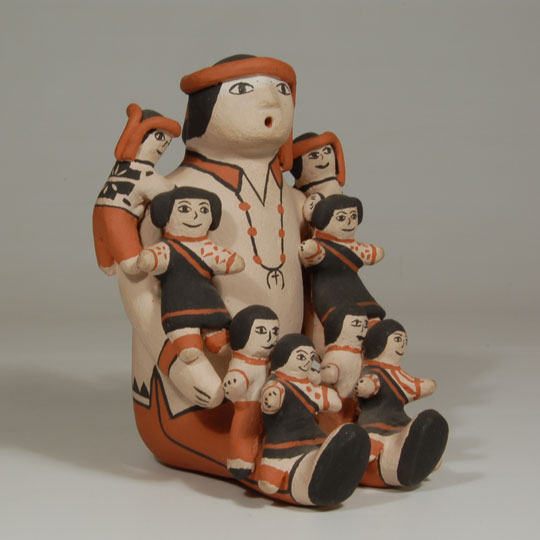 Elizabeth Trujillo is best known for making large storage jars, ollas, bowls, lamp bases, mugs and figurines. In 1990, her large storage jar was judged best pot at Santa Fe's Indian Market. We have had stew bowls by her in the past but never a storyteller figurine so it is nice to have one of those.
Black and Sienna Seed Jar with Avanyu Design by Juan B. Tafoya - 25725
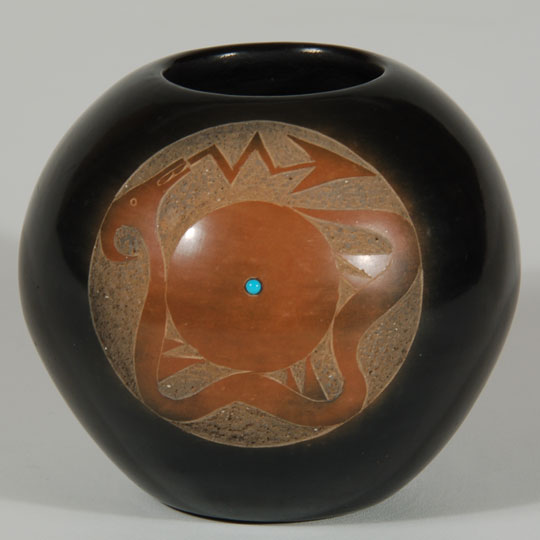 Juan Tafoya was a well-known San Ildefosno potter who passed away prematurely at age 57 years. He specialized in sgraffito designs where he would chip away at the polished slip to form a textured background for his design, in this instance for the design of the Avanyu (water serpent). After firing the jar in a reduction firing to achieve a black finish, he then re-oxidized the designed area to bring the black color to sienna, after which he inserted the turquoise cab.
Polished Black Carved Jar with Cloud Design by Rose Gonzales - 25724
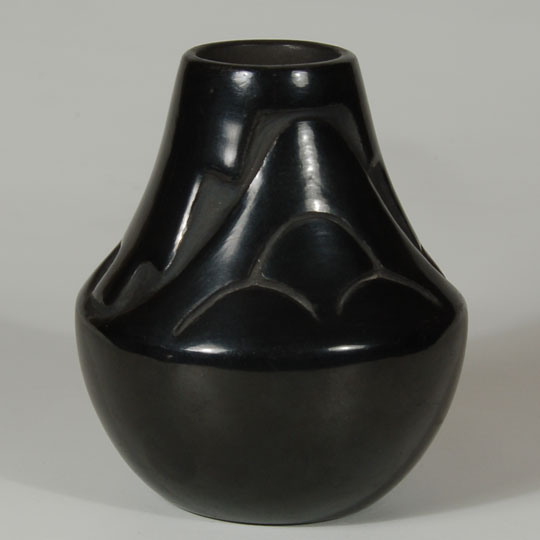 Rose Gonzales was an accomplished potter who experimented for years with blackware, redware, black-on-black ware and carved ware. She became very proficient at all styles. According to Russell Sanchez of San Ildefonso Pueblo, she frequently fired up to twenty pots in a single firing, a feat most potters will not try. If one pot explodes during firing, it could damage all the pots surrounding it causing a great loss. Rose was confident enough in her work not to worry about a pot exploding. She would fire redware and blackware in the same firing. She first removed the red pots from the fire then smothered the fire with pulverized manure and left the remaining pots in the firing for another hour or so to produce blackware. Most potters fire redware and blackware in separate firings.
Original Painting of a Woman with Ladle in Hand by Ben Adair Shoemaker - C3441L
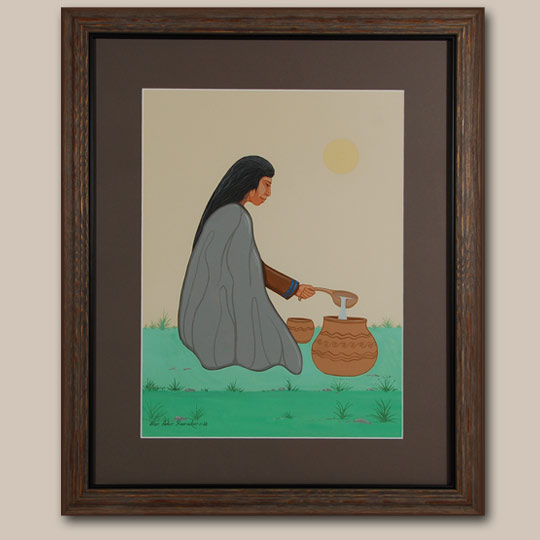 Ben Adair Shoemaker (Quapaw/Shawnee/Cherokee) presents a daily occurrence on the reservation by painting a woman kneeling by a water jug while she ladles out water. She is wrapped in a grey cape or blanket over her brown dress. She is presented in profile. The only background is a muted Sun.
Original Painting “Brokers of the Unseen” by Baje Whitethorne, Sr. - C3584E
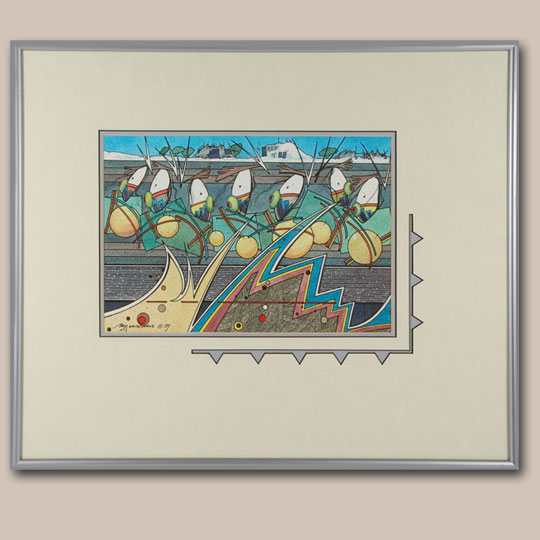 Whitethorne's paintings are full of activity and color. Usually they are of events on the Navajo Reservation or events of Navajo life. In this painting, the seven facial items that appear to float across the painting represent the Navajo supernatural Yei*. Interestingly, it appears that the top of the paining represents a reservation scene of ahogan covered in snow with trees around the area. The rest of the painting appears to be an underground scene? In addition to the Yei masks, there are green squares, yellow circles, zigzag elements rising from the base of the painting, and strata of earth in horizontal bands.
Navajo Couple Riding among a Herd of Horses by Anthony Chee Emerson - C3624C
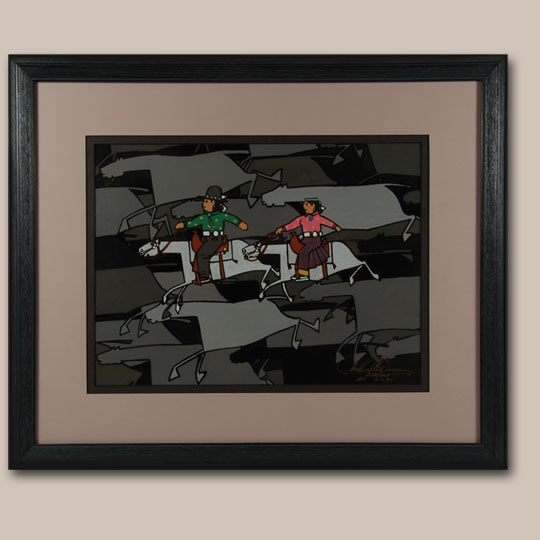 Navajo artist Anthony Chee Emerson has developed a whimsical style that incorporates both traditional Navajo cultural values and a modernist approach. Emerson is a native of the Four Corners area where, as a self-taught artist, he paints Navajo settings and people. His colorful renditions of Navajo life reflect upon the important values of family and tradition.
In this painting, Chee has a Navajo man and woman cheerfully riding their horses among a stampede of horses. They appear to be happy and carefree so it must not be a serious stampede.
Historic Four Color Polychrome Zia Pueblo Olla, circa 1890s - C3595J
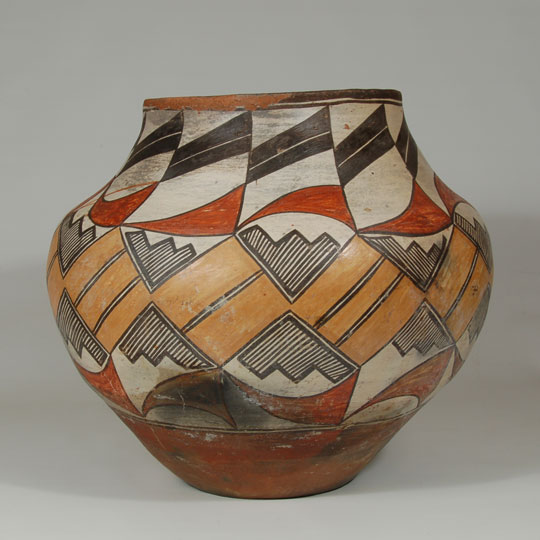 Zia Pueblo refrained from making tourist-related pottery during the late 1800s when other pueblos succumbed to doing so. Zia potters did make pottery for sale in the latter half of the 1800s but they only improved over those that they made for their own use. They took pride in making better pottery for sale than for their own use. That, in part, is the reason there are so many beautiful Zia ollas from 1880 to 1930.
Harlow and Lanmon, in their book The Pottery of Zia Pueblo, largely devoted a chapter to what they described as split rectangles-the design seen on this jar at the widest point of diameter and colored orange. Black split rectangles circumnavigate the neck of the jar. They state that split rectangles became quite prominent about 1880. Such prominence is accented by the use of red and deep black design elements as compliments. The potter of this jar filled all available space with design.
Santa Clara Pueblo Black Bear Paw Design Jar - C3637H
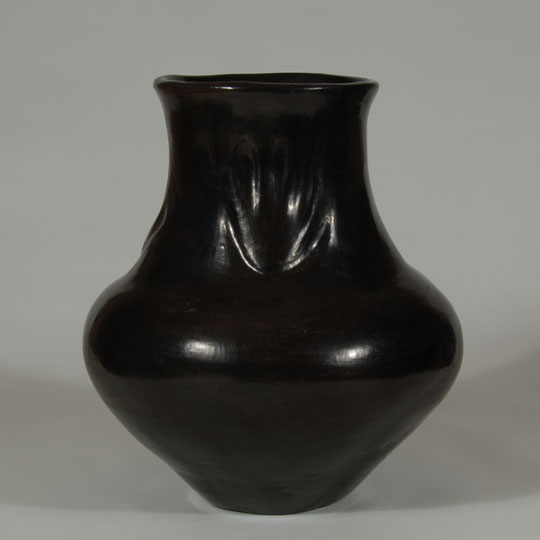 This is a very traditional Santa Clara vessel shape, one of the most popular. The design-bear paws-too are very traditional. It is said that the bear paw is put on water jars to enhance the chances that the jar will never be empty of water, a belief based on the fact that bears can always find water. What a wonderful tribute to nature that is, something that Native Americans are known for doing.
Sometimes the manner in which the bear paw is designed provides a hint to the potter but, in this example, I have been unable to tie these bear paws to a specific potter. The important consideration is that the jar was beautifully constructed and finished on this Southwest Indian Pottery olla.
Santa Clara Black-on-black mid-20th-century Plate by Margaret Tafoya - C3637A
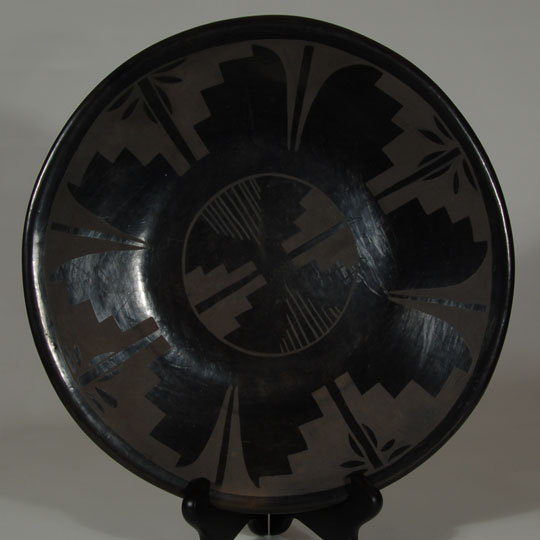 This appears to be an early item of pottery by Margaret Tafoya, perhaps circa 1950s or so. The design is unlike that used by her on later pottery. It has been stated that the stepped elements in the center and on the edge represent the mountains and the parallel lines in the center represent rain. The plate is signed Margaret Tafoya Santa Clara.
Starting sometime in the early 1950s, Margaret made smaller bowls, jars, plates, candlesticks and canteens for sale to tourists visiting the pueblo as well as to take to Royal Gorge for the summer. She and her family spent their summers-from Memorial Day to Labor Day-at Royal Gorge near Canon City, Colorado, selling pottery and entertaining the tourists with dances and permitting them to photograph the family members. She had made enough pottery before going to Royal Gorge to take with her to sell. She did not make pottery on site. Perhaps this plate is one that made the trip to Royal Gorge.
Hopi Pueblo Wood Dance Wand - C3325G
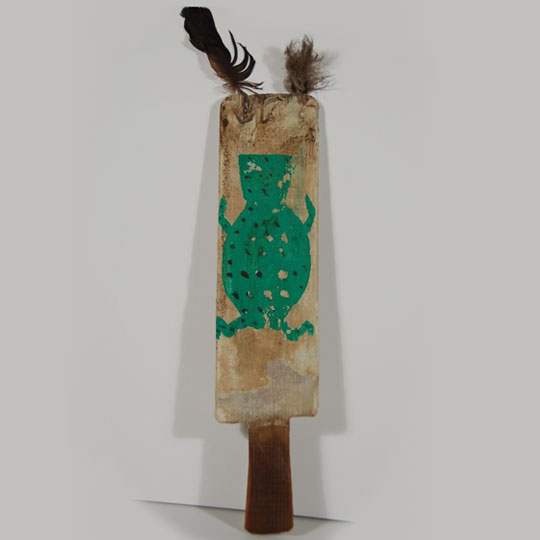 Dance wands are customarily carried by the women during some dances. They are flat wood panels with a handle at the end. Decorations may be of any variety of subjects. This one has a green frog with black dots as the sole item of design. Water creatures are always considered fertility indicators so perhaps the frog is used on the wand in a fertility dance. It also could be a clan symbol.
San Ildefonso Pueblo Large Polychrome Jar by Carmelita Dunlap - C3646
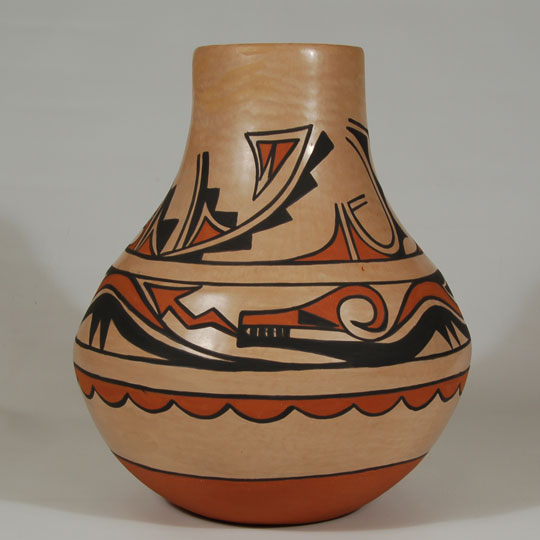 Carmelita Dunlap (1925-1999) was the daughter of Juanita and Romando Vigil of San Ildefonso Pueblo. Her mother passed away when Carmelita was very young and her mother's two sisters, Maria Martinez and Desideria Montoya, raised her. She took turns staying with Maria for a few months and then with Desideria for a few months. She learned to make Southwest Indian Pottery by watching Maria and Desideria at work.
Carmelita lived in California in the early 1950s while her dad worked for Walt Disney Studios. In 1955, she moved back to San Ildefonso and began seriously focusing on pottery. In 1974, she was one of the pueblo potters invited by President and Mrs. Nixon to visit the White House and one of her large pots was displayed at that time at the Smithsonian Institution.
Navajo Elder Storyteller Painting by Andrew Van Tsihnahjinnie - C3636D
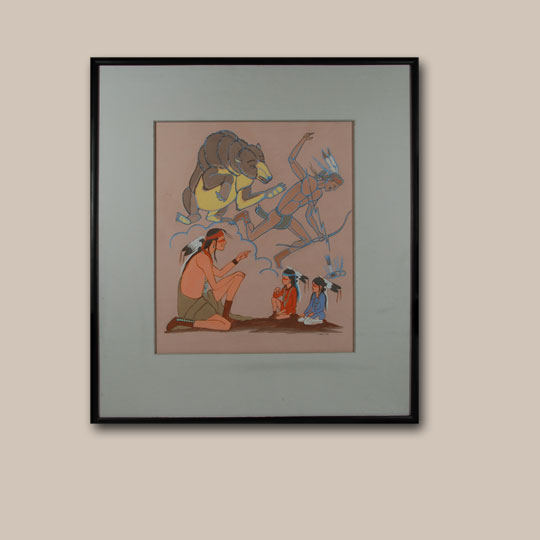 This appears to be a very early painting by Andrew Van Tsihnahjinnie (1916 - 2000), possibly one painted while attending the Santa Fe Indian School. The style is that of a student, not an accomplished artist, and the mat board appears to be hand cut, both being indications of student work. The painting was very well executed and illustrates why Dorothy Dunn thought so highly of Andy Tsihnahjinnie as an artist. She stated "[He] had no equals among the artists of the [Santa Fe Indian School] studio and perhaps few superiors among modern painters. If equanimity and self-confidence were to rule his artistic abilities, Tsihnahjinnie might well be one of America's top-ranking painters."
Navajo (Diné) Yeibichai Night Dance Painting by Andrew Van Tsihnahjinnie - C3636C
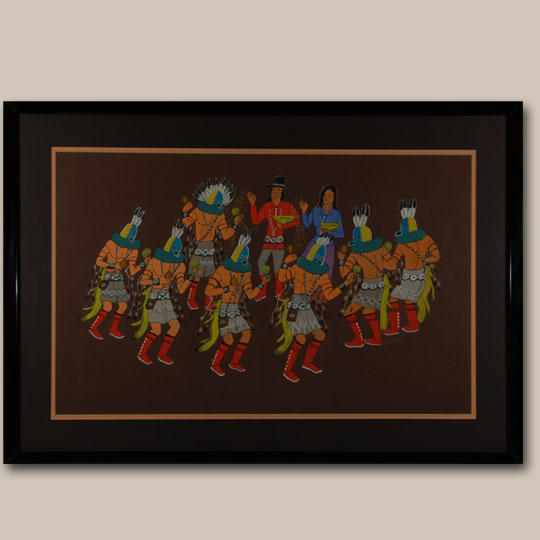 Andrew Van Tsihnahjinnie was born near Chinle, Arizona, in 1916. He attended elementary school at the Indian School at Fort Apache, but ran away and returned back to the reservation. He then attended school in Santa Fe and became a student of Dorothy Dunn at the Santa Fe Indian School. He was an avid student and was known to have stayed in the studio painting until forced to return to the dormitory. Following his graduation he went to work as an illustrator for the Indian Service.
Dorothy Dunn spoke highly of Andrew Van Tsihnahjinnie. She thought he displayed"incisive interpretation, spontaneity of brushwork, originality of color, vigor of draftsmanship and vitality of action and that he had no equals among the artists of the Santa Fe Indian School studio and perhaps few superiors among modern painters." She thought he might well be "one of America's top-ranking painters. In the brief seasons when he felt freed to paint the things he knew so deeply, without troubled concern for doing otherwise, his work attained a trenchant beauty, unique in modern art." Dunn 1963
Hopi Pueblo Unfinished Kokosori Katsina Doll by Lowell Talashoma, Sr. - C2425F
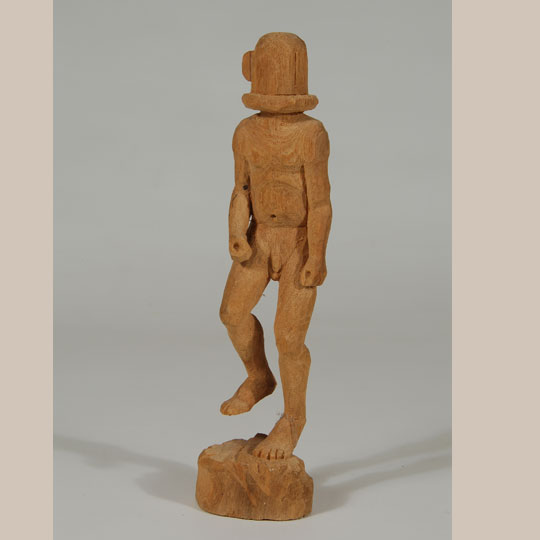 Lowell Talashoma, Sr. has always been one of the finest carvers on the Hopi Reservation. He prided himself on good form, good musculature, and carving the complete doll from a single piece of cottonwood root. I talked Lowell into selling it to me because I was so impressed with the form and proportion of the body, all accomplished with a pocketknife. I find it fascinating that a carver can pick up a round piece of cottonwood root and carve a human body in such accurate proportion using only a pocketknife.
Hopi Pueblo Unfinished Crow Mother Katsina Doll - C3642F
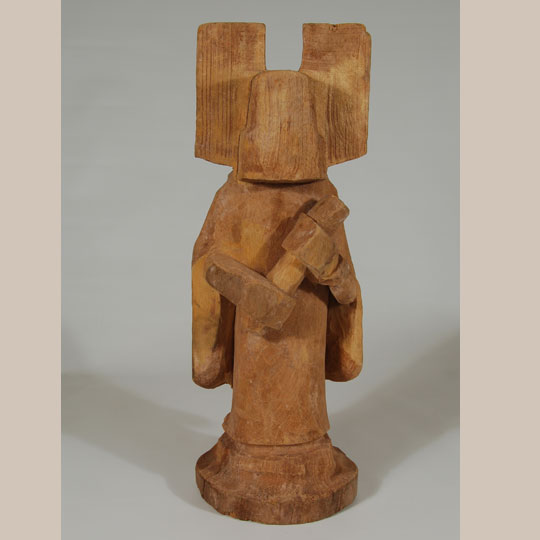 This unfinished katsina doll was going to represent Crow Mother Katsina but, during carving, a section of the cape on the back side broke off so the carver abandoned the work. The cylindrical shaft in her hands was going to be a bunch of yucca leaves. This is an excellent example illustrating the process of kachina doll carving from a single piece of cottonwood root.
San Ildefonso Black-on-black Plate signed Marie & Santana - C3504H
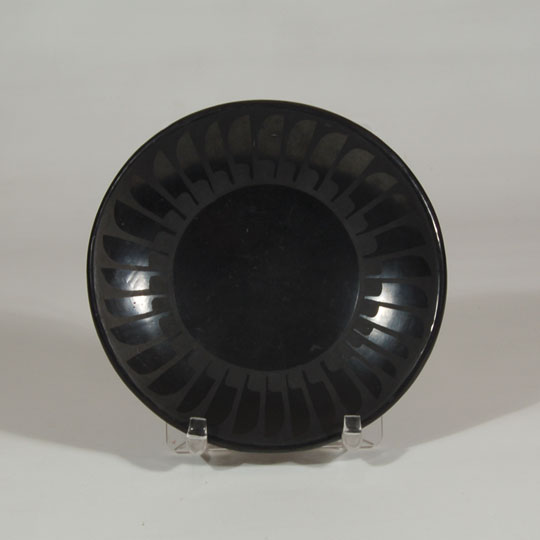 Maria and Julian had four sons: Adam, John, Popovi Da, and Philip. Adam's wife was Santana and it was she who worked with Maria following the death of Julian in 1943. There are two periods of pottery that was collaborated by Maria and Santana. The earlier ones were signed Marie & Santana and that period lasted from Julian's death in 1943 until 1956, at which time Popovi Da replaced Santana and helped his mom. Maria did not immediately stop working with Santana when she began working with Popovi but did continue on and off for a few more years. Those pieces are signed Maria & Santana.
San Ildefonso Black-on-black Small Dish signed Marie and Santana - C3512.21
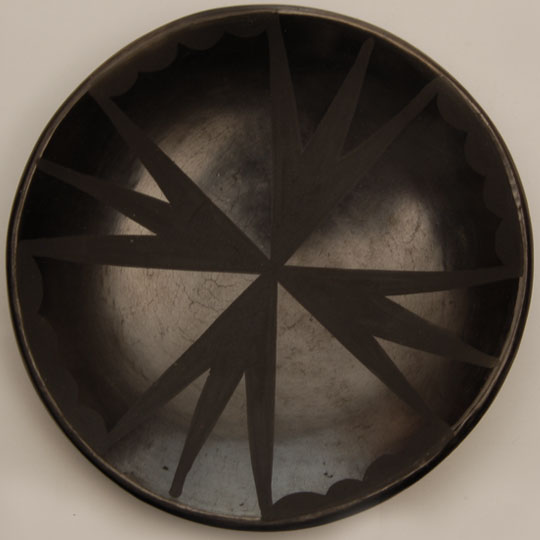 This plate is signed Marie & Santana, an earlier signature, indicating that it was made from mid-1940s to mid-1950s. Santana had started assisting Maria following the death of Julian in 1943. Maria made the plate and Santana decorated it with a four pronged element radiating outward from the center. Cloud elements are attached to the rim.