



Hopi Pueblo Motsin - Disheveled Katsina Doll by Roy Tawahongva - C3627E
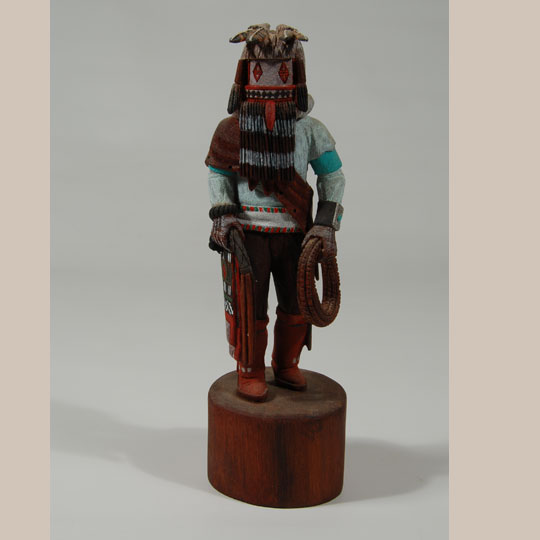 There is very little information published on the artist Roy Tawahongva. From his brother's (Mark Tawahongva) biographical information, who is listed as being born in 1948 at the Hopi village of Hotevilla, one can assume that Roy is 65 or more years old and was from the village of Hotevilla, as well. Roy is listed as being a katsina doll carver and a jeweler.
Hopi Tasavu Clown Poking Fun at the Navajo by Lem Poola - C3383M
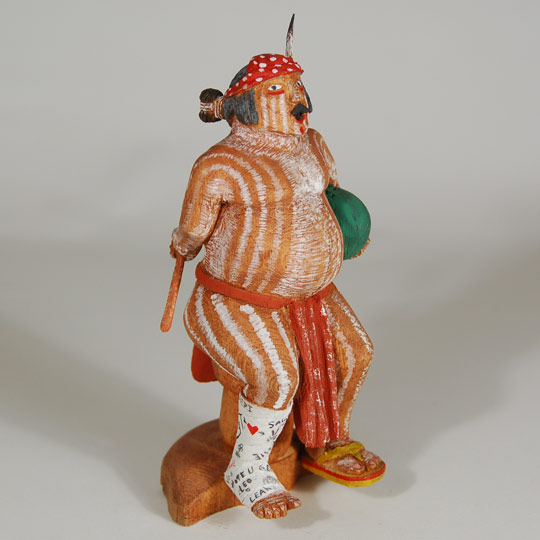 There is a category of Hopi Clowns that has been named Piptuyakyamu. They represent a group of Hopi men who band together to perform impromptu skits for the amusement of the people. They are not sacred clowns, as are the Koosa, nor are they equivalent to the Koyemsi (Mud Heads). They do not have a prescribed appearance except for painting their faces white, and may appear in any dress of choice. They dress according to the skit being performed. Their antics are usually something related to happenings at the pueblo. Their skits are usually presented in the most obscene manner possible.
#adobegallery #HopiPueblo #Katsina #Kachina # #Doll #SouthwestIndianArt #PuebloArt #SantaFeNM #LemPoola
Hopi Pueblo Old Katsina Doll with Loss of Most Paint - C3642G
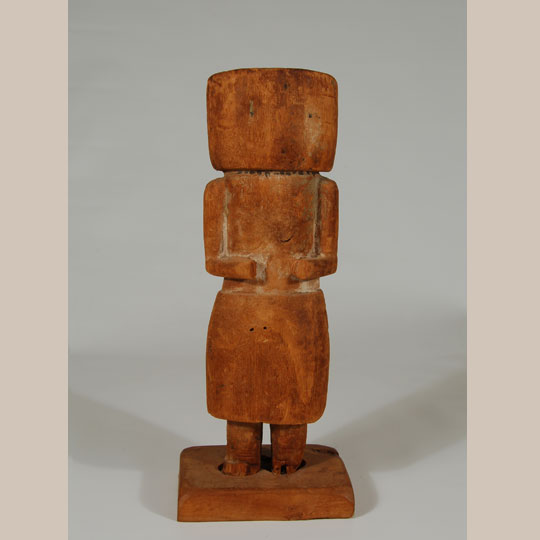 This katsina doll from Hopi Pueblo appears to be very old-perhaps late 1800s or early 1900s. There are remnants of paint in the recessed areas of the carving and a little remaining on the face. It is strange that so much of the paint is missing, as that is not the normal wear pattern, however, what paint remains does appear to be authentic.
San Ildefonso Black-on-black Wedding Vessel signed Marie - C3812A
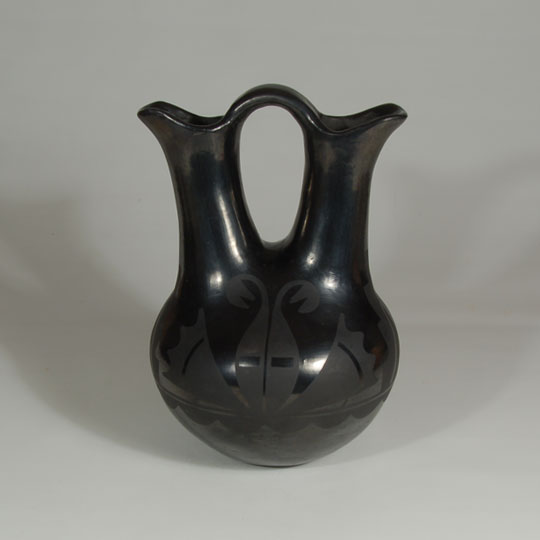 It is not an accepted practice in pueblo culture for individuals to seek fame or to stand out from others of the village. This attitude seems more relaxed today than it did a hundred years ago when fame began to be bestowed on Maria Martinez. Maria was very conscious of not seeking fame but it came her way anyway. She did not sign her earlier pottery partly for that reason.
Maria was encouraged by Museum of New Mexico staff to sign her pottery because demand for her work was growing. The earlier pieces were simply signed Marie and that seems to have begun around 1923. Julian painted the designs on this early pottery but his name was not added to the vessels, most likely because pottery was considered "woman's work." It was a couple years later before Maria added his name by encouragement of Kenneth Chapman.
San Ildefonso Stone Polished Plain Black Small Jar signed Marie - C3812D
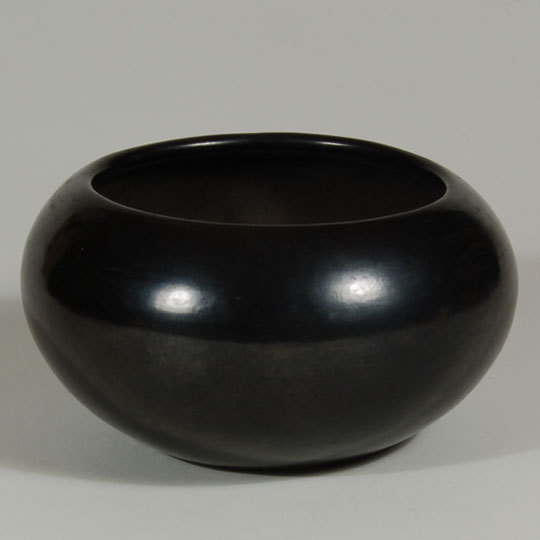 Early pottery made by Maria was generally decorated by her husband Julian and it would either be signed Marie or Marie & Julian, however, there are always exceptions to every absolute. Another absolute is that all plain black vessels void of decoration were signed Maria Poveka. This small black jar deviates from the norm in that is it signed Marie S.I.P., an indication that it was made in the early 1920s when Maria was signing her name as Marie.
Very Large Black-on-black Plate signed Marie & Santana - C3813
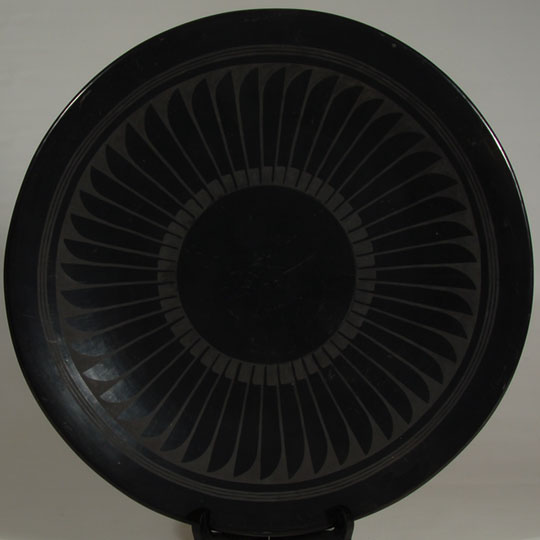 Maria's husband Julian Martinez was a janitor at the Museum of New Mexico for a dozen or so years early in the museum's history. It was there that Julian most likely saw the Mimbres bowl in the museum's collection that was decorated with eagle feathers. Julian may have been working as a janitor but his mind was working as an artist.
At some time in the 1930s, Julian adapted the Mimbres feather design to fit the plates and shallow bowls that Maria was making. The design became a favorite of his for years. After Julian passed away in 1943, Maria's daughter-in-law took over the task of painting Maria's pottery and Santana also used the Mimbres feather design as shown on this plate.
Collection of 26 Original Etchings by Woody Crumbo - C3806
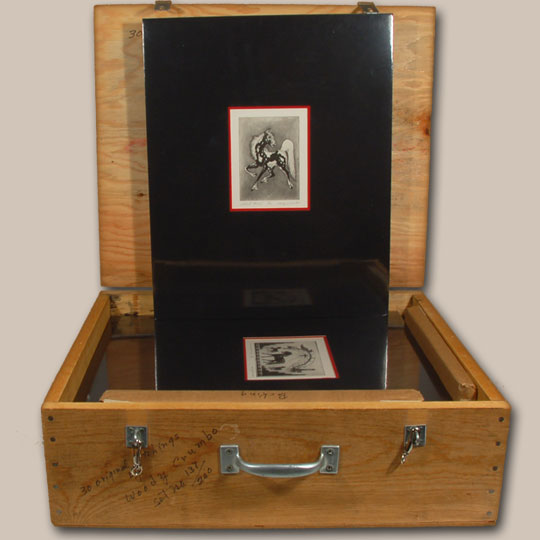 In the late 1970s, Woodrow Wilson Crumbo (1912-1989) Woody Crumbo would pack up his silkscreen prints and etchings and sell them from the back of his van. He was very friendly and would chat with anyone who stopped by his van. That visitor inevitably left the conversation with one or more prints in his hand.
Crumbo made wooden boxes to hold collections of prints and would sell from those boxes. He would label each box with a notation of the contents. This box is labeled "30 original etchings by Woody Crumbo." In this box were 30 individual etchings, each one numbered 137/200. It is quite likely that an individual purchased the entire collection of etchings and the box. Now there are 4 etchings missing from the box, however, the remaining 26 are available.
Model Students: Native painting from the Santa Fe Indian School
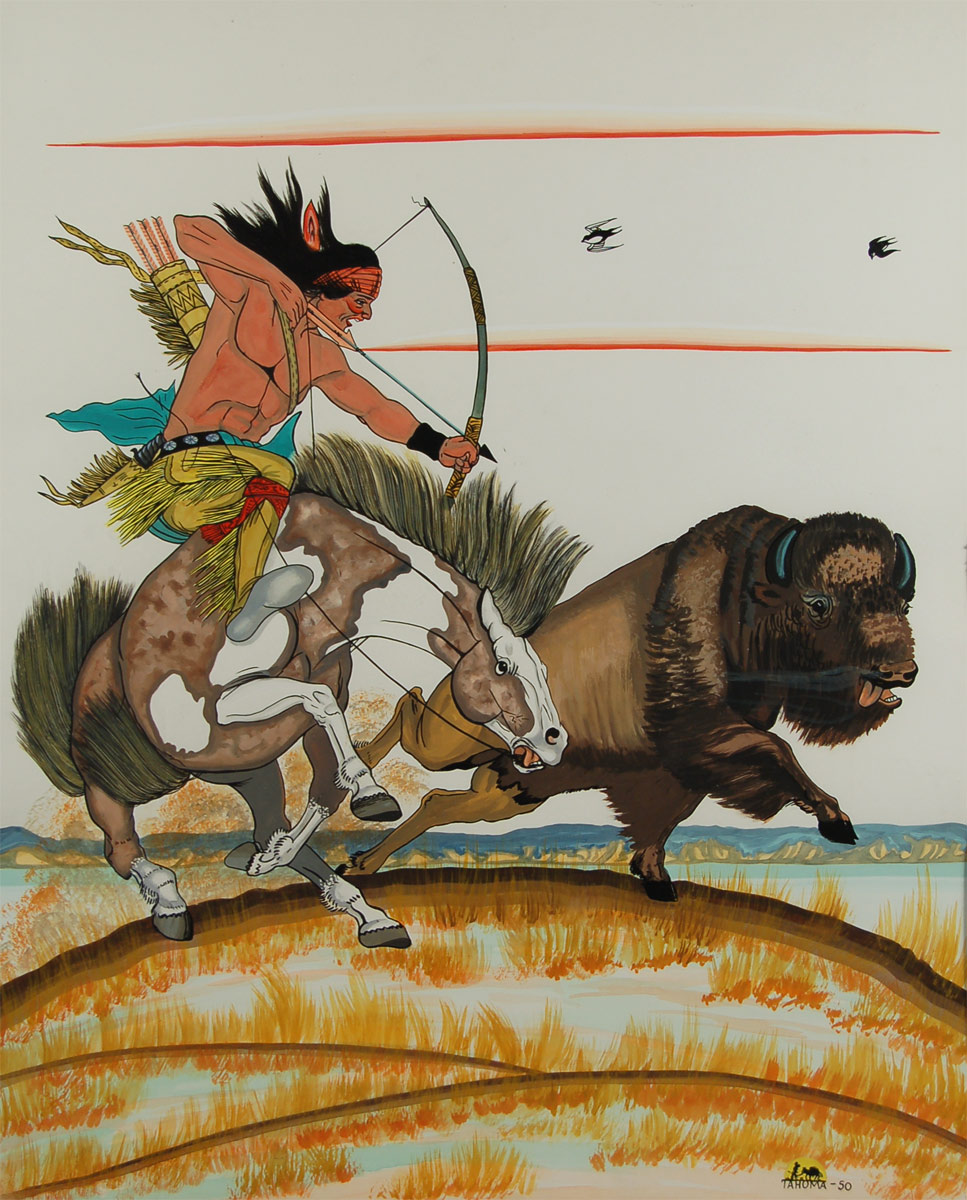 The Pueblo Indian artists who were the first to take brush to paper, establishing the easel-art tradition in Native America, are the focus of the current exhibition Paintings by Early Students of the Santa Fe Indian School at Adobe Gallery. "We've always given Dorothy Dunn credit for bringing in art at the Santa Fe Indian School in 1932," said the gallery's Alexander E. Anthony Jr., "but before that, as early as 1900, the teacher at the San Ildefonso Day School, Esther Hoyt, encouraged her kids to paint whatever they wanted to paint. That was against government policy. The government was very strongly trying to downplay the paganism of the Indians and to get rid of their religion and voodoo kind of dancing."
The one-room school run by Hoyt had 18 students from San Ildefonso Pueblo in 1902, and three years later, enrollment climbed to 31. The little artists included Awa Tsireh (Alfonso Roybal), who was four years old in 1903; Tonita Peña, who was ten; and Tse Ye Mu (Romando Vigil), who was four in 1905. Among Hoyt's other students who kept at what they learned and became famed painters as adults were Alfredo Montoya, Santana Roybal, and Abel Sanchez. "These young artists from San Ildefonso got a jump-start on all the other pueblos, and it became the beginning of the Native American easel-painting movement," Anthony told Pasatiempo in a recent interview at his gallery, which he said will be forty years old in 2017. Anthony opened his gallery on Albuquerque's Old Town plaza and moved it to Santa Fe in 2001.
"Teacher Elizabeth Richards, who replaced Esther Hoyt, not only allowed her students to paint as they wished, but encouraged them to do so, and provided art supplies to them," said Anthony. Later in the next decade, Elizabeth DeHuff, who was the wife of the Santa Fe Indian School superintendent, hosted students of grade-school age at her house, which was against government regulations, and gave them paints and paper - and her husband was reprimanded. Among DeHuff's regular visitors were Fred Kabotie and Otis Polelonema from Hopi and Velino Herrera from Zia Pueblo. "The students from San Ildefonso have been known as the ‘self-taught' artists who brought Indian easel painting to the attention of the nation's art patrons," Anthony said. "It was not until the 1920s that they were able to sell their artworks."
In his 1997 book, Pueblo Indian Painting: Tradition and Modernism in New Mexico, 1900-1930 (School of American Research Press), J.J. Brody writes that the problem hinged on how to classify these paintings. "Useful objects, or at least those that had an appearance of usefulness, were at the heart of the Indian curio market. It was important that an Indian object, even if called ‘art,' look utilitarian and ‘authentic' enough to convince both the casual tourist and the serious collector that it represented a genuine experience with a real person from an exotic society. Paintings and other objects that did not fit those expectations presented special marketing problems."
No paintings from the earliest days at San Ildefonso are known to exist, Anthony said, "but fortunately a number of these artists, such as Julian Martinez and Miguel Martinez, continued on at the Santa Fe Indian School, so we have work that was done later. But we are emphasizing that the young people from San Ildefonso were the people who started the whole thing rolling."
The first woman who became a well-known painter was Tonita Vigil Peña. "She bucked the system because painting was considered the men's art form, and pottery was the women's, and you didn't mix. But Tonita persevered, and she was finally accepted by the men as an equal." The second significant woman painter, Anthony said, was Pablita Velarde of Santa Clara Pueblo. "Her dad didn't think she should paint, but when she ran into Tonita at the Indian School, Tonita said, ‘Do what you want to do,' and she did."
Velarde honed her craft in Dorothy Dunn's art department at the Santa Fe Indian School. Dunn, who was born in Kansas and educated at the Art Institute of Chicago, first encountered Native American art at Chicago's Field Museum in 1925. Seven years later, she obtained permission to initiate an art program at the Santa Fe Indian School. In what was called the Studio School, Dunn "strove to create an atmosphere of genuine creative expression, encouraging her students to celebrate their unique cultural heritage and cultivate their natural talents," Anthony said.
Stylistically, the early casein and tempera paintings made under Hoyt, Richards, and DeHuff relied on uncomplicated portrayals of the people who participated in the tribe's ritual dances. "The San lldefonso paintings are almost always simple, linear compositions organized parallel to the picture plane," Brody writes. The young artists usually presented the dancers in profile and exhibiting limited interactions with one another. "The Indian school artists, on the other hand, used many different dance subjects in realistic, active, and interactive postures" and included panoramic and vanishing-point perspectives.
"The early ones have no ground plane, no trees, nothing but the dancers," Anthony said. "That was the ‘flat painting' style that was even encouraged by Dorothy Dunn: Just paint the dancers. Don't do the European style of putting them in the landscape." This curricular choice, zeroing in on the documentation and celebration of Pueblo mythology and ceremony, was a commendable departure from what were too often racist Indian-school policies, but it has been criticized by some Native American artists as lacking in originality. In any case, the success and resulting influence of Dunn's students suggest that her training was eminently effective; her other alumni included the Navajo painter Quincy Tahoma and two more groundbreaking artists, Pop Chalee (Taos Pueblo/Swiss) and Eva Mirabal (Taos).
Dunn was only at the Santa Fe Indian School for five years. Her successor, Gerónima Montoya, told The New Mexican in 2010 that Dunn was "a wonderful person, and a wonderful teacher. She was very understanding about Indian people." Montoya was a native of Ohkay Owingeh who graduated from Santa Fe Indian School in 1935 as valedictorian. She was first hired as Dunn's assistant and then directed the school's art program from 1937 to 1961. Indian arts education in Santa Fe saw a substantial shift in 1962, when the Santa Fe Indian School campus (temporarily) closed and the Institute of American Indian Arts was founded on the site. "That's when the whole idea changed," Anthony said, "with Allan Houser, Fritz Scholder, Otellie Loloma, and others saying, ‘Don't do what you've always seen. Be yourself.' "
The exhibition at Adobe Gallery has a relatively narrow focus, but there is great variety in the paintings shown, even by single artists. There are two paired images - the sweet Navajo Boy and Girl with Fawns and the colorful, dazzling Pair of Paintings of Navajo Feather Dancers by the renowned Navajo painter Harrison Begay, another student who pursued an artistic career after his departure from Dunn's Studio School.
Some of the pioneering artists had, during their lifetimes, long gaps between the years when they painted. "Tse Ye Mu ended up leaving San Ildefonso and became an illustrator for Walt Disney for a couple of decades, then came back to the pueblo late in life," Anthony said. "Another of the early ones from San Ildefonso was [José] Encarnacion Peña. He was a farmer and cattle man who painted when he was young and came back to it after he retired from that work. He and his wife used to bring his paintings in the first year I had the gallery, which I started in 1977. He died in 1978."
Some of the early artists contrast the realism of the human dancer figures with stylized (geometrical, symmetrical) clouds, rainbows, and other forms. Two examples, both by J.D. Roybal, are Corn Dance Procession at San Ildefonso and a painting of twin avanyu (water serpent) figures entwined on a rainbow arch over three deer. Abstracted geometrical backgrounds appear in Pablita Velarde's whimsical Mineral Earth Painting of a Koosa Clown and her detailed, almost portrait-like Pueblo Eagle Dancer and Tewa Pueblo Ram Dancer.
A standout feature in the earliest paintings is the faithful depiction of ceremonial regalia. These artists did not have the idea, or the audacity, to introduce fanciful variations. "No, they didn't," Anthony said. "Works by Tonita Peña and others are considered to be great ethnographic documents of the early days."
Would you like to know more about this exhibition?
Source: www.santafenewmexican.com/pasatiempo
Written by: Paul Weideman (Pasatiempo)
Cochiti Pueblo Four-piece Nacimiento by Mary Martin - C3688.62
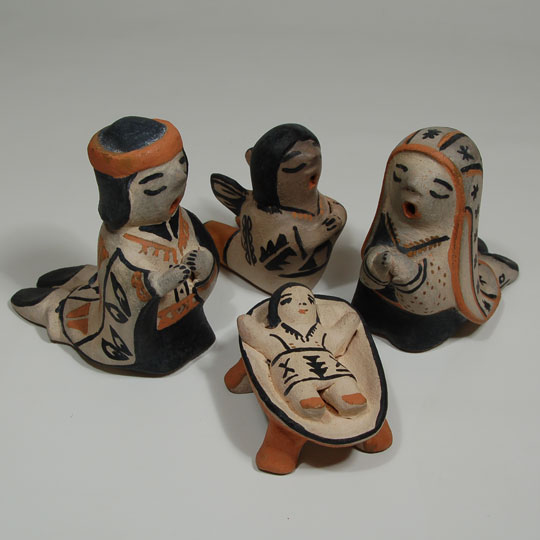 When the book Nacimientos was first published in 1979, there were only 15 pueblo potters included, of which there were only five from Cochiti Pueblo. Mary Martin was not in the group of five listed which indicates that she was not making nacimientos in 1979. According to research by Guy and Doris Monthan, when planning to write a book on Native nacimientos, "the first Indian-made Nativities appeared in the late 1950s. Into the early 1960s, the craft was engaged in by only three or four artisans on an occasional basis. It accelerated in the late 1960s and swelled to the proportions of a movement in the late 1970s."
Cochiti Miniature Black Bear with a Cub on her Back by Louis Naranjo - C3688.69
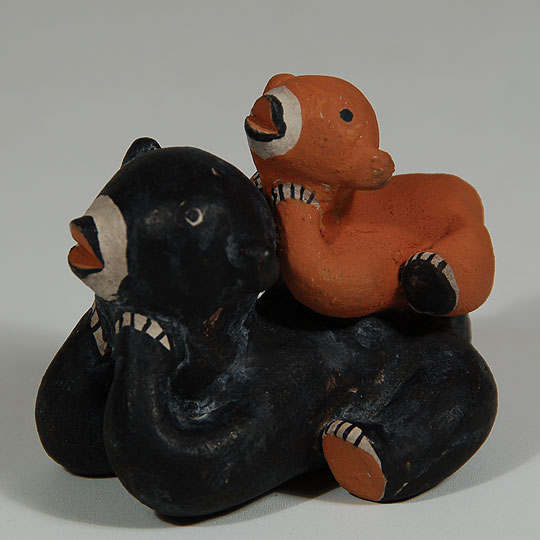 Cochiti Pueblo potter Louis Naranjo was the creator of the bear storyteller figurine. He said he was hunting one day and saw a mother bear watching her two cubs playing nearby. That gave him the idea for the figurines.
This black bear female is spread out on the ground with her front legs up under her chin. Her cub, resting on her back, has its legs up under its chin too.
Cochiti Pueblo Seated Black Bear Figurine by Guadalupe Ortiz - C3688.74
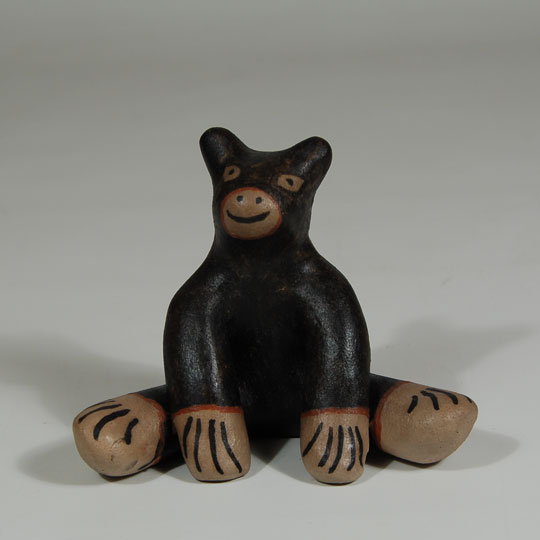 Guadalupe Ortiz was the husband of Seferina and the father of Virgil and his siblings. He passed away in 2015. He had been an active potter since only 1998 so there is not a large quantity of his pottery available. His interest was in making frogs and other pottery figurines and occasionally bowls and jars. He also was a maker of drums, rattles and wood carvings. He was an award winner at the 1998 Santa Fe Indian Market and at the New Mexico State Fair the same year.
Cochiti Pueblo Mother Turtle Figurine with 3 Kids by Buffy Cordero Suina - C3688.64
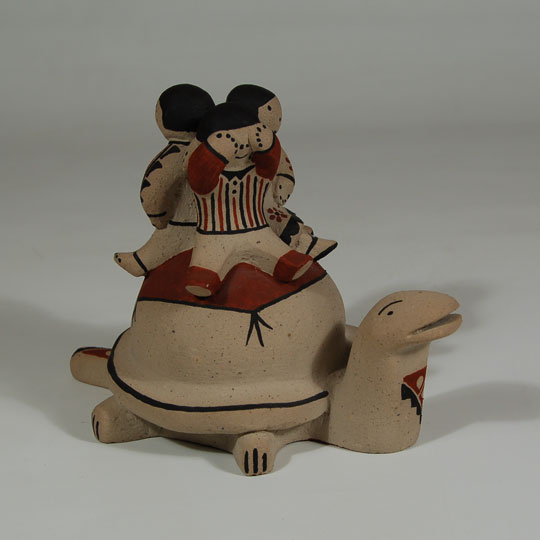 This charming Mother Turtle figurine was created by Cochiti potter Buffy Cordero, granddaughter of the famed Helen Cordero. Helen Cordero was the creator of the Mother Turtle figurine which this represents. She said that there was a legend at Cochiti Pueblo that refers to a turtle rescuing the children in time of peril or flood and transporting them to safety.
Cochiti Pueblo Mother Turtle with 3 Kids on her Back by Rita Lewis - C3688.73
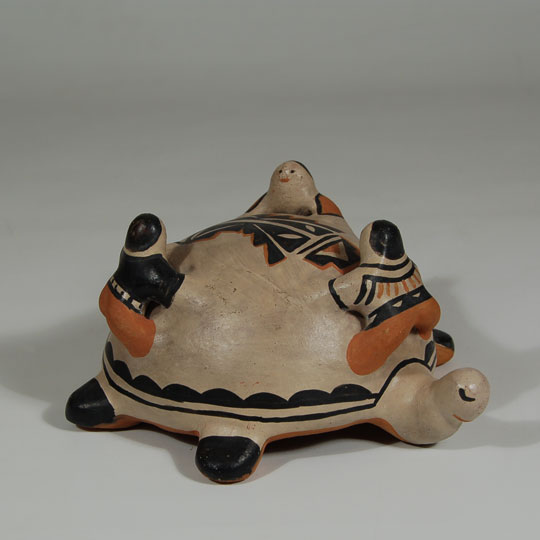 Rita Lewis, the daughter of famous potter Ascencion Banada, married Ivan Lewis, son of famous potter Lucy Lewis. Together they started making pottery bowls and animal figurines around 1971, and storyteller figurines around 1973.
Cochiti Female Figurine with 2 Children in Her Arms by Felipa Trujillo - C3688.68
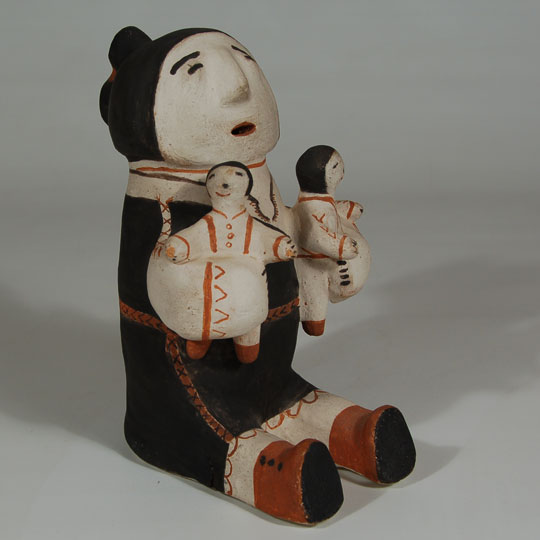 It is well known that Helen Cordero made what has now been named the Storyteller figurine in 1964. Her definition of a storyteller was that it was in honor of her grandfather, a well-known storyteller at Cochiti Pueblo, so it was always a male figurine in Helen's eyes.
Before Helen Cordero's first storyteller, female figurines were made by potters at Cochiti and they have been named Singing Mothers. In the book The Pueblo Storyteller by Barbara Babcock, there is a Singing Mother figurine which Babcock says pre-dates 1930. She further states that "The shape of her head and ears and her 'coffee bean' eyes are remarkably similar to figures made by Felipa Trujillo in the 1960s and 1970s." If this is indeed one made by Felipa Trujillo before 1930, she must be one of the earliest Cochiti potters to do so.
Cochiti Pueblo Seated Male Storyteller with 2 Children by Carol Pecos - C3688.71
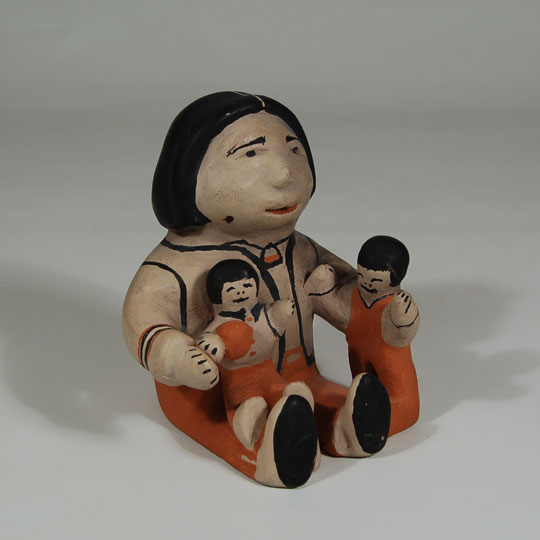 This seated male storyteller holds two young boys on his lap. The Cochti Pueblo potter is Carol M. Pecos but I have not yet determined who she is and what family she is from. She obviously is an accomplished potter as this figurine was beautifully constructed and painted. The adult's hair is sculpted around his face and his eyes are inset. It is quite a stunning figurine.
Cochiti Female Storyteller with 6 Children and 1 Dog by Mapuwana - C3688.72
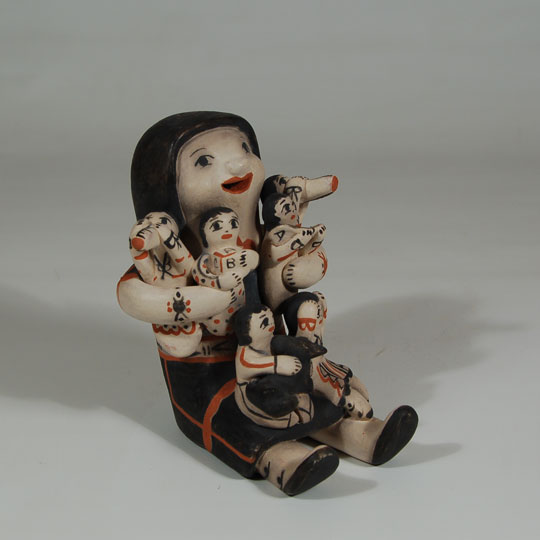 Cochiti Pueblo potter Juanita Inez Ortiz learned pottery making from her mother, Seferina, and her grandmother, Laurencita Herrera. It is traditional for pueblo potters to teach their children the art of pottery making starting at an early age. Inez's siblings, all of whom are potters, are Virgil, Joyce, and Janice. Inez was the mother of Lisa Holt. Unlike her brother, Virgil, Inez remained with traditional designs and shapes, much like her mother.
Hopi Pueblo Traditional Salakomana Katsina Doll - 24823
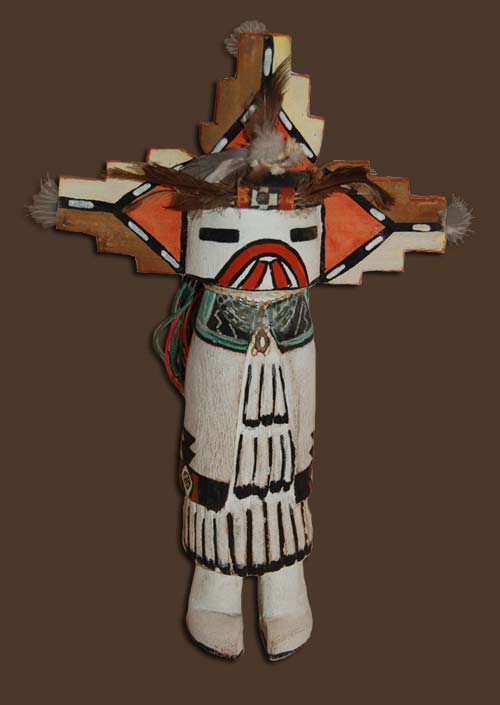 The Salakomana is the female version and the Salakotaka is the male version of the Hopi Pueblo pair of katsinas. The Salakomana is distinguishable by her white face and white moccasins. The two always appear as a pair. The basic intent of the Salako Ceremony is, of course, to bring the clouds from which will come the rain.
This carving is from cottonwood root and is a single-piece carving except for the addition of the three-piece tablita and the piece of wood on the forehead from which feathers protrude. Multi-colored embroidery thread falls from a bundle of feathers on the back of the mask. The feathers on the front and around the hem are carved into the wood and highlighted with black paint. The painted design on the neck and hem of the manta reproduce the embroidered design on a woman's manta.
Hopi Pueblo Traditional Salakomana Katsina Doll - 25040
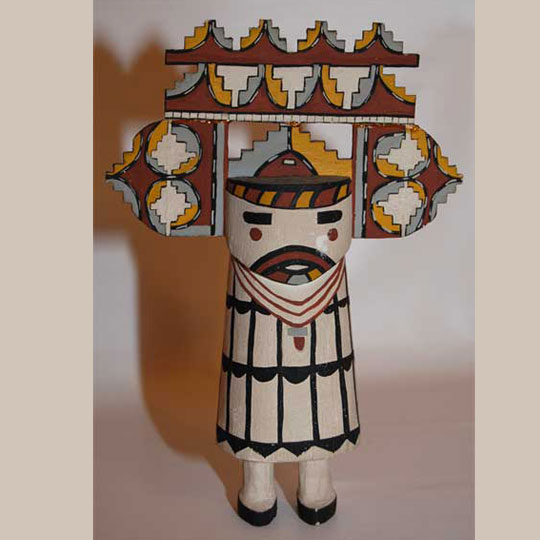 The Hopi Salako Ceremony is held infrequently and is therefore one of the least known of the Hopi Pueblo ceremonies. According to Barton Wright, the last known one on Third Mesa was held in 1912, and the last one on Second Mesa was held in 1972. I attended the ceremony at the village of Shungopavi on Second Mesa around 1985, but I do not recall the exact year. It was held following another ceremony and I was about ready to leave the plaza when this ceremony started. It was a most impressive ceremony.
Cochiti Pueblo Female Buffalo Dancer Painting by Joe Hilario Herrera - C3808D
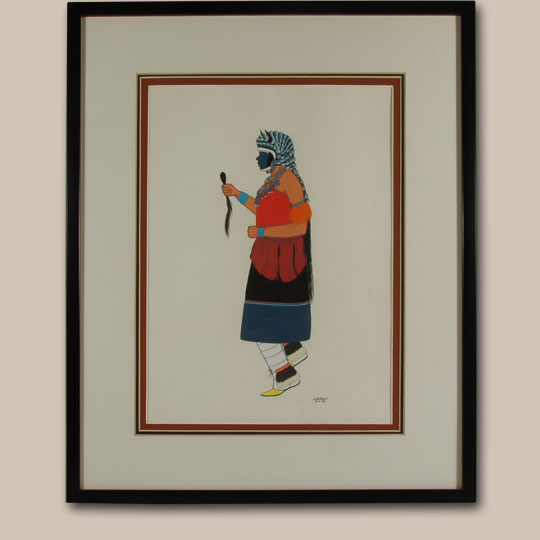 Joe Hilario Herrera was born at Cochiti Pueblo, the son of Tonita Peña, who was originally from San Ildefonso, but moved to Cochiti after the death of her mother. She was raised by an aunt and uncle. Although she lived at Cochiti all of her adult life, she is still known as a San Ildefonso artist. Her son, Joe, however is recognized as a Cochiti Pueblo artist. Joe grew up watching his famous mother paint on an almost daily basis. His early art education was home schooled.
Herrera attended the Santa Fe Indian School and continued on to achieve a Bachelor of Arts and a Masters of Arts in Education, both from the University of New Mexico. He continued his education in Puerto Rico, studying briefly under Raymond Jonson.
Kneeling Mudhead with Drum Katsina Doll from Zuni Pueblo - 25879
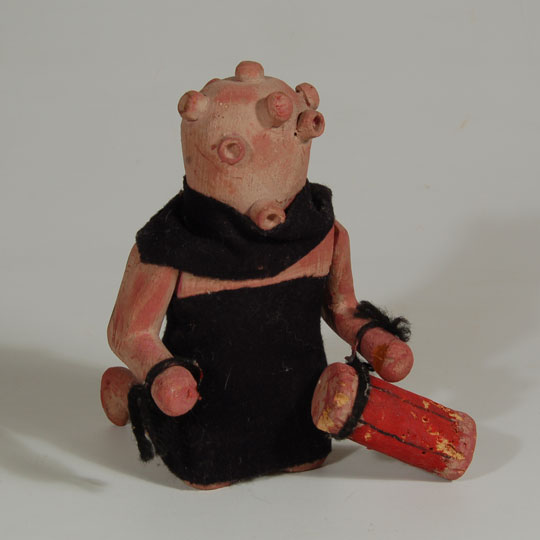 Although the Koyemshi (Mudheads) are childlike, or witless in their behavior, they are regarded as the "sages of the ancients, oracles who speak with the voices of idiots mixing wisdom and nonsense in every utterance. They are considered the fathers of the Zuni people and no other group is more sacrosanct or dangerous than the Koyemshi. To deny them anything, even in one's heart or mind, is to court disaster." They are major participants in the Zuni Shalako ceremony and are the first to appear for the event, arriving eight days before the ceremony. Wright, 1985