



Original Painting of a Hunter signed Julian Martinez - C3512.26
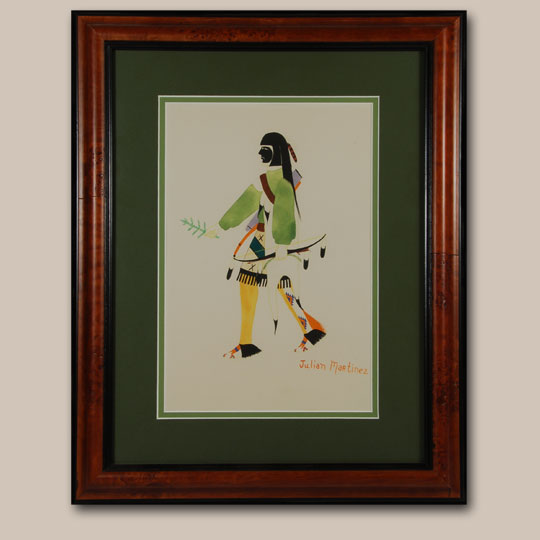 Julián Martinez is most often associated with his wife, Maria Martinez, as the painter of her ceramics from the early 1900s until his death in 1943. He did, however, execute paintings on paper as well. He was one of the very early San Ildefonso self-taught easel artists. His watercolor paintings were definitely a minor activity as compared to his brilliant achievements as the decorator of Maria's pottery. He was painting watercolors before 1920 and continued as time permitted until his death.
Original Painting of a San Ildefonso Pueblo Eagle Dancer by Julián Martinez - C3674D
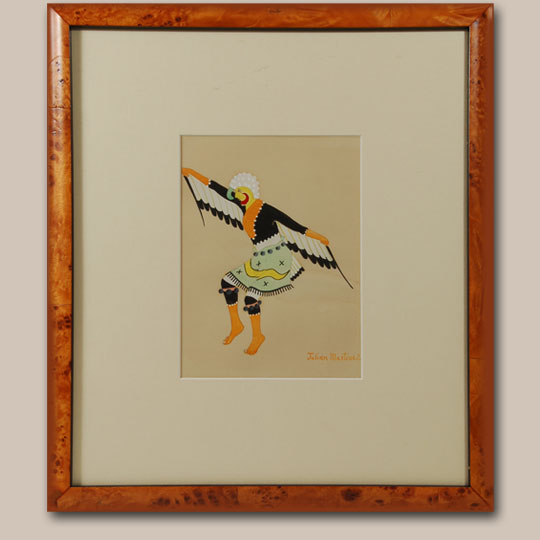 This is an excellent presentation by Julian Martinez of an Eagle Dancer as seen at San Ildefonso Pueblo. He has cotton on his head to represent eagle down and the green hook represents the beak of the eagle. Feathers attached to each arm represent the eagle's wings. Feathers trail behind the dancer representing eagle tail feathers. The dancer's body is covered in black pigment representing the color of the eagle. The painting is signed in lower right.
Original Painting of Pueblo Dance Scene by Tonita Vigil Peña - 25366
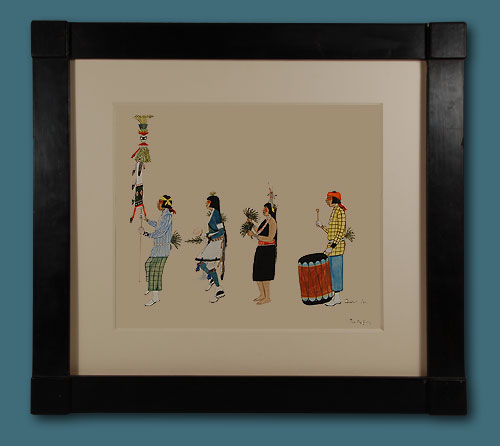 This original painting by Tonita Peña (Quah Ah) of San Ildefonso Pueblo was probably painted in the 1920s as determined by the style of the signature. Over her career, Tonita used a variety of signatures on her paintings. (A complete description of the signatures and corresponding dates used may be seen in the biographical information provided by clicking on her name just below the above picture.)
The image depicts a pueblo ceremonial dance in the traditional style with no ground plane and no background. In her paintings of dancers such as this she was able to make her dancers appear in motion rather than fixed in time. Take note of the raised feet of the two male figures and the slightly raised right foot of the female dancer.
Original Paintings of Deer under an Avanyu Rainbow by J.D. Roybal - C3514.07
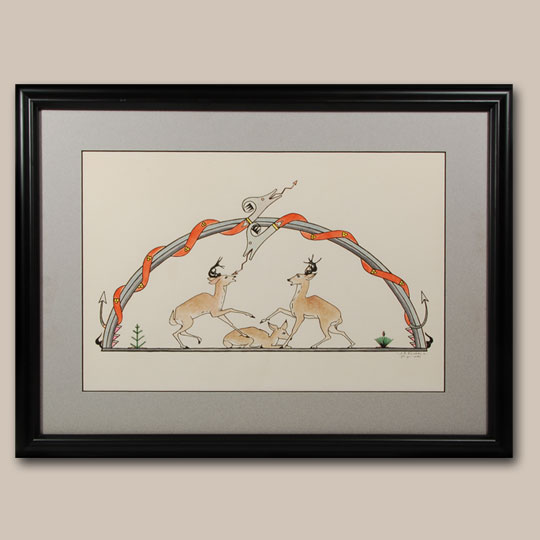 This painting by Roybal featuring deer under an Avanyu Rainbow probably has some meaning related to a pueblo legend, but I am unfamiliar with its meaning. The pair of Avanyu do not appear to be adversaries but appear to be ceremonially blessing the buck and the situation. Avanyu are often seen on water jars but seldom in paintings. Legend has it that the Avanyu bring water down the arroyo to the fields, but apparently there are other legends perhaps more ceremonial in nature.
J. D. Roybal grew up under the artistic influence of his well-known uncle Awa Tsireh at San Ildefonso Pueblo. Early in his education, he studied at St. Catherine's School in Santa Fe and at the Business College of Santa Fe. In the early 1950s he and Julia were married and it was then that he started producing pueblo dance designs on hand-painted Christmas cards. By 1955 he was seriously painting larger works and recognition for his talents came from the Heard Museum in Phoenix and the Philbrook in Oklahoma. He received a consistent string of first prizes in painting for each year since the Eight Northern Pueblos Arts and Crafts Shows began.
Original Santa Clara Painting of a Pueblo Eagle Dancer by Pablita Velarde - C3058
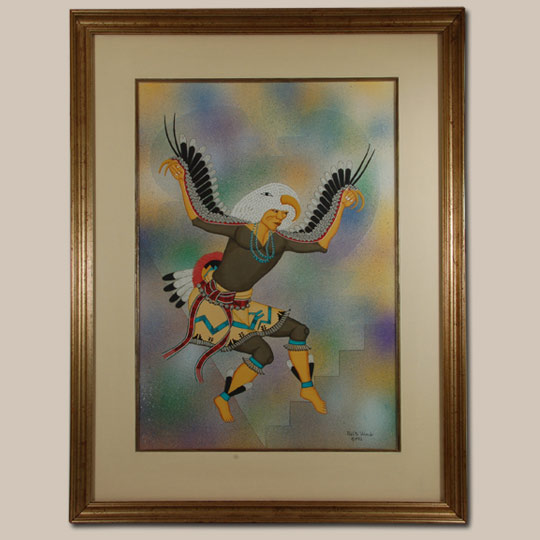 Pablita Velarde (1918-2006) Tse Tsan - Golden Dawn was perhaps one of the most compelling of the early pueblo artists. She produced unique and superlative works of the highest quality. This image, depicting a single eagle dancer, is superbly rendered on a colorful background of sprayed paint in gradating values, the pattern being a stepped motif at the lower portion and a circular pattern outlining the wing motions of the eagle, a powerful foil to the monumental figuration.
The main figure is superbly and precisely rendered in Pablita Velarde's inimitable style; each object, be it feather, head piece, sash, or kilt treated with the most beautiful detail and attention to the finest of subtleties.
Pair of Original San Ildefonso Paintings of Pueblo Dancers by J.D. Roybal - C3437B
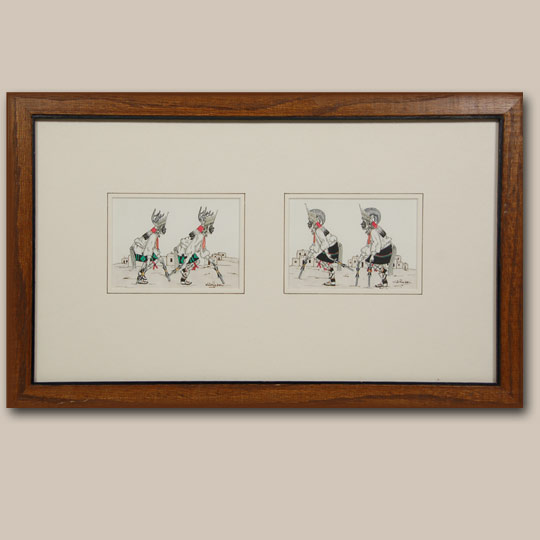 J. D. Roybal spent a large portion of his career painting small paintings such as this pair, generally the size of note cards or postcards, featuring two or three costumed dancers. These were his bread-and-butter paintings as they were inexpensive and easy to sell. Occasionally, he painted larger-scale paintings, again with two or three costumed dancers, but only rarely did he paint major dance ceremonies with background materials behind the dancers.
Two Santa Clara Pueblo Koosa Clowns by Pablita Velarde - C3469E
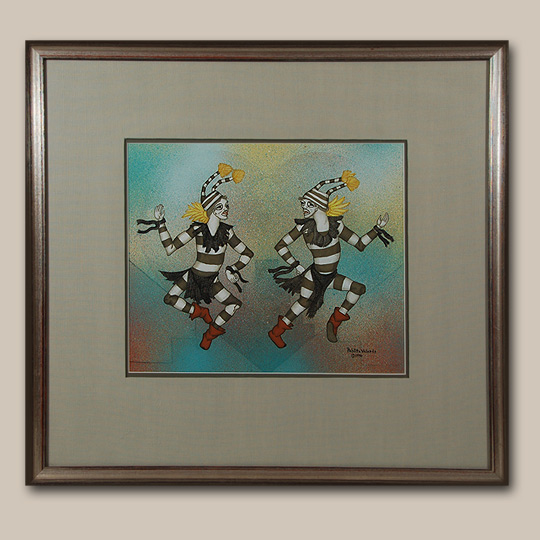 Pablita Velarde (1918-2006) Tse Tsan - Golden Dawn was from Santa Clara Pueblo and was able to accurately portray cultural life events. As in this example, during a ceremonial plaza dance, the Koosa are not clowns and are not intended to amuse. They represent the spirits of the ancestors or Ancients of the people, those who have direct influence with the gods. During such dances, the Koosa dance with the performers but are not to be seen as they are supposedly invisible. During a dance ceremony there is nothing but the utmost seriousness by the Koosa. There is no clowning at any time. Clowning, such as chasing the children and making advances to the women, is indulged outside the dance.
Late 19th-century Cochiti Pueblo Serving Bowl - C3753.15
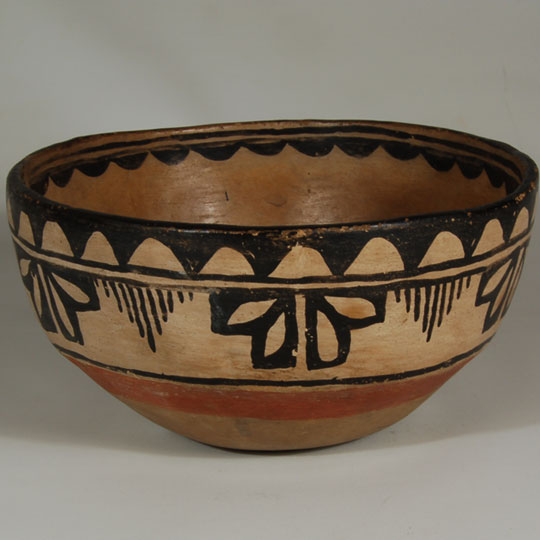 Pueblo potters devised a method by which to start the construction of a new vessel that made use of a previous vessel. The bottom of a broken olla or an old bowl was used to form the beginning of a new jar by placing the clay in the older vessel and molding it to conform to the shape of the older one. The old broken vessel or any other form for starting a new vessel is called a puki.
The weight of new rolls of clay gradually caused the jar to expand out over the edge, forming a ridge or bulge as it rose above the top of the old vessel. This bulge was generally overlooked in historic pottery until around the turn of the 19th to the 20thcentury. It was then that potters sanded the outer wall of the vessel to eliminate the "puki line" or bulge. It is the existence of such a puki line that helps provide a time period when an item was made.
Historic Zuni Pueblo Small Bowl with Red Bottom - C3776A
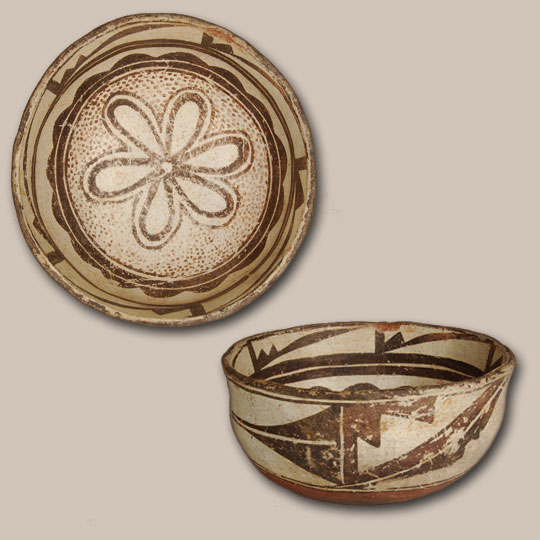 It is recognized that changes in pueblo pottery occur about every decade with the maturity of a new generation of potters. These changes may not be significant or important and may not be explainable as to why they occurred. We have to accept that there was a reason or were reasons and appreciate that researchers have used these changes to assist in dating pottery.
One change that occurred at Zuni Pueblo was the abandonment of a red underbody on bowls and jars in favor of using a black pigment. It seems that this change began to be noticed around 1850. Over the next 45 years, red pigment was seen less and less on bases, and black appeared more frequently. By 1885, black pigment predominated and by 1895 the use of red disappeared.
Navajo Ceremonial Antelope Hunt by Ha So De (Narciso Abeyta) - C3807
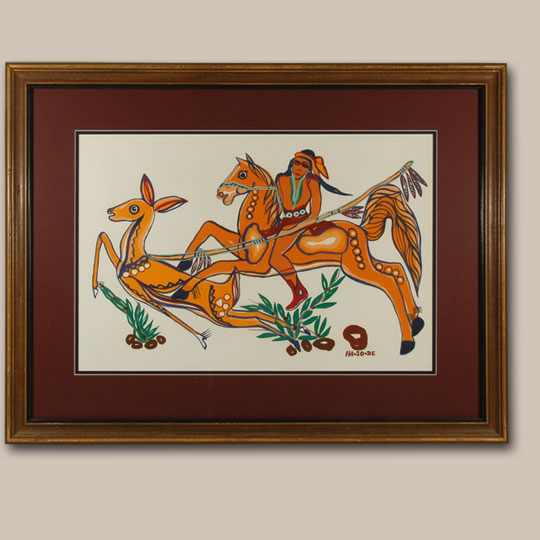 Narciso Abeyta was known for his Indian-themed paintings, which, stylistically, are atypical of most of the Indian art of his generation. Abeyta attended the Santa Fe Indian School and the University of New Mexico. He also participated in exhibitions throughout the United States and in Paris, France. He won awards at the San Francisco Fair and at the New Mexico State Fair. He was living in Gallup, New Mexico, at the time of his tragic death.
Abeyta regularly utilized a "somber" color palette, as Clara Lee Tanner refers to it in her book Southwest Indian Painting: A Changing Art (see reference link below). She states that he tended towards blacks, browns, burnt ochre and reds. Tanner also notes that Abeyta was more interested in "bold effects than in minute detail."
Hopi Pueblo Black-on-cream Bowl with Polished Interior - C3776i
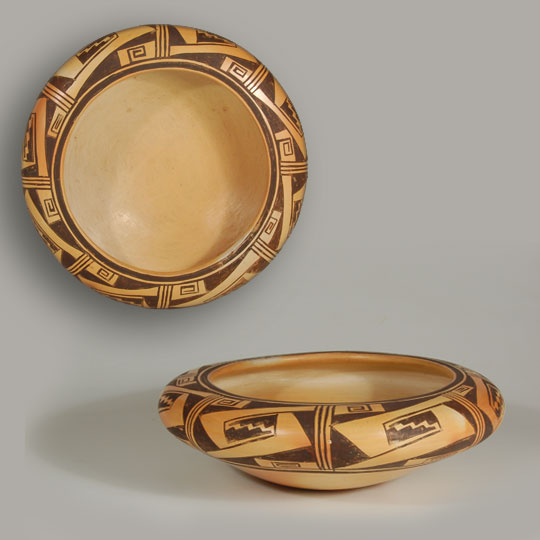 It would be difficult to operate a house without the use of bowls. Pueblo households have a tradition of making bowls of various shapes and sizes for the intended use. The smallest bowls were and are used from which to eat, medium size bowls were and are used to bring large servings to the dining table. The largest bowls, referred to as dough bowls, serve for making bread dough. Some bowls found a second use in pueblo households as lids for jars. Rather than make a lid that served only that function, a bowl could be used for many functions including being turned upside down over a jar as a lid when not in use for something else.
Paintings by Early Students of the Santa Fe Indian School - Special Exhibit
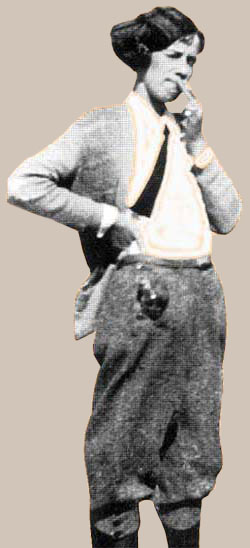 The Santa Fe Indian School's art department was created in 1932 by Kansas-born, Chicago-educated artist Dorothy Dunn. Dunn first discovered Native American art at Chicago's Field Museum in 1925, and eventually moved to New Mexico to teach grade school. In 1931, while back in Chicago completing her degree, she outlined and submitted a proposal to begin teaching art at the Santa Fe Indian School. Her proposal was accepted, and on September 9, 1932, The Studio opened its doors. Native artists Alfonso Roybal and Julian Martinez created murals to welcome and inspire The Studio's young artists.
Cochiti Pueblo Male Storyteller Holding a Child and an Infant by R. Dushkin - C3688.55
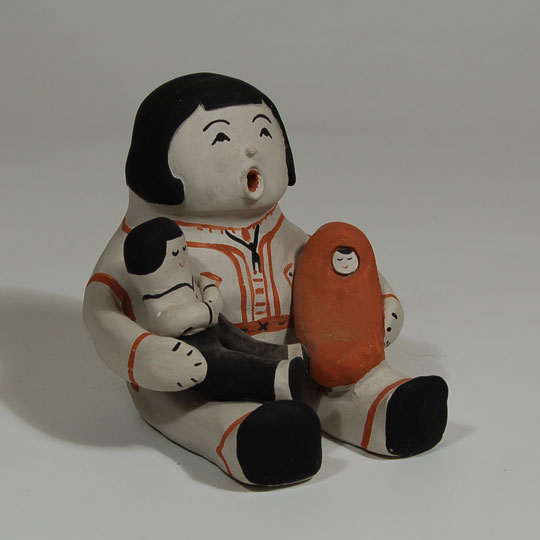 The maker of this charming male storyteller must remain a mystery as I cannot find any published information on the artisan although we do know the name but no other information. The maker obviously is a talented and experienced potter as the figurine was beautifully made and designed. He is holding one boy and a blanket-wrapped infant. His shirt is decorated and around his neck is a bola.
Cochiti Pueblo Female Storyteller with 14 Children by Rufina Trujillo - C3688.59
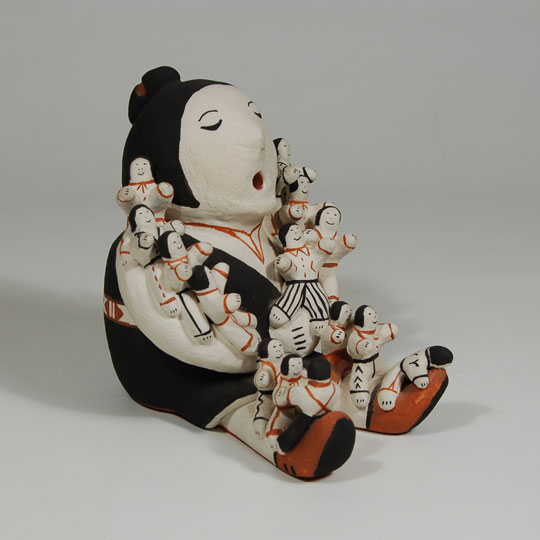 I have been unable to find any published information on Rufina Trujillo. In a personal conversation with Mary Trujillo of Cochiti Pueblo on 20 April 2010, I learned that she was originally from Acoma Pueblo and married a Cochiti Pueblo man and moved to Cochiti. She passed away in 2007 from complications of asthma. Mary said she does not think she made much pottery in her time at Cochiti.
Glazed Columnar Wine Goblet, circa 1973 by Rick Dillingham - C3705A
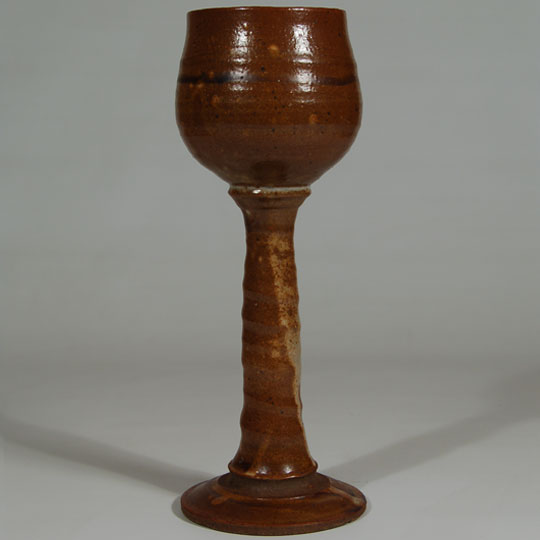 In an almost playful manner, Rick Dillingham created a single wine goblet of elegant yet casual appearance. The very standard round base gives way to a twisted tower that decreases in girth and spreads out to form the bowl.
The goblet is signed but I do not see a date when it was made. One goblet we had in the past was dated 1973 so perhaps that is when he was making them. Since these were probably made in 1973, they might have been a college project.
Cochiti Figurine of a Seated and Chanting Drummer by Buffy Cordero Suina - C3688.54
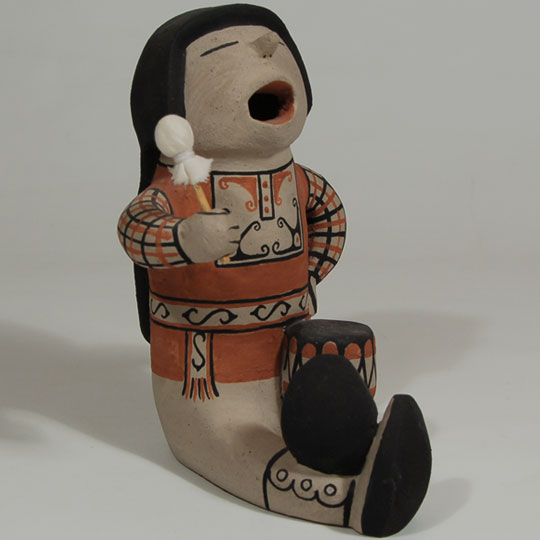 Helen Cordero's husband, Fred Cordero, was a drum maker. Cochiti and Taos Pueblos are famous for the drums made by men of the villages. It is known that Helen created the storyteller in honor of her grandfather. What is less known is that she created the drummer figurine in honor of her husband.
Cochiti Pueblo Standing Female Storyteller with 2 Kids by Maria Laweka - C3688.60
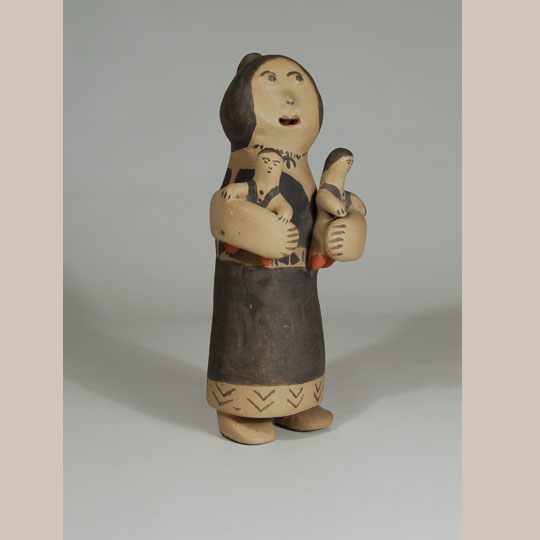 Maria Laweka was a daughter of Damacia Cordero, the famous figurine potter from Cochiti Pueblo, and sister to Martha Arquero and Josephine Arquero, both of whom were potters of note. It is not known if she is still making pottery figurines. Not many potters make standing figurines, perhaps because it is difficult to get them to balance and stand securely.
Hopi Pueblo Kuwan’Heheya Katsinas and Side Dancer by Emerson Quannie - 25875
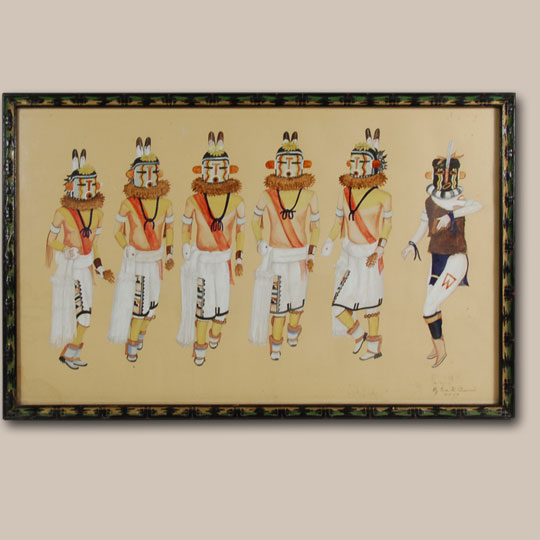 It is always tragic when a talented artist passes away at a young age, after demonstrating his or her talent to a limited audience. The questions always remain whether the artist would have continued in an art career and, if so, whether he or she would have continued producing such outstanding paintings.
Emerson T. Quannie was born in the Hopi village of Kykotsmovi, on Third Mesa, in 1916. He attended the Albuquerque Indian School in 1932 and, while there, painted a mural at the Albuquerque Kimo Theater. According to his wife, Quannie did very little painting after leaving the Indian School. She knew of only one painting by him after their marriage in 1939. Seymour 1988.
Kewa (Santo Domingo) Pueblo Pictorial Storage Jar by Vidal Aguilar - C3513K
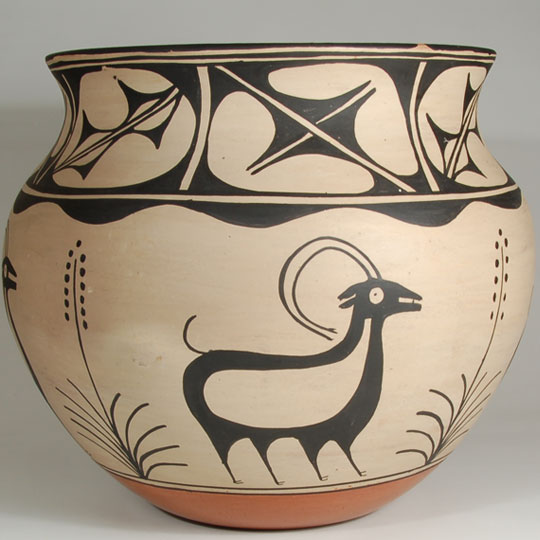 This large storage jar was purchased by the current owner directly from the potter about 15 years ago. It is decorated with pictorial elements of Mimbres rams and yucca plants. Pictorial elements on Kewa pottery, other than birds, are quite rare as almost all Kewa pottery is decorated with geometric designs in bold scale. For a potter at Kewa to use Mimbres animals on a jar is most unusual.
Original Hopi Pueblo Painting of Sotungtaka Katsina by T. T. Dashe - C3098B
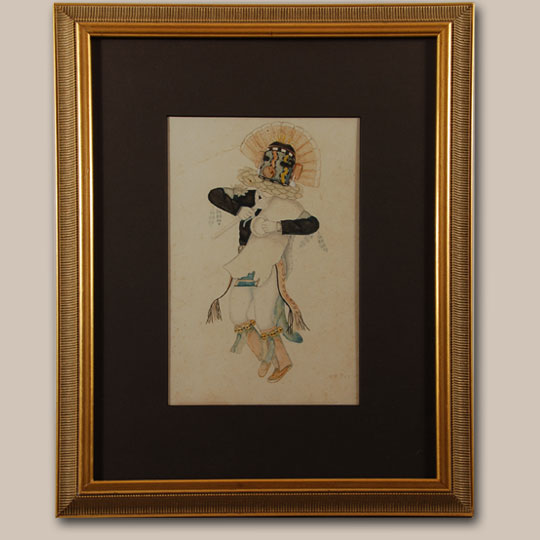 The katsina pictured here is one of the Corn katsinas. There is a typed label on verso that reads KAö KATCHINTA"A A M'. There is a Hopi Katsina named Qa'ö which also is a Corn Katsina, however, the image in this painting more closely resembles the Sotungtaka (Corn) Katsina than that of the Qa'ö (Corn) Katsina. Regardless, I think it is established that the image is that of a Corn Katsina.
Sacred Corn is very important to the Hopi, as it means life. It is not unusual for there to be a number of Corn Katsinas in the Hopi pantheon.