



Historic Tesuque Pueblo Black on Red Jar with Avanyu - C3924L
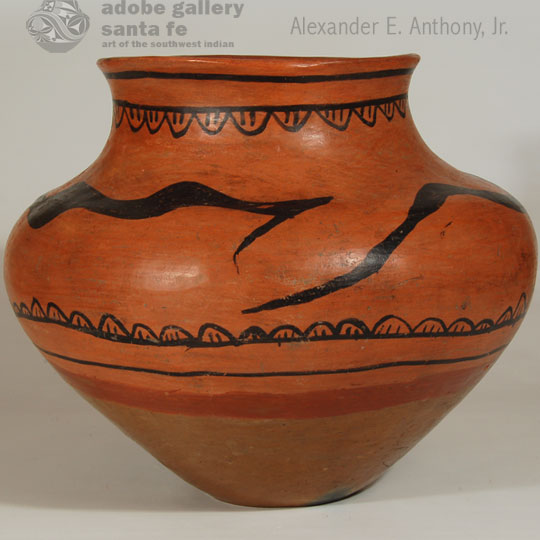 It is often difficult to distinguish historic pottery made at San Ildefonso from that made at Tesuque Pueblo. Both pueblos traditionally produced Black-on-red pottery like this jar and it has always been similar. Sometimes, the distinguishing factor is the natural tan underbody of the jar. Neither pueblo applied a slip to the underbody, but only stone polished it. The underbody is sometimes bumpy on Tesuque wares and smoother on San Ildefonso wares, however, that may not always be a determining factor.
Tesuque Black-on-red pottery is fashioned in the same manner as Polychrome pottery. Clay, temper, paste, and construction do not differ. The difference arises when a red slip is wiped on the vessel in lieu of a cream slip.
Would you like to purchase or read more about this historic pottery?
Rare Historic Aguilar Kewa Pueblo Black on Red Jar - C3945B
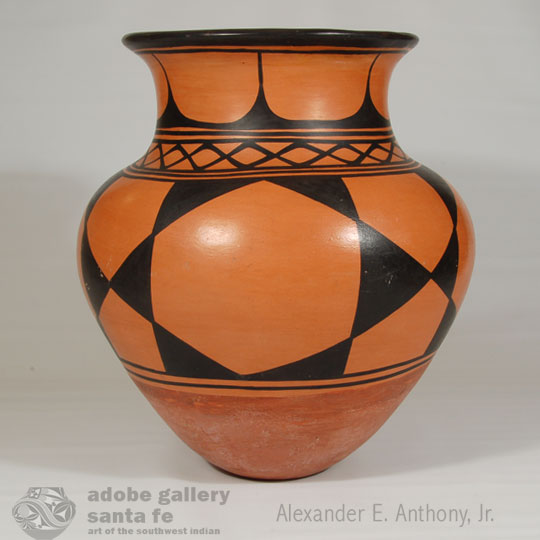 The Aguilar sisters-Asunción Aguilar Caté and Felipita Aguilar Garcia-and their sister-in-law, Mrs. Ramon Garcia, were exceptional potters in the late 19th and early 20th century periods at Santo Domingo Pueblo (now Kewa Pueblo). They followed tradition in their early works in that designs on their pottery were typical strong black geometrics on creamy white slip. According to some records, sales of pottery of all potters drastically slowed around 1910 and Mr. Seligman, trader at the post at Santo Domingo, suggested to potters that they try developing something different to see if that would spur sales.
Historic San Ildefonso Pueblo Polychrome Pictorial Jar - C3945C
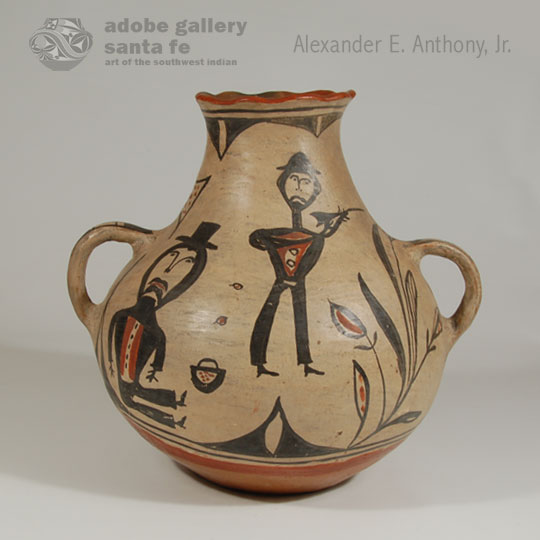 An analysis of the pictorial elements is subjective but it appears that the standing male is holding a rifle over his left shoulder in anticipation of shooting the deer on the opposite side of the jar. The beard and mustache, black hat, and black clothing would indicate the potter was picturing a local Spaniard. The seated male is similarly pictured, probably intended to represent another Spaniard. What the seated male represents remains a mystery, as does the small container next to him. Is it a doctor's medicine bag?
To truly understand what the potter had in mind, we would have to be present around circa 1890 and understand what was happening at San Ildefonso Pueblo. Was there animosity between the Puebloans and the Spaniards or was the potter having a moment of levity and lightheartedness? I choose to think she was enjoying her play on her Spanish neighbors and that the jar was made in good humor. It is an amazing work of art and perhaps a moment in history.
Would you like to purchase or read more about this pottery?
Historic Fine and Exuberant Zia Pueblo Jar with Zuni Designs - C3924N
 Zia potters have been consistent in producing beautiful and strong pottery vessels, both for use in their homes and for sale to tourists. Potters, today, still prefer to use ollas for water as the porous jars allow for seepage through the walls which cools the water. The clay sweetens the taste of water.
Traditional shapes and decorative style have changed very little at Zia since the 1700s. Tradition is hard to break.
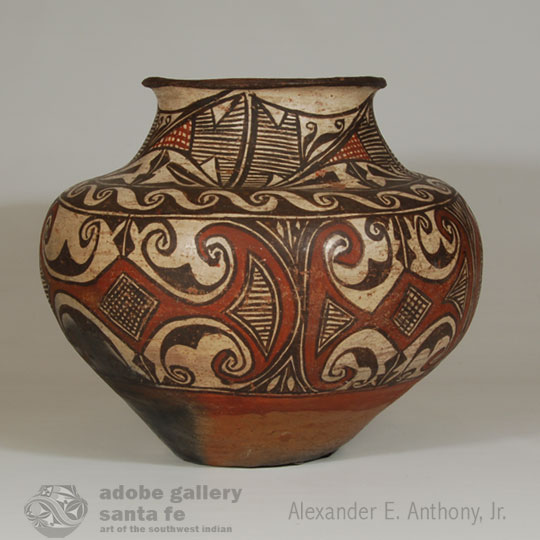
One must wonder why a potter, around 1890, would make a jar that resembles the shape of those made by the Tewa potters and then place on it designs that obviously are of Zuni origin. There is nothing to make one think this is a Zia jar, except for the tell-tale sign of basalt temper. It is strikingly beautiful and certainly a work of art by a talented and creative potter. If only we knew who she was or what made her depart from the traditions of Zia to create such a beautiful jar!
Would like to purchase or read more about this Zia Pueblo pottery?
Historic Four-color Polychrome Olla from Zia Pueblo - C3328B
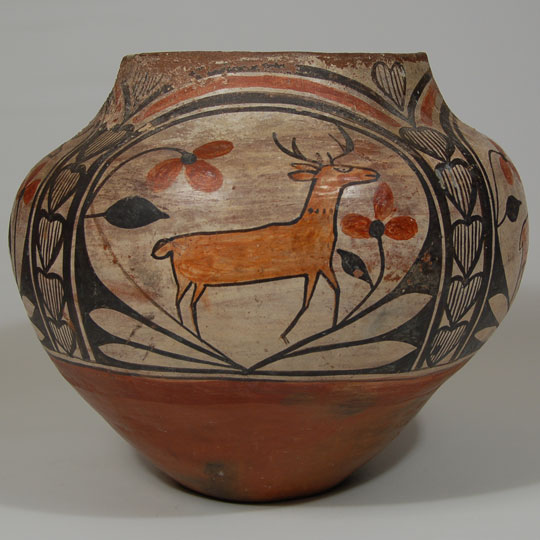 There is precedence for picturing animals on pueblo pottery-namely the Mimbres, in the 1100s, featured insects, fish, birds, and large and small animals primarily on the interior of bowls. There was then a large time span before animals appeared again, this time in the late-1800s on Zuni Pueblo pottery in the form of heartline deer figures. It could be that this inspired potters to paint deer on Zia Pueblo pottery. According to Harlow and Lanmon, the earliest documented Zia pottery with deer designs is 1870s.
This jar is probably from the first quarter of the 20th century. The design is divided into four quadrants, each of which contains basically the same design. There is an orange colored deer outlined in black. The deer is housed in an arch similar to that seen on Zuni pottery. There is what may be a rainbow arch above the deer house, flowers inside with the deer and black outlined hearts separating the four quadrants. Each heart is filled with parallel vertical black lines.
Would like to purchase or read more about this Zia Pueblo pottery?
Zia Pueblo Pottery Pictorial Tile by Diana Pino Lucero - C3954A
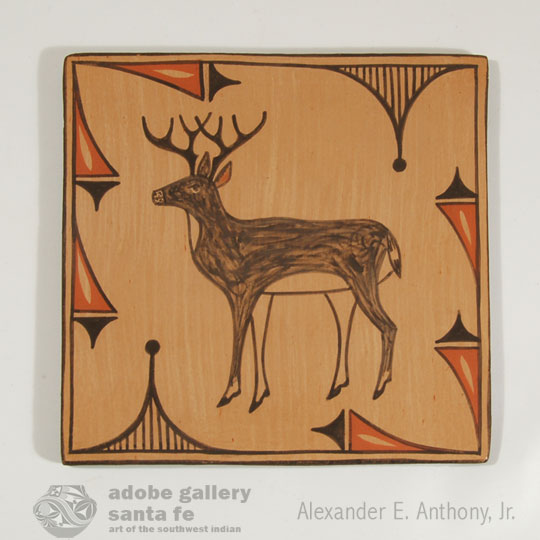 This square Zia tile features a very realistic and artistic deer, head held high, motionless, and unafraid. The deer is the focal point of the tile. There is no ground plane, no trees, or other distracting items to draw attention away from the deer. Traditional Zia pottery designs outline the edges of the tile. The slip is a warm cream color on the front. Red stone-polished slip covers the back. The tile is signed with the artist's name and pueblo name.
Diana Pino Lucero is the adopted daughter of John and Vicentita Shije Pino. The Pinos had married in 1934. They had one son, José Hilario, and adopted three children, Diana being the only female. Diana learned pottery techniques from Vicentita. She has won awards at Santa Fe Indian Market, exhibited at Heard Museum Show, Northern Indian Pueblos Arts & Crafts Show; Walatowa Arts Festival at Jemez Pueblo, New Mexico State Fair and other venues.
Would you like to purchase or read more about this Zia Pueblo pottery?
Historic Zia Pueblo Traditional Serving Bowl, circa 1890-1900 - C3925Y
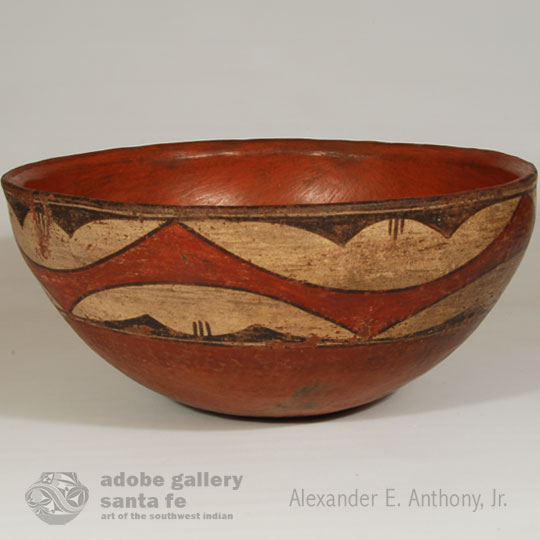 This Zia Pueblo bowl dates to around 1890-1900. Its main element of design is the red undulating band encircling the bowl. Above it are clouds and below it are water forms. A wide red band was wiped on under the design panels. Such wiped on bands got thinner over time and discontinued around 1935.
The rim of the bowl flares outward slightly, a feature seen on bowls made for pueblo use more often than on bowls made for sale. Serving bowls like this one were often used to work small amounts of bread dough and allow the dough to rise.
Would like to purchase or read more about this historic Zia Pueblo pottery?
Navajo Original Painting “Going to the Rodeo” by Beatien Yazz - C3242A
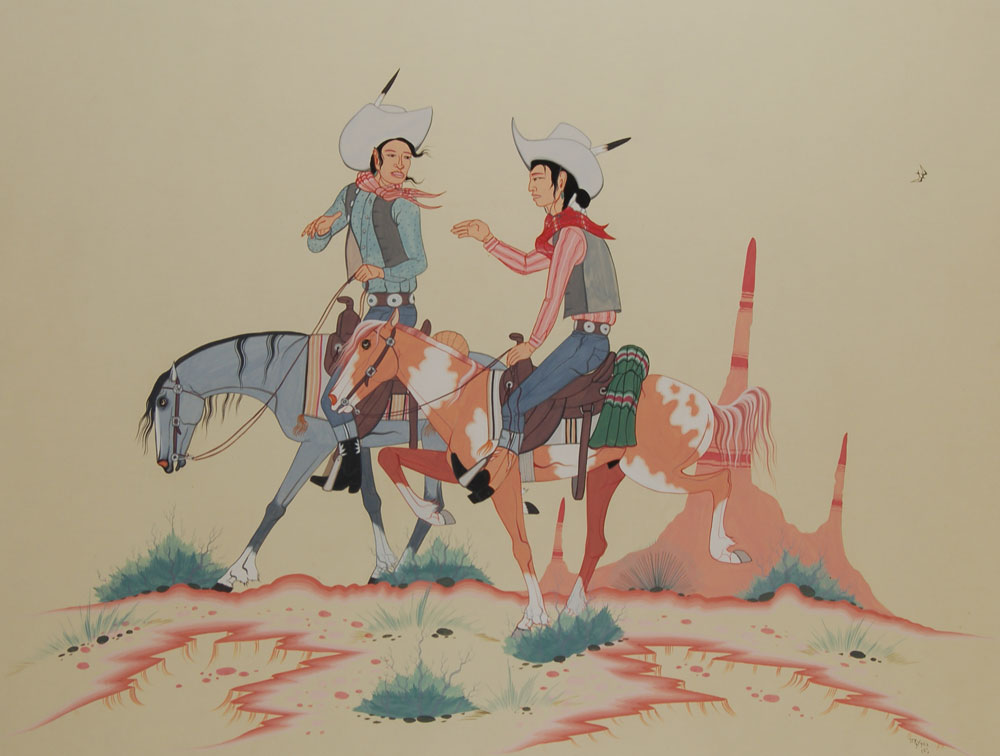 No artist can portray the daily activities of the Navajo Reservation as well as Beatien Yazz, who, having grown up on the Reservation, was well familiar with the daily activities and he has always portrayed them with young features in a grown-up appearance.
This painting of two young Navajo men, casually riding their horses and chatting while on their way to the rodeo, is presented in Yazz's traditional style. Each is dressed in traditional garb of the times-cowboy boots, vest over the shirt, concha belt, Levi trousers, neck scarf and a large cowboy hat. His use of soft, almost pastel, paints blends the subjects well into the desert landscape. The lack of background subjects, except for the single rock formation, reinforces the starkness of the desert.
Would you like to purchase or read more about this painting?

Very Large Hopi Pueblo Polychrome Pictorial Storage Jar - 25994
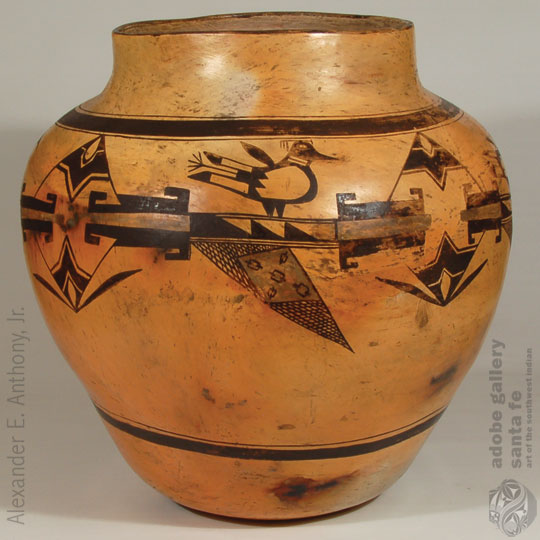 When a magnificent Hopi jar surfaces, the temptation is to try to assign the name of the maker. Most often, there are clues that lead one to select a maker-clues such as vessel shape, certain design elements, and age, perhaps-but it is not always so clear cut. When this jar came to us, our first guess was that it could have been made by Daisy Hooee Nampeyo (1920-1990), daughter of Annie Healing Nampeyo and granddaughter of Nampeyo, however we now believe it dates too early to have been made by her.
<!-- /* Font Definitions */ @font-face {font-family:Verdana; panose-1:2 11 6 4 3 5 4 4 2 4; mso-font-charset:0; mso-generic-font-family:auto; mso-font-pitch:variable; mso-font-signature:-1593833729 1073750107 16 0 415 0;} @font-face {font-family:"Cambria Math"; panose-1:2 4 5 3 5 4 6 3 2 4; mso-font-charset:0; mso-generic-font-family:auto; mso-font-pitch:variable; mso-font-signature:-536870145 1107305727 0 0 415 0;} @font-face {font-family:Calibri; panose-1:2 15 5 2 2 2 4 3 2 4; mso-font-charset:0; mso-generic-font-family:auto; mso-font-pitch:variable; mso-font-signature:-536870145 1073786111 1 0 415 0;} /* Style Definitions */ p.MsoNormal, li.MsoNormal, div.MsoNormal {mso-style-unhide:no; mso-style-qformat:yes; mso-style-parent:""; margin:0in; margin-bottom:.0001pt; mso-pagination:widow-orphan; font-size:12.0pt; font-family:"Times New Roman"; mso-fareast-font-family:Calibri; mso-fareast-theme-font:minor-latin;} .MsoChpDefault {mso-style-type:export-only; mso-default-props:yes; font-family:Calibri; mso-ascii-font-family:Calibri; mso-ascii-theme-font:minor-latin; mso-fareast-font-family:Calibri; mso-fareast-theme-font:minor-latin; mso-hansi-font-family:Calibri; mso-hansi-theme-font:minor-latin; mso-bidi-font-family:"Times New Roman"; mso-bidi-theme-font:minor-bidi;} @page WordSection1 {size:8.5in 11.0in; margin:1.0in 1.0in 1.0in 1.0in; mso-header-margin:.5in; mso-footer-margin:.5in; mso-paper-source:0;} div.WordSection1 {page:WordSection1;} --> Part of the A Century of Hopi-Tewa Pottery: From Nampeyo of Hano to Mark Tahbo exhibit.
Would you like to purchase or read more about this Hopi Pueblo Pottery?
Hopi-Tewa Very Large Polychrome Seed Jar by Grace Chapella - C3960C
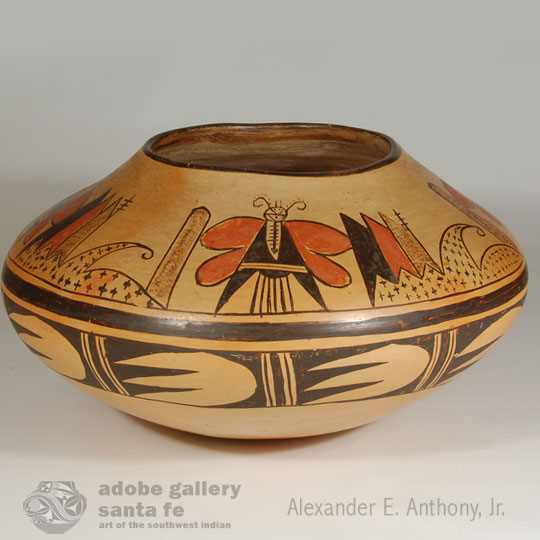 Grace Chapella was born in the Tewa village of Hano at First Mesa on the Hopi Reservation in 1874, eight years before the Reservation was established as such, and before Custer's Last Stand at the Battle of the Little Big Horn. She witnessed the first "horseless carriage" arrive on the Reservation and recalled how frightening it was. In 1927, she became the first person from the Hopi Reservation to fly in an airplane, going from Grand Canyon to Long Beach for a pottery demonstration.
Having lived for over a century-she passed away at age 107-Chapella (pronounced Tsepela) witnessed many changes in her life at Hopi where she lived. She was a youngster at a time before trading posts and tourists were introduced to the reservation and lived to see both flourish and the demand for pottery grow at leaps and bounds. Although her pottery, and that of others at First Mesa, is referred to as Hopi pottery, technically it is Hopi-Tewa potteryas the residents of Hano Village at First Mesa are Tewa-speaking Indians originally from New Mexico.
<!-- /* Font Definitions */ @font-face {font-family:Verdana; panose-1:2 11 6 4 3 5 4 4 2 4; mso-font-charset:0; mso-generic-font-family:auto; mso-font-pitch:variable; mso-font-signature:-1593833729 1073750107 16 0 415 0;} @font-face {font-family:"Cambria Math"; panose-1:2 4 5 3 5 4 6 3 2 4; mso-font-charset:0; mso-generic-font-family:auto; mso-font-pitch:variable; mso-font-signature:-536870145 1107305727 0 0 415 0;} @font-face {font-family:Calibri; panose-1:2 15 5 2 2 2 4 3 2 4; mso-font-charset:0; mso-generic-font-family:auto; mso-font-pitch:variable; mso-font-signature:-536870145 1073786111 1 0 415 0;} /* Style Definitions */ p.MsoNormal, li.MsoNormal, div.MsoNormal {mso-style-unhide:no; mso-style-qformat:yes; mso-style-parent:""; margin:0in; margin-bottom:.0001pt; mso-pagination:widow-orphan; font-size:12.0pt; font-family:"Times New Roman"; mso-fareast-font-family:Calibri; mso-fareast-theme-font:minor-latin;} .MsoChpDefault {mso-style-type:export-only; mso-default-props:yes; font-family:Calibri; mso-ascii-font-family:Calibri; mso-ascii-theme-font:minor-latin; mso-fareast-font-family:Calibri; mso-fareast-theme-font:minor-latin; mso-hansi-font-family:Calibri; mso-hansi-theme-font:minor-latin; mso-bidi-font-family:"Times New Roman"; mso-bidi-theme-font:minor-bidi;} @page WordSection1 {size:8.5in 11.0in; margin:1.0in 1.0in 1.0in 1.0in; mso-header-margin:.5in; mso-footer-margin:.5in; mso-paper-source:0;} div.WordSection1 {page:WordSection1;} --> Part of the A Century of Hopi-Tewa Pottery: From Nampeyo of Hano to Mark Tahbo exhibit.
Would like to purchase or read more about this Chapella pttery?
Sikyatki-style Contemporary Hopi Pueblo Seed Jar by Garnet Pavatea - C3960B
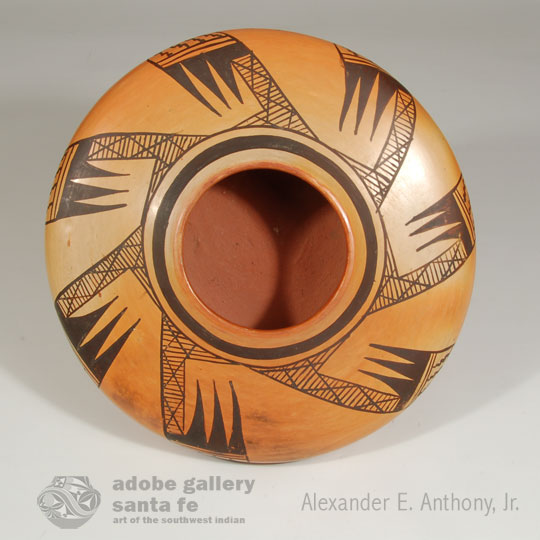
This seed jar of the Sikyatki-shape is a shining example of her expert craftsmanship in vessel construction and her artistic talent in designing and painting a jar. She extended the red paint on the rim down into the interior of the jar, a step not necessary, but one that demonstrates her attention to detail. The jar was constructed from all native materials and fired in a traditional outdoor firing. It is signed Garnet Pavatea on the underside.
Part of the A Century of Hopi-Tewa Pottery: From Nampeyo of Hano to Mark Tahbo exhibit.
To purchase or read more about this Nampeyo pottery.
Tall Hopi Pueblo Cylinder with Clay Appliqué at Rim by Nampeyo of Hano - C3960A
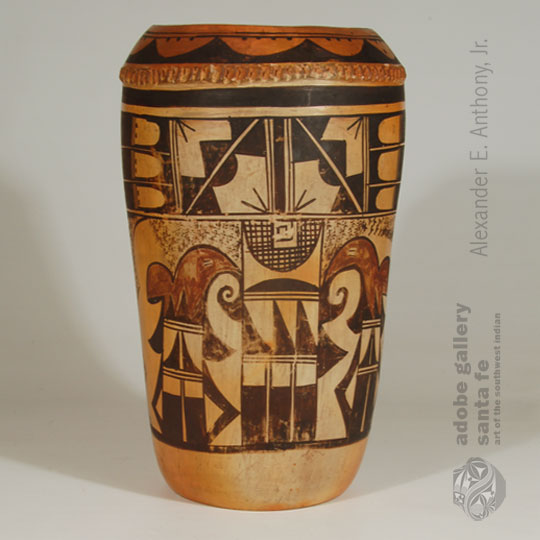 In the 1900-1910 periods, Nampeyo was potting at her prime. She was creative and continually improvising more varied work than in any earlier or later period. By the 1910 decade, she was producing for a collector market and was producing outstanding quality but with less improvisation. By the 1930s, she was producing more tactile work as her eyesight was failing.
Sometime in the late 1800s, Nampeyo sometimes added a row or rows of clay appliqué to her pottery. There is one in the Milwaukee Museum with a collection date of 1895. This magnificent very large cylindrical jar features such a ring of clay near the rim. It is typical of Nampeyo's construction, as she is known for introducing the tall shapes.
Part of the A Century of Hopi-Tewa Pottery: From Nampeyo of Hano to Mark Tahbo exhibit.
To purchase or read more about this Nampeyo pottery.
A Century of Hopi-Tewa Pottery: From Nampeyo of Hano to Mark Tahbo Exhibit
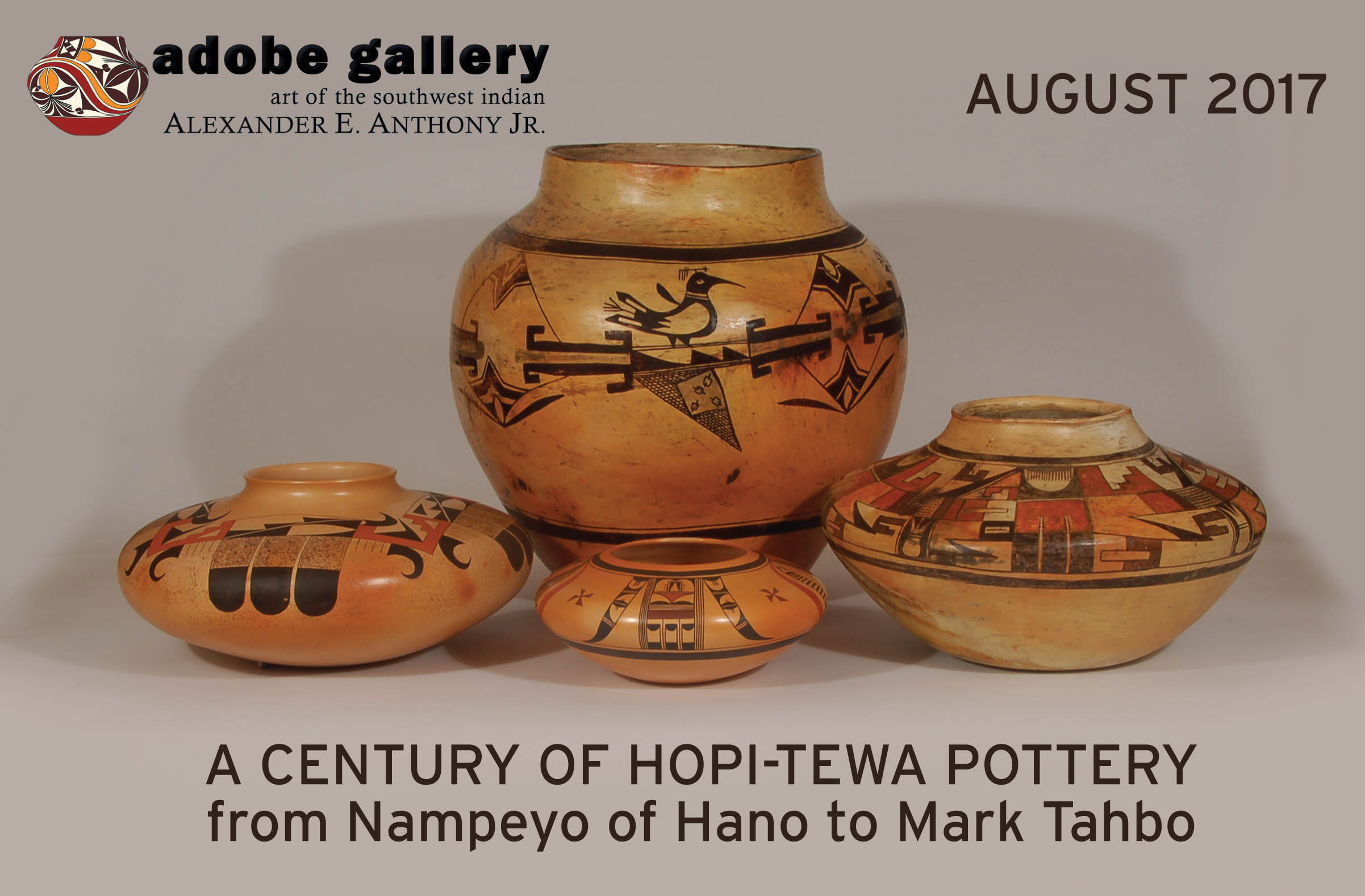
Adobe Gallery's special exhibit "A Century of Hopi-Tewa Pottery: From Nampeyo of Hano to Mark Tahbo" will open Monday, August 7, with reception at 221 Canyon Road from 5 to 7pm.
Legendary Hopi matriarch Nampeyo of Hano used designs created by her prehistoric ancestors to bring Hopi pottery to the masses in the early 1900s. Today, Hopi potters like Mark Tahbo use Nampeyo's designs as inspiration for their new works. This exhibit, which features works by both of these potters and many others who produced between them, will showcase the ways that today's artists continue to be influenced by those of yesteryear.
With this exhibit, we wish to shine a light on the link between New Mexico Pueblo Indians and the pottery being produced today at Hopi. The majority of the potters whose works we feature in this exhibit are Hopi-Tewa people-the descendants of those who migrated to Hopi from New Mexico's Tano Pueblo in the 1690s.
Would you like to purchase or view the show?
Santa Clara Pueblo Copper Plate Etching “The Healers” by Helen Hardin - C3943C
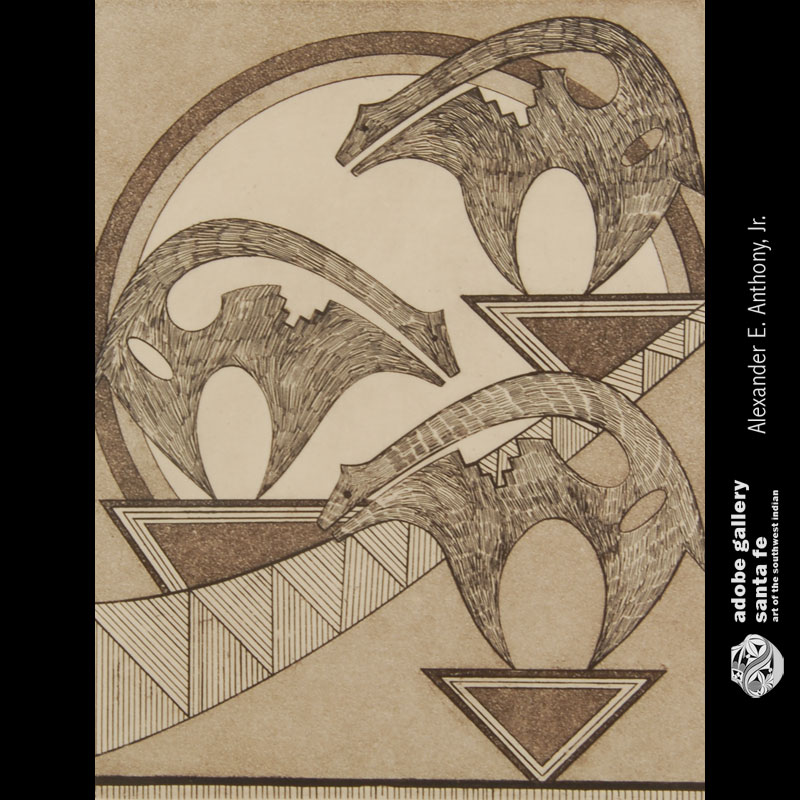 Tewa Pueblo legend states that bears have the power to heal. They are considered medicine men. Santa Clara Pueblo artist Helen Harden drew three arched bears in this etching for which she named it "The Healers." The bears are in the curved style made famous by San Ildefonso potter, Tony Da. Each bear stands on a triangular pedestal.
Most Unusual Hopi Pueblo Jar by Nampeyo of Hano - C3942B
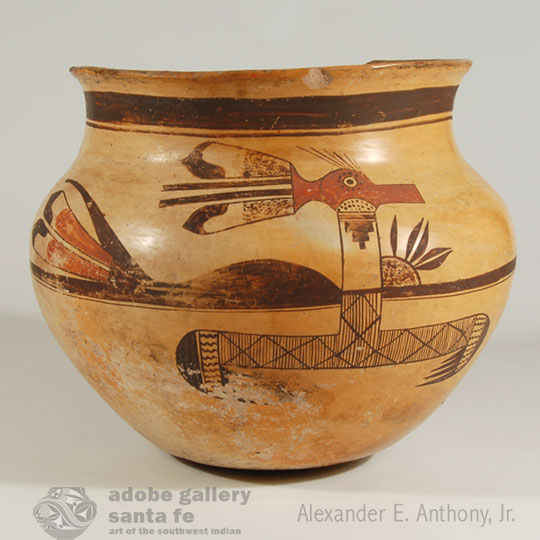 This jar shape is not what one normally associates with Hopi potters, yet there are jars in the Museum of Northern Arizona with similar shapes, both historic and contemporary. We just are not familiar with seeing such on a regular basis. It might be classified as a small storage jar. It has a rounded base like those of storage jars.
The bird flying on the neck of the jar has a rather squared off beak, which is not what we associate with Hopi birds but "There are a few odd bird heads on Nampeyo jars at the Museum of Northern Arizona." Personal note from Dr. Ed Wade. The polka-dot element below the bird's eye and the dark brown stepped cloud are most unusual elements on a bird's head.
Would like to purchase or read more about this Nampeyo pottery?
Hopi Pueblo Heheya Aumutaka Katsina Doll signed Mike - C3383ZK
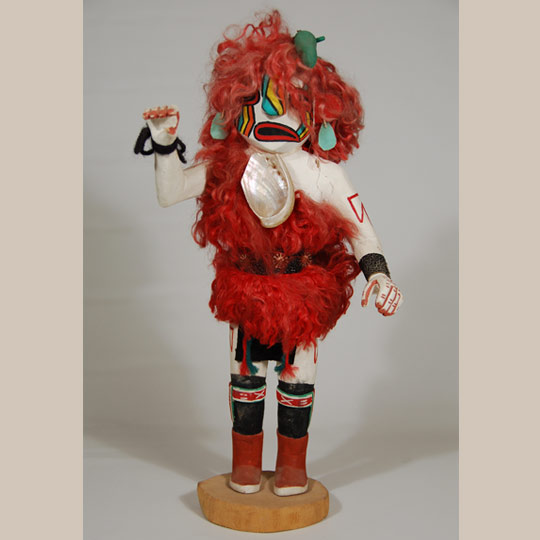 According to Barton Wright, Heheya Aumutaka means "like Heheya" and this version of Heheya appears only on Third Mesa. Other versions appear on First and Second Mesas. He is a relative of the Ogres, although he himself is not an Ogre. The interesting thing about this Katsina is that he speaks the opposite of what he means. If he says something is "good," he means it is "bad." Formerly he accompanied the Soyoko when they appeared on Third Mesa but since the Soyoko no longer come, his role is shifting to that of a general Powamu Katsina.
Would you like to purchase or read more about this Katsina?
#adobegallery #HopiPueblo #Katsina #Kachina # #Doll #SouthwestIndianArt #PuebloArt #SantaFeNM
Historic Kewa (Santo Domingo) Pueblo Decorated Deep Serving Bowl - C3924K
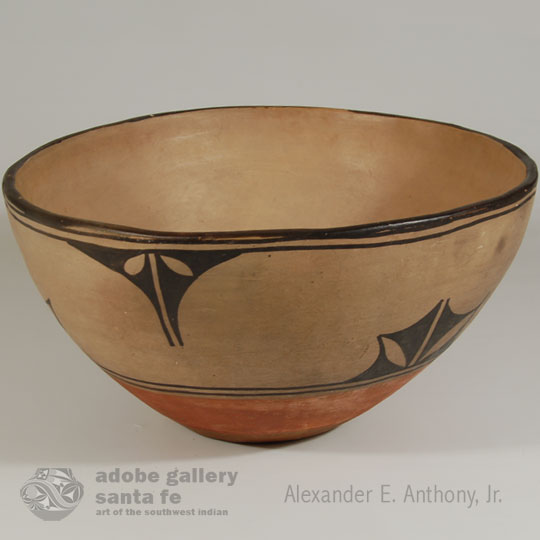 Kewa Pueblo food bowls assume the most beautiful patina from daily use. The cream slip with which they are coated absorbs the oils from foods and then turns a beautiful brown with an added sheen. Not only is the interior enhanced with an outstanding patina, the exterior assumes a patina from the hands of the handler. This one is no exception. It is the size bowl used for serving food at the table, not for eating from. This size is also used for preparation of bread dough when only a small amount of bread is being prepared.
Would you like to purchase or read more about this pottery?
#adobegallery #SouthwestIndianPottery #KewaPueblo #KewaPottery #PuebloPottery #SouthwestIndianArt #SantaFePottery #FinePuebloPottery #HistoricPottery
Hopi Pueblo Seed Jar with Migration Pattern by Fannie Nampeyo - C3924Z
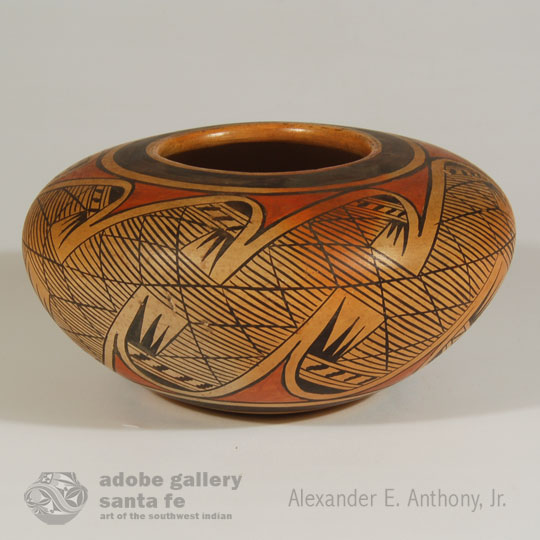 Fannie won her first Blue Ribbon in 1961 from the Museum of Northern Arizona at the annual Hopi Show. Her pottery was selected for several museum exhibits in the 1990s. Since she was the youngest daughter of Nampeyo and Lesou, she was better known, personally, by many collectors, most of whom never met Annie or Nellie. She was still actively making pottery in the mid-1980s.
One of Fannie's favorite designs was the migration pattern-supposedly delineating the migration of the Hopi people through four worlds. Whether it was her favorite or whether she produced it because it was collectors' favorite is unknown, but it is the one she seems to have made more often.
Would you like to purchase or read more about this pottery?
Pictorial Design Bowl from the Hopi Mesas - C3925D
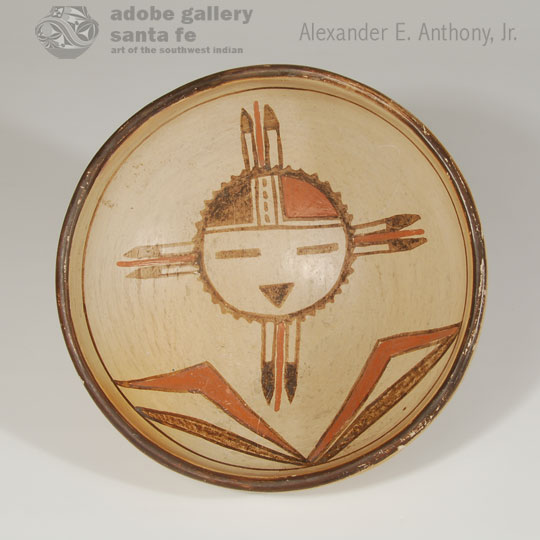 Before 1900, bowls such as this were routinely made for food. It would not have been decorated on the interior, however. After 1900, potters were encouraged by traders Thomas Keam and Lorenzo Hubbell to produce products for sale. Pictorial designs were particularly desirable as tourists were likely to prefer those over geometric designs.
Hopi-Tewa Nampeyo of Hano Jar with Hopi Village Label - C3924C
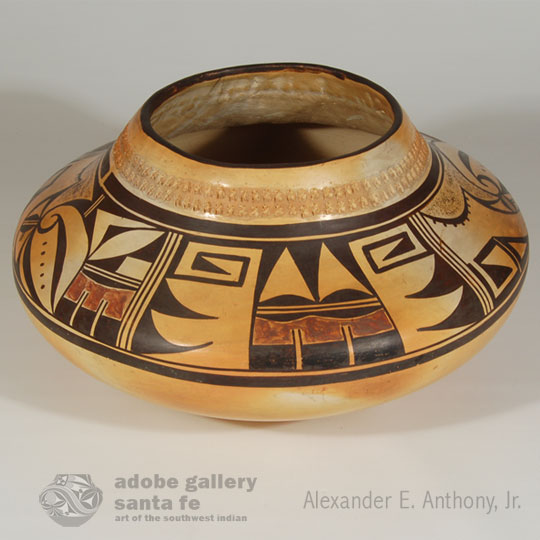 "Nequatewa states in his biography of Nampeyo that 'when she became a young maiden she was as good a potter as any in Walpi, and she did all the decorating for the old lady, her father's mother, a Tewa lady and her teacher, as she had become a good pottery designer.' He went on to say that 'when the stores were established on the reservation by the white traders, she was doing a good deal of pottery work, so that when the stores began to trade for pottery, her work was among the best, and she was getting good prices.'" Allen, 1984:21
By 1900, the Polacca Polychrome pottery of the past was no longer being made, instead what replaced it was a yellow ware with black and red painted designs, with a slip that did not crackle like the Polacca slip. It was then that Nampeyo was encouraged to reproduce pottery of the style being excavated. She, instead, used those excavated ceramics as inspiration for her work. She was not interested in copying others.
Would like to purchase or read more about this pottery?