



Hopi Pueblo Kokosori Katsina Doll with a Rabbit by Lowell Talashoma, Sr. - C3627G
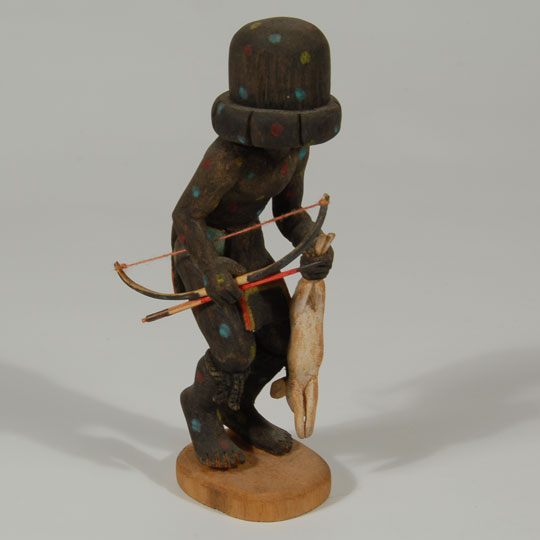 A pre-pubescent boy always portrays Kokosori. Formally his presentation was without clothing. He is one of the oldest recorded katsinas for the Hopi, as he was seen in 1852 according to documented records. He is best known in Zuni Pueblo, where his name is Shulawitsi. At both Zuni and Hopi, he is often referred to as the Fire God Katsina. He appears on all three Hopi mesas in differing functions. As portrayed here, he is shown after a successful rabbit hunt.
Mojave Standing Male Pottery Figurine with Beads - C3251B
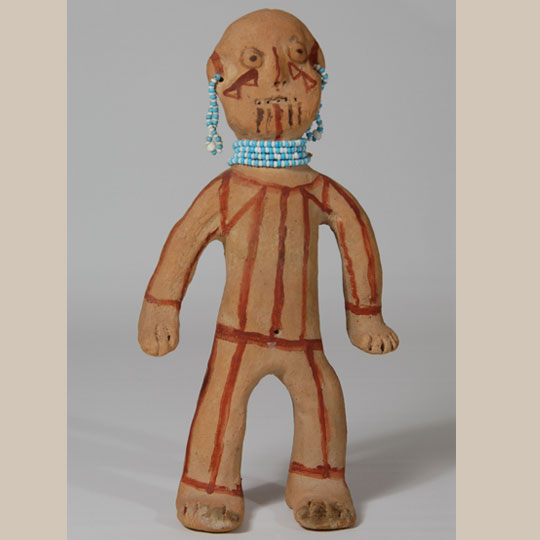 Rick Dillingham, a nationally known artist and a collector and author of Native American pottery, amassed, over many years, a collection of Mojave pottery, and bequeathed it to the School for Advanced Research (SAR) in Santa Fe. His collection was the largest and most complete Mojave assemblage in the world. It has been fully documented in the book Mojave Pottery, Mojave People: The Dillingham Collection of Mojave Ceramics by Jill Leslie Furst and published by the SAR Press in 2001.
Oil Painting “Sangre de Cristo Range” by Carl Von Hassler - C3844
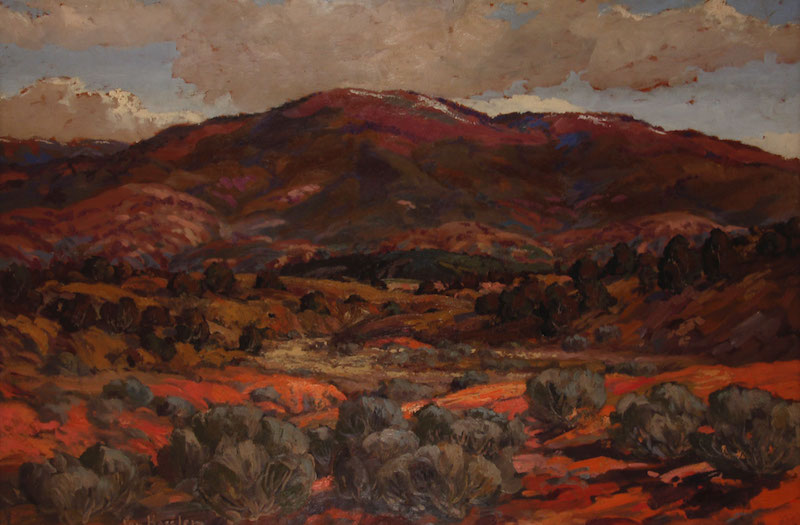 This painting is very representative of Von Hassler's northern New Mexico landscapes, although it is much larger than most of his works. Large paintings express his talents more accurately than the smaller quick ones he painted so he could make a fast sale. Large ones took time and patience and more careful attention. They were apparently ones he enjoyed working on when time permitted.
This painting is entitled "Sangre de Cristo Range" on verso. It is signed in lower left but not dated. It probably dates from the mid-twentieth century.
Ohkay Owingeh Pueblo Painting “Eagle Dance” by Manuel Trujillo - C3839C
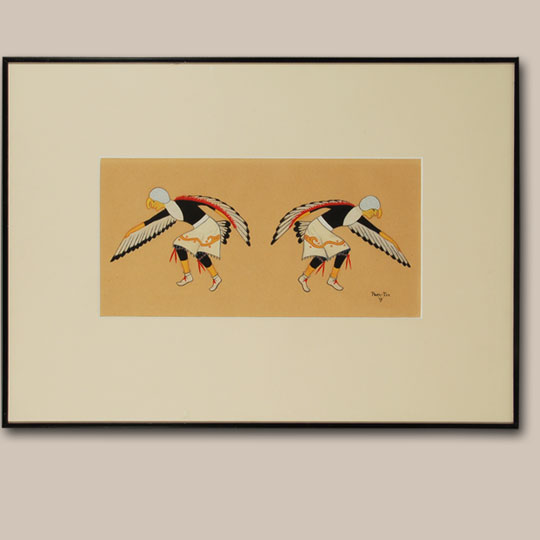 Surprisingly, this is the first painting by Manuel Trujillo (1927 -) Peen Tsa we have had in the gallery. This one was painted while he was a student at the Santa Fe Indian School. It bears the stamp of The Studio U. S. Indian School Santa Fe, NM on the back. It is dated October 6, 1941 on verso and signed and dated 1943 on the lower right front.
Hopi Pueblo Pottery Tile of Kokopellmana Katsina by Gwen Setalla - C3843L
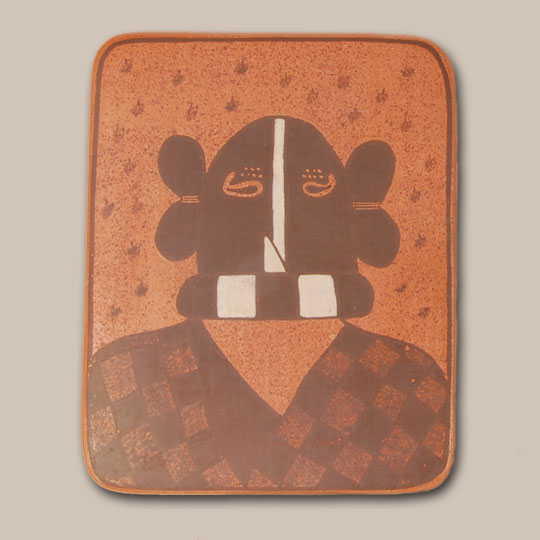 Gwen Sharon Setalla (b.1964-) Aȁs-kữ-Mana is a Hopi from the village of Mishongnovi on Second Mesa. Her mother is Pauline Setalla from Mishongnovi. They are of the Frog Woman and Feather Woman families. The family lived on a ranch not far from Keams Canyon and Gwen spent her early childhood there. She learned pottery making from her mother, starting as early as age 5 and began to take it seriously by age 21.
Hopi Pottery Tile with Sio Hemis Katsina Face by Barbara Polacca - C3843Q
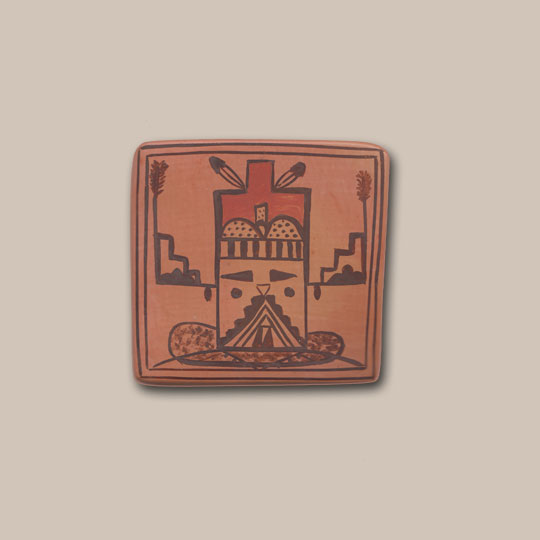 Barbara Polacca is a Hopi-Tewa of the Spider Clan who has been an active potter since 1970. She is an accomplished potter known for making seed jars, cylindrical vases, bowls, canteens and tiles. She painted the face of a katsina on this tile. Pueblo pottery tiles have been a popular collector's item for over a hundred years. The Hopi-Tewa potters have always been more prolific than the Rio Grande Pueblos in making them.
Original Hopi Pueblo Painting of a Buffalo Dancer by Lomawywesa - C3840A
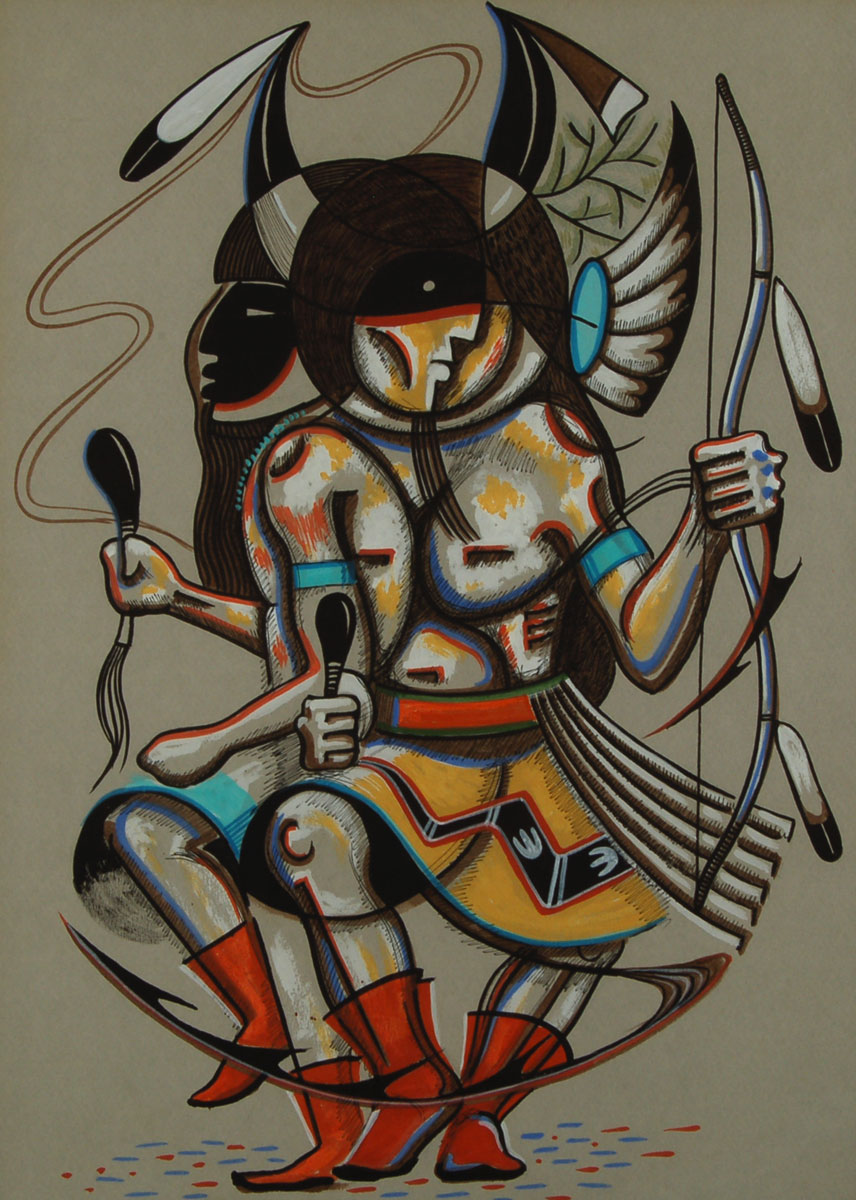 This painting of a Buffalo Dancer was sold through the Hopi Arts and Crafts Shop at Second Mesa on the Hopi Reservation. The Hopi Arts and Crafts Shop was the original outlet for works by the Artist Hopid.
It appears that Kabotie failed to sign this Original Hopi Painting of a Buffalo Dancer, however it does have a Hopi Arts and Crafts tag taped to the back of the painting with the artist listed as Michael Kabotie so there is no doubt that he was the artist. It is also unmistakably the work of Michael Kabotie (1942 - 2009) Lomawywesa.
Original Watercolor Painting “New Mexico Memories” by Morris Rippel - C3843B
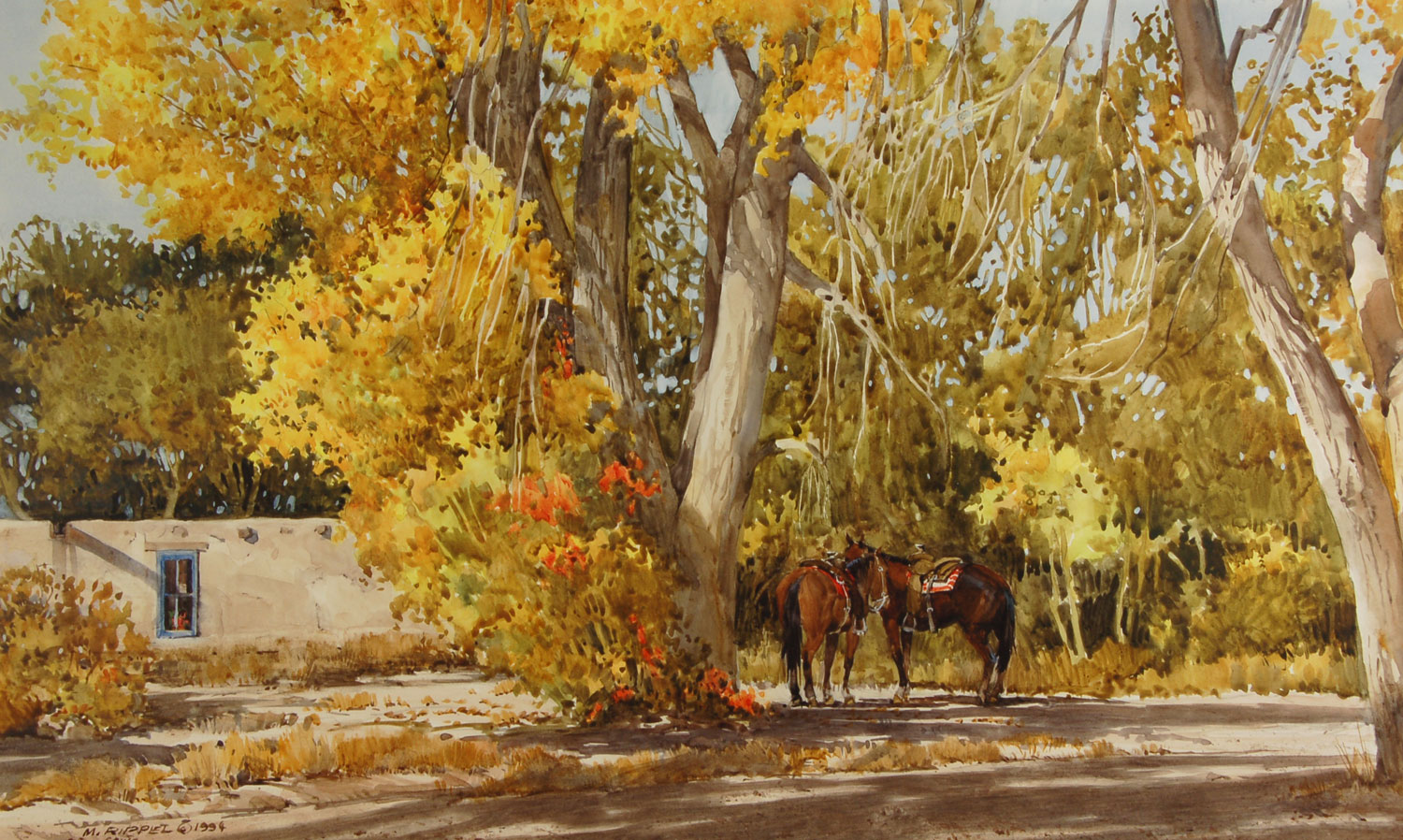 "New Mexico Memories" is an apt name for this painting. There is nothing more New Mexican that an adobe building nestled under or among cottonwood trees. There is no manicured lawn or formal entrances to the home, just native plants growing without need of water or attention. The two saddled horses are ready for a tromp down by the acequia. The cottonwood trees are displaying their beautiful fall colors. There is no memory of New Mexico more memorable that such a view as this.
Morris Rippel was basically a self-trained artist, having obtained an architectural degree from the University of New Mexico. He worked in that field for 15 years but then decided to see if he could make a living for himself and his family by becoming an easel artist. He succeeded and did so very well.
Original Watercolor Painting “Romero Street” by Morris Rippel - C3843A
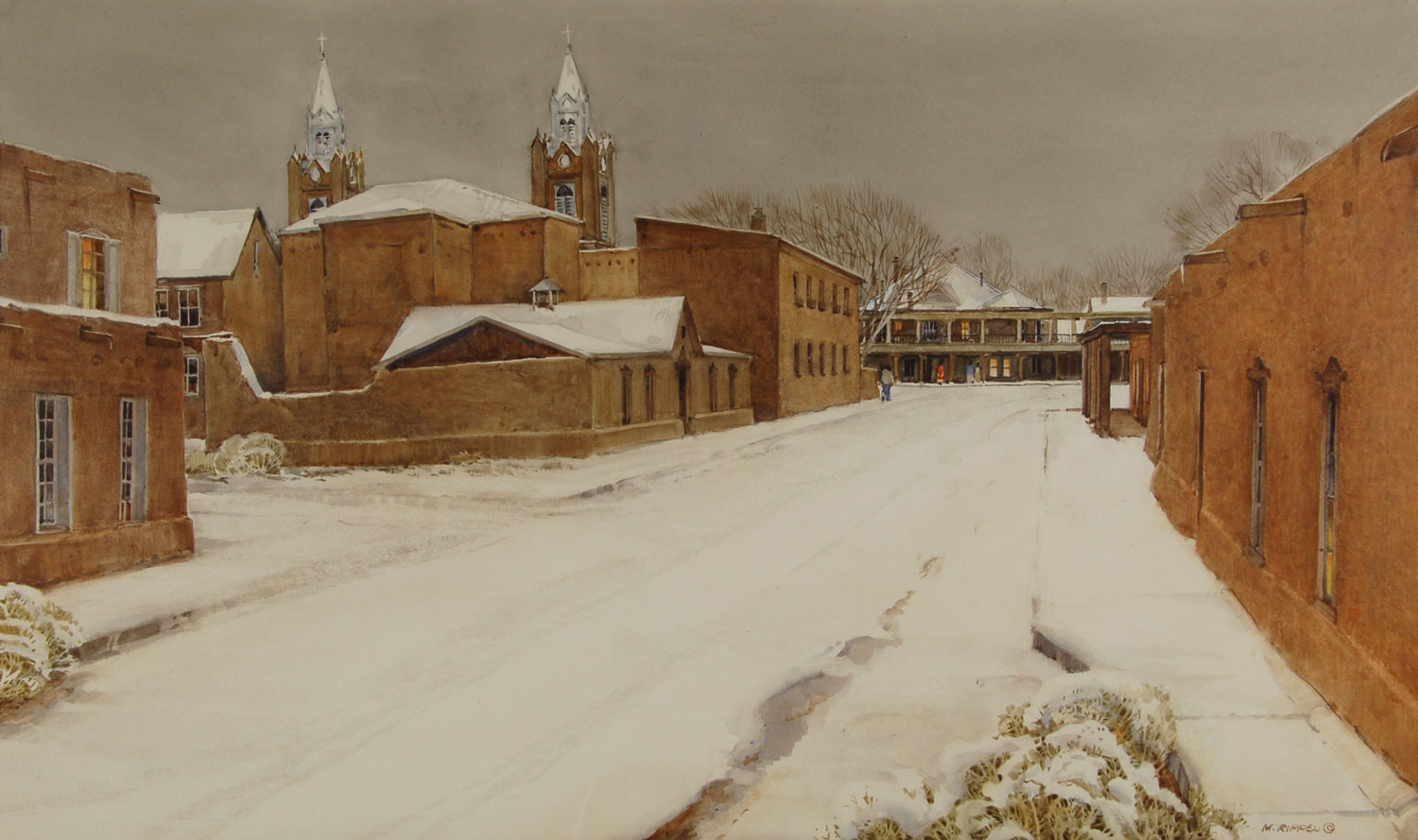 Morris Rippel lived his whole life in Albuquerque. He attended the University of New Mexico from which he earned a degree in architecture, a career he practiced for 15 years. He decided to try his hand at fine art painting and took two paintings to a gallery in Santa Fe which sold them immediately so he decided to drop his architectural career and become a fine art painter. He had a very successful art career.
This watercolor of Romero Street is a very accurate portrayal of that section of Old Town Albuquerque. The long adobe building on the right with two long and narrow windows and a door was the home of Adobe Gallery for 25 years! We have fond memories of that building.
Hopi Pueblo Kwivi Koyemsi Katsina Doll - C3843C
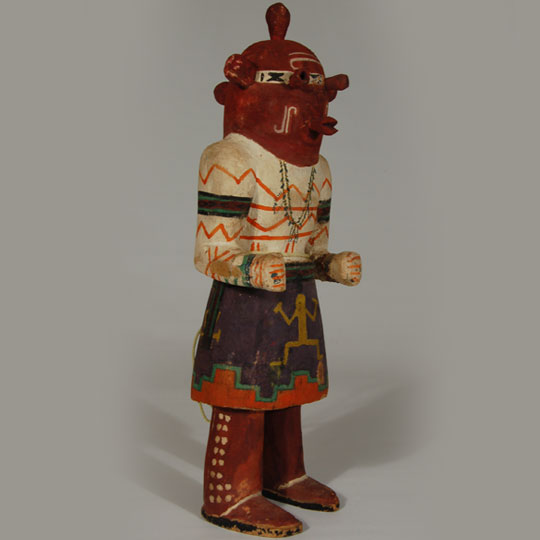 This personage has been known by several names-Mudhead, Koyemsi, Clown, Tachukti, and has been referred to as a Katsina. Barton Wright states that it is not considered a Katsina at Hopi and that Mudhead and Koyemsi are both nicknames and that Tachukti is the correct name but that he is not a clown in the sense we normally consider a clown. It will, however, always be called a Mudhead as that name has existed for a hundred years already and is not likely to go away.
Artist Profile - Myron Denetclaw (1999- )
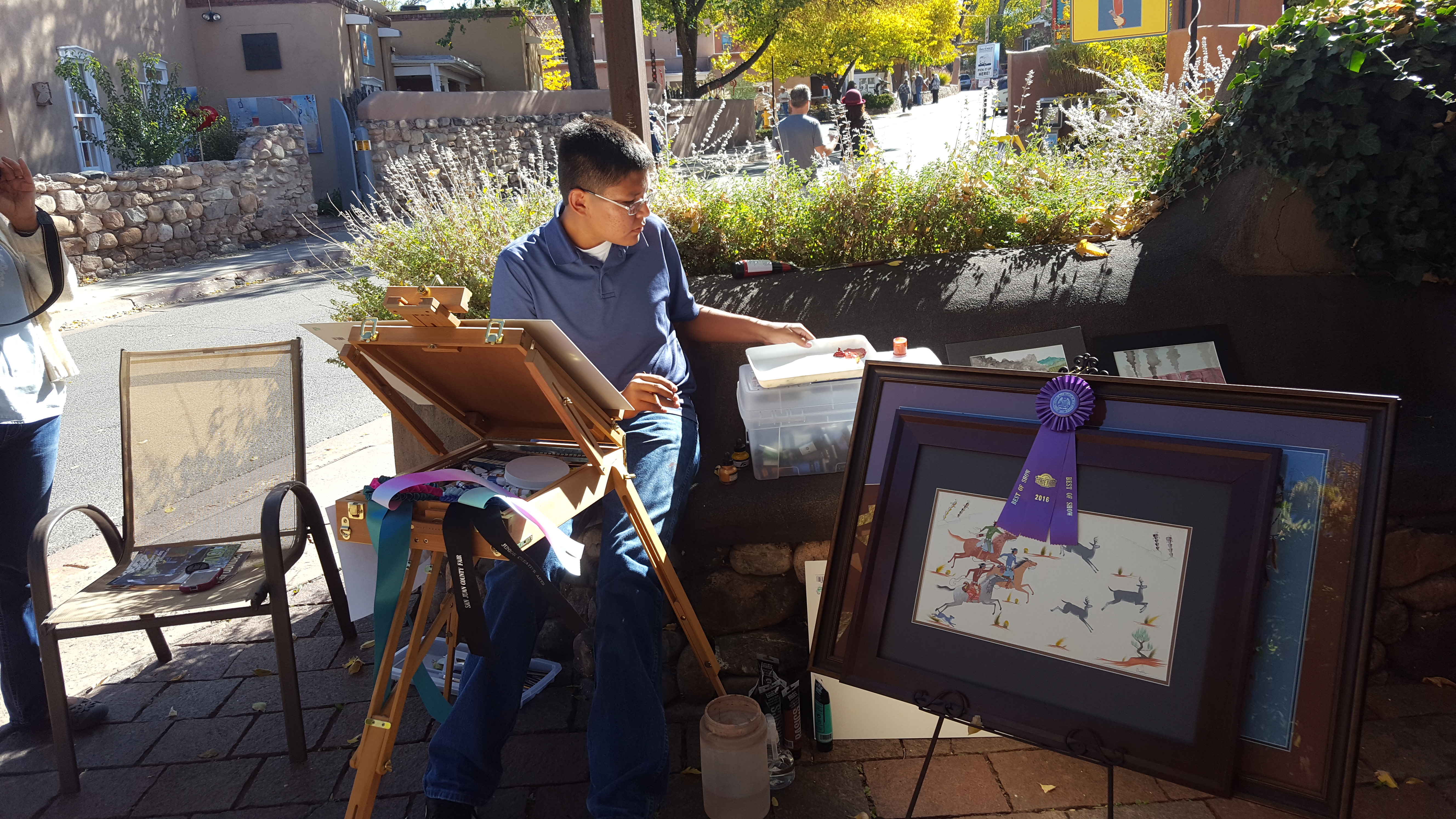 Myron Denetclaw is a self-taught painter born on September 5, 1999 in Shiprock, New Mexico. He resides in Shiprock with his parents, Milford and Mamie Denetclaw and brother Matthew. His maternal clan is Táchiiníí and his paternal clan is Hooghanłání.
Denetclaw developed his painting ability slowly through trial and error by practice of drawing. He holds in particular esteem the naturalism of Bob Ross' work which is a significant force characterized by an ongoing determination to produce beautifully rendered gouache and acrylic paintings with a specific emphasis on Yeíí, the Diné Deities. Denetclaw's interest in the elegance of the spiritual world finds expression within his figurative subjects, the intimacy of which invites us to reflect freely upon their narrative content. He paints in the style of the early Navajo painters Harrison Begay and Beatien Yazz. There are not many young Navajo artists today who paint in this style. His work is clearly influenced by his predecessors, while expanding on their style in a way that only a young artist would. We are very impressed by this emerging artist's work, and are excited to be able to share it with our clients.
Learn more about Myron Denetclaw here.
Untitled Painting of Navajo Boys Chasing Deer by Myron Denetclaw - 25907
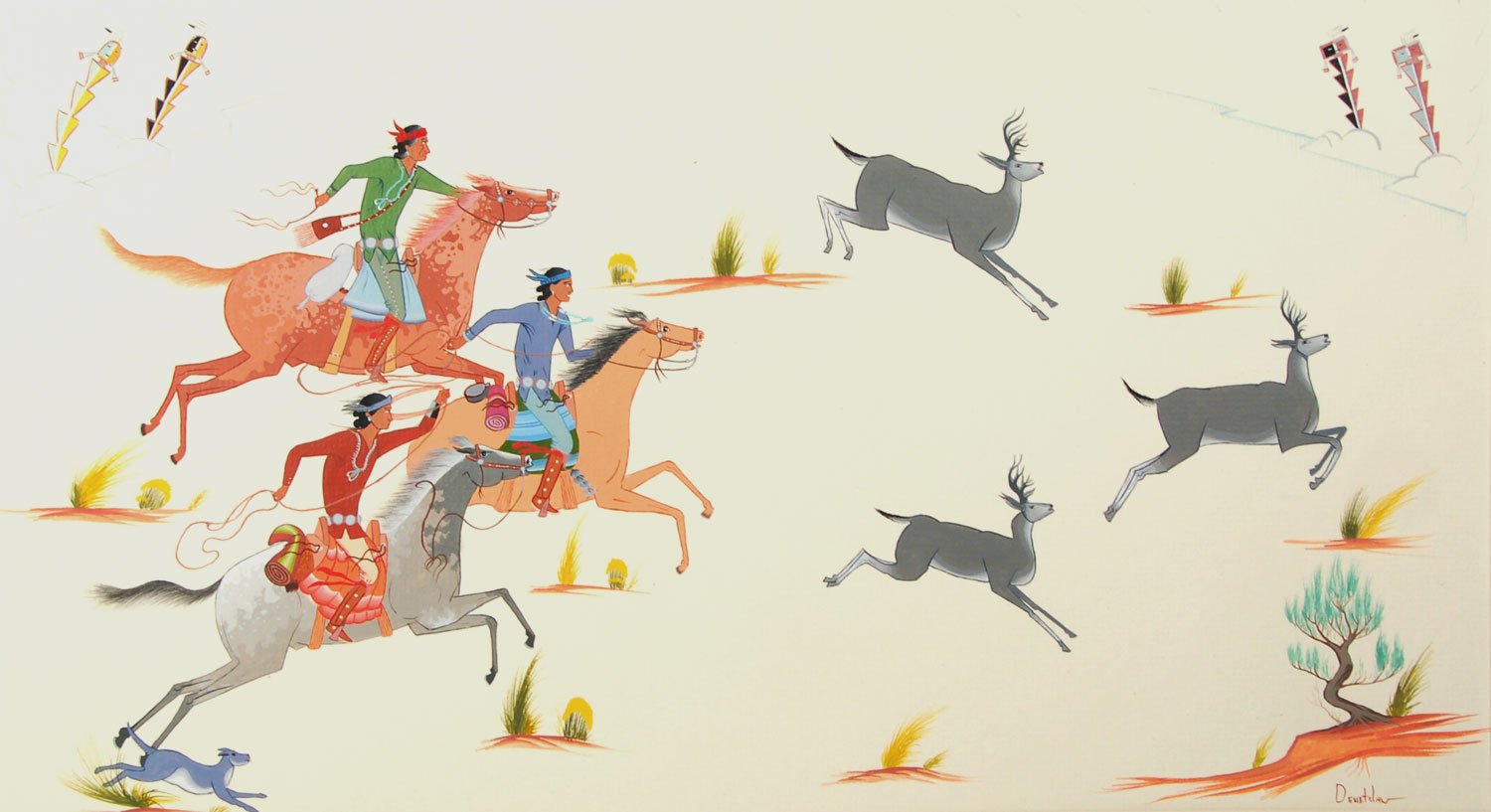 Self-taught artist Myron Denetclaw paints in the style of the early Navajo painters Harrison Begay and Beatien Yazz. Myron developed his painting ability slowly through trial and error by practice of drawing. He holds in particular esteem the naturalism of Bob Ross' work which is a significant force characterized by an ongoing determination to produce beautifully rendered gouache and acrylic paintings with a specific emphasis on Yeíí, the Diné Deities. Denetclaw's interest in the elegance of the spiritual world finds expression within his figurative subjects, the intimacy of which invites us to reflect freely upon their narrative content.
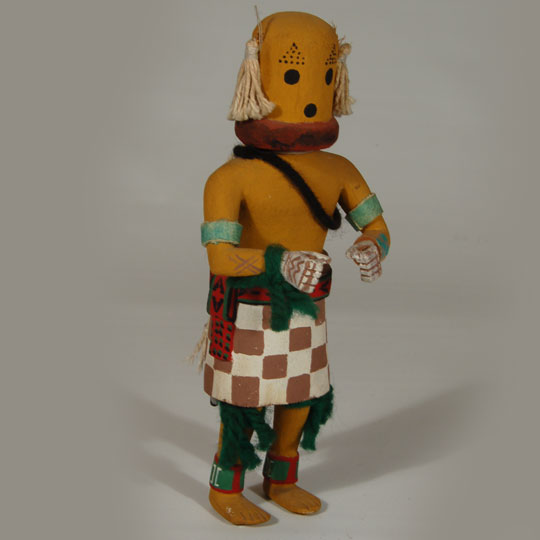
Hopi Cottonwood Kokopelli Katsina Doll with Genitalia by Jimmie Koots - C3843i
 Jimmie Kootshongsie is best known by everyone as Jimmie Koots. He was born at Hopi Pueblo on the Third Mesa village of Hotevilla during the period of World War I. At a very young age, he and many other Hopi children were removed from their homes and taken to government schools where they were to be stripped of their Hopi beliefs and heritage and assimilated into the White man's culture. Koots survived the five long years at the Bureau of Indian Affairs School and then returned to his native village.
Hopi Pueblo Cottonwood Root Hú Katsina Doll - C3843G
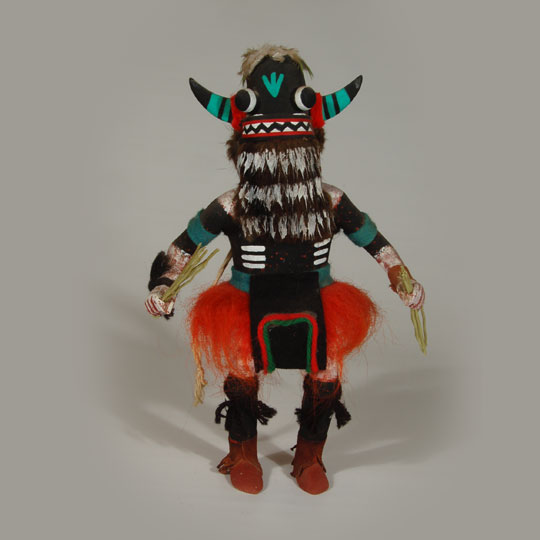 "When the time approaches for whipping the children during ceremonies in the kiva, a signal is given and the three Kachinas: the Crow Mother and her two sons, the Hú Kachinas, come rushing toward the kiva. There they make four circuits of the hatchway creating as much noise as possible by beating the hatchway with their whips and bounding about to make their rattles sound. At the end of the fourth circuit they enter the kiva and take their positions north of the fireplace. The initiates are brought forward by their ceremonial god-parents and placed on the sand painting. The Hú Kachinas advance and give them four strokes with their yucca whips. As each candidate is struck the yucca whip is waived through the air with a wicked swish. This is a gesture of purification.
Hopi Pueblo Cottonwood Root Tunei-nili Katsina Doll - C3843H
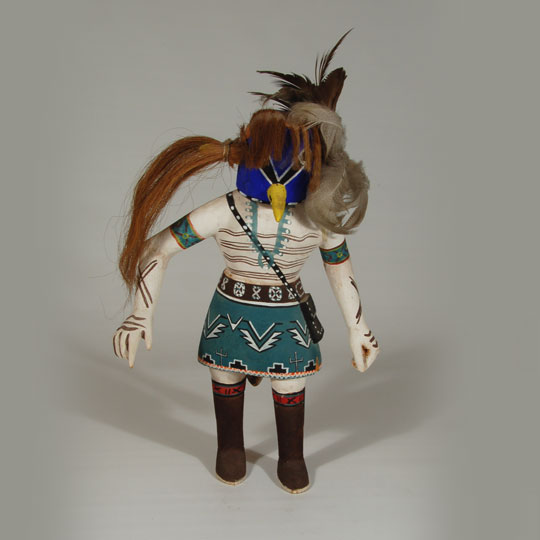 Tunei-nili is a Navajo-derived katsina. He is the individual who looks after the Navajo or Tasap Katsinas and is usually called a side dancer for them. He may not always appear with the Tasap, however. He was inspired by the Navajo Rain Gods the Tone-nili, who appear on the sixth day of the Navajo Yeibichai Ceremony. The name Tunei-nili Bitzai means "little wash" or "little river grandfather." He sometimes appears with the Velvet Shirt Katsinas also.
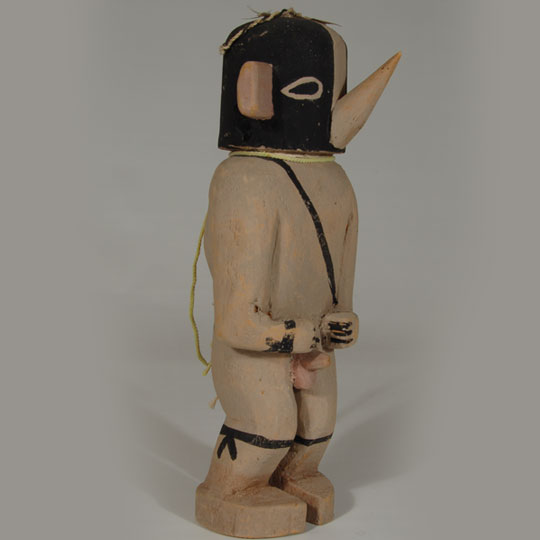
Hopi Pueblo Susöpa - Cricket Katsina Doll - C3843F
 The Cricket Katsina (Susöpa) appears as a racer, although many Hopi will say that he appears only at night in the kivas. This seems to be a difference among villages. Usually this katsina appears with a black bandolier over his chest, represented here by a black yarn strip. He is sometimes pictured with a tuff of small feathers in place of ears. The ears on this carving are made from string. Two bundles of grasses point upward from the ears but they are missing from this carving.
Hopi Circular Pottery Tile with Sun Katsina Face by Darlene Nampeyo - C3843o
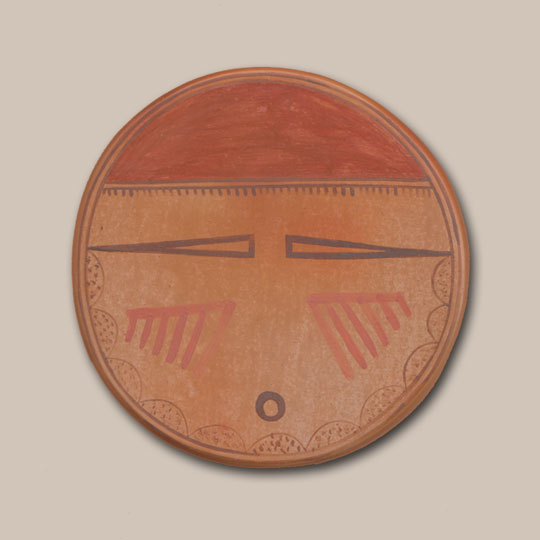 Darlene James Nampeyo, who passed away in 2012 at the age of only 56 years, was a granddaughter of Rachel Nampeyo, great granddaughter of Annie Healing Nampeyo and great-great granddaughter of Nampeyo of Hano. She had been a constant winner of awards at the Museum of Northern Arizona's annual Hopi Show and was awarded the Fannie Nampeyo Memorial Award, Best of Division at the Scottsdale Native American Indian Cultural Foundation Show, and seven consecutive Santa Fe Indian Marketawards.
Hopi Pueblo Pottery Tile with Cow Katsina Image by Alberta Adams - C3843J
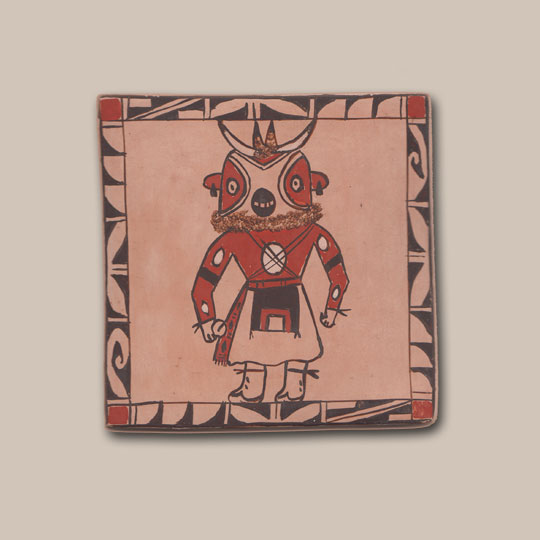 Alberta Adams is listed in Gregg Schaaf's book Hopi-Tewa Pottery 500 Artist Biographies but only the statement "active 1980-present: polychrome wedding vases, bowls" is included for her. She is not mentioned at all in Messiers' book Hopi & Pueblo Tiles so there seems to be little biographical information on her as a potter even though she is acknowledged as having produced since 1980. She is from Hopi Pueblo in Arizona.
Hopi Pueblo Tile with Three Horn Katsina Image by Alberta Adams - C3843K
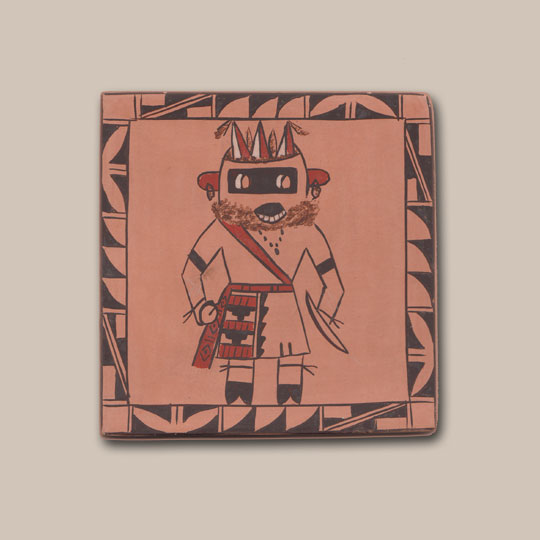 The Payik'ala - Three Horn Katsina appears in the Mixed Dance. Barton Wright says that there are Hopi who remember this Katsina being danced at Third Mesa before 1906. This is a good representation of this Katsina, and it is in very good condition. Harold S. Colton states that it was introduced from Zuni to First Mesa in 1921.
The Kachina has a black band across his eyes, three horns sticking upward from his mask and is bare chested. He carries a bow in his left hand and a gourd rattle in his right. The artist has presented a very good likeness of the Katsina.
Oil Painting “Red Rocks—Near Gallup” by Joseph R. Willis - C3835
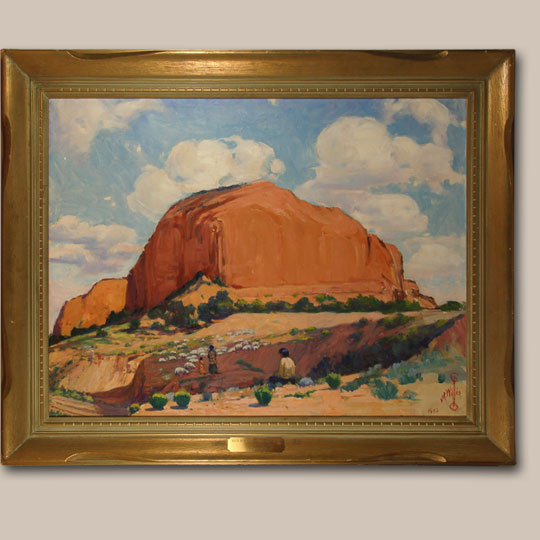 Joseph R. Willis (1876-1960) is best known for his Indian photographs and paintings and southwestern landscapes. Before moving to the Southwest, he had earlier traveled throughout the Southeastern part of the United States where he took advantage of the beauty of the region to paint many portraits and landscapes.
In 1917, he settled in Gallup, New Mexico, where he established a photography studio. Then in 1931, he moved to Albuquerque where he settled for the remainder of his life. After leaving Gallup, Willis spent more time painting than photographing. His style was realism, not unexpected since his eye was trained for photography. His paintings are not photo realistic, but are softer in presentation.