



Navajo Single Turquoise Cab Set in Lacy Silver Wire Ring - C4070W
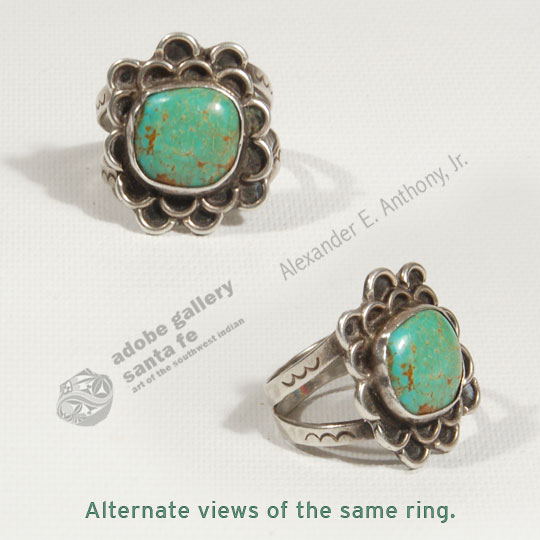 A series of small crescent-shaped pieces of silver mimic the petals of a flower surrounding a pretty, green turquoise cabochon in this lovely Navajo-made ring. An innovative Diné artist created this unique frame to highlight the beauty of an irregularly-shaped turquoise stone.
Rather than cut the turquoise to fit the setting, the artist made the setting fit the stone. The artist created an asymmetrical frame consisting of tiny silver wires shaped in half circles resembling the lacy texture of a flower.

#adobegallery #SouthwestIndianJewelry #Navajo #Diné #Silver #Turquoise #Jewelry #SantaFeNM #NavajoJewelry #SantaFeJewelry
Zuni Square Top Ring with Diamond Shape Turquoise Set in Silver - C4070A
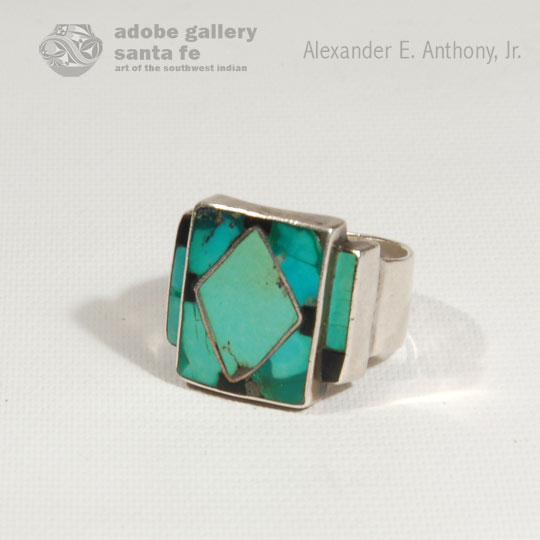 By all indications, this Zuni Pueblo-made ring dates from the 1930s or 1940s. It was artistically crafted, with sections of light green turquoise and jet set in silver channels. The center features a diamond- shaped turquoise cab placed in silver channels with jet at each of its corners, which was then set in a frame of silver channels and turquoise.
#adobegallery #SouthwestIndianJewelry #NativeAmericanJewelry #zuniJewelry #ZuniPueblo #Silver #Turquoise #Ring #SantaFeJewelry
Original Navajo Painting of a Colorful Bird at Night by Chethlahe - C4061
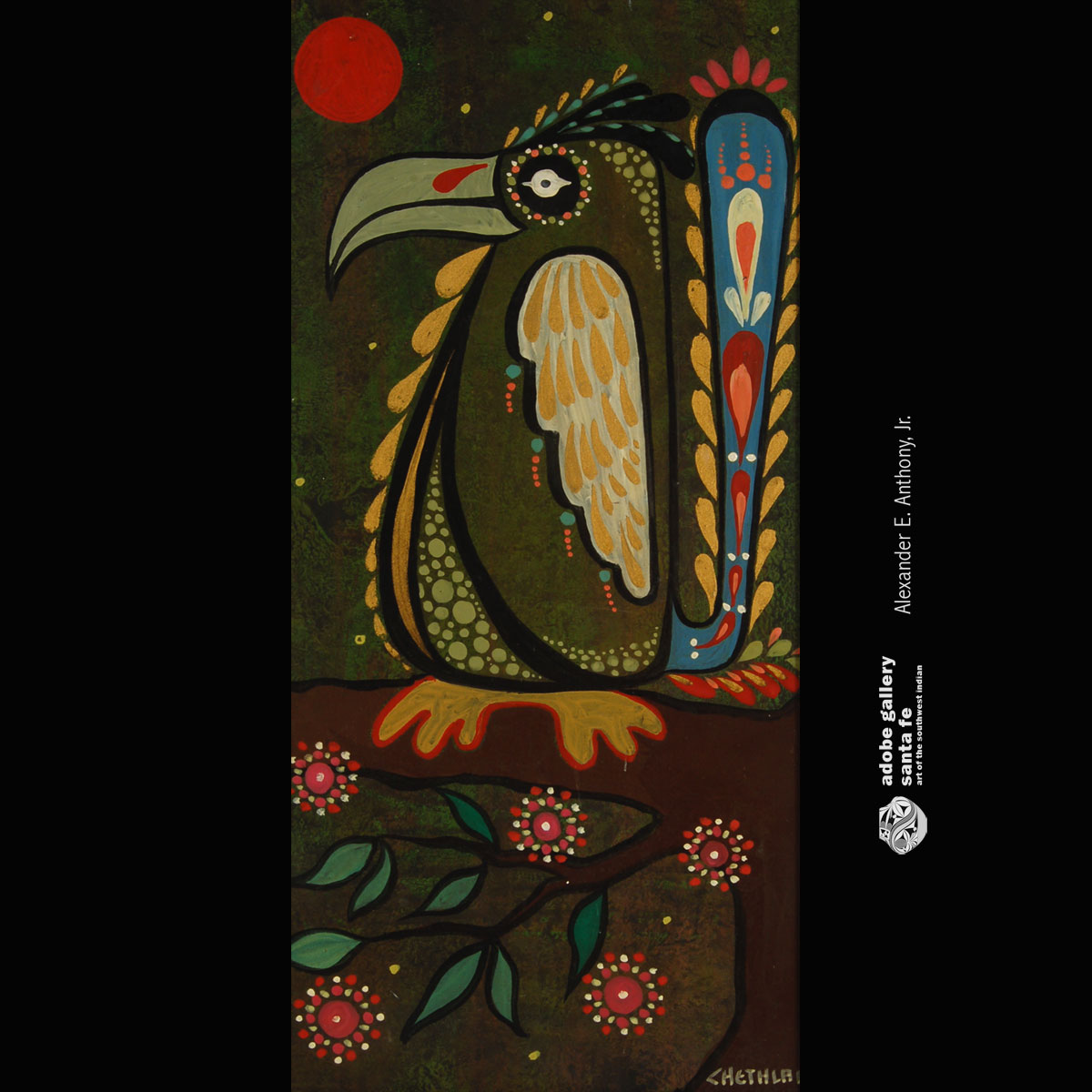 David Chethlahe Paladin (1926-1984) was a student of the Santa Fe Indian School, where he learned the basic fundamentals of painting from Dorothy Dunn. Dunn encouraged her students to document and celebrate their cultures. As a young man, Paladin struggled with his identity as the mixed-race son of a Navajo woman and a visiting white missionary. As he developed as an artist, he began to display a genuine affection for his Navajo culture. His style evolved considerably over the years, and ultimately drew from a wide variety of influences while always remaining grounded in his Native American roots. Paladin-a recovering addict and World War II prisonor of war survivor-was eventually trained as a shaman, using his uniquely challenging life experiences to serve the Huichol and Tarahumara tribes in Mexico as well as his native Navajo people, or *Diné.
Paladin's work evolved drastically over the course of his career, moving away from what was common among Native American artists of his time towards more abstract contemporary work. Though his methods changed over time, his preferred themes remained the same: spirituality, creation, and rebirth. Paladin depicted the same rituals, ceremonies and symbols as many of his Navajo contemporaries, but did so from a unique, constantly evolving perspective.
#adobegallery #SouthwestIndianPainting #NativeAmericanPainting #Navajo #PuebloPaintings #SantaFeNM #FineArt #Painting #Chethlahe
Rare Historic San Ildefonso Pueblo Very Large Dough Bowl - C4068B
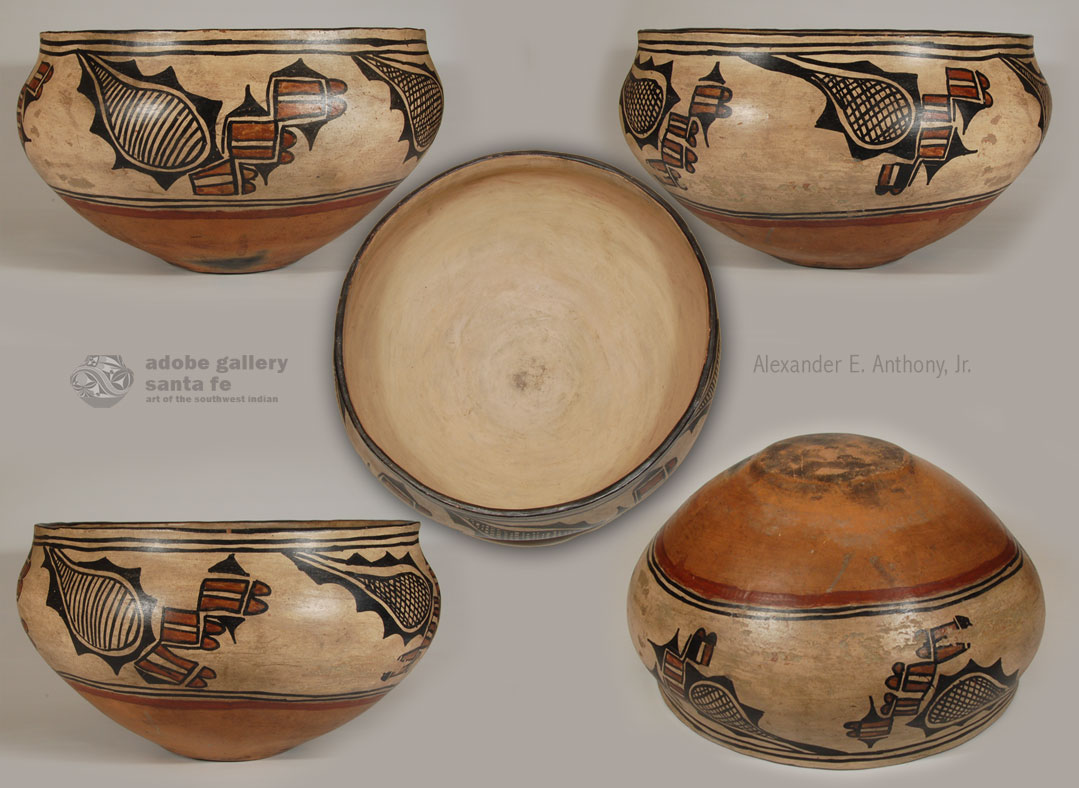 From extensive research, many early potters of San Ildefonso Pueblo have been identified and, in some cases, associated with some of their early works. Jonathan Batkin has associated some of the fine examples of San Ildefonso Polychrome pottery with Martina Vigil (1856-1916) and Florentino Montoya (1858-1918); Tonita Peña - Ba Tse - (1847-c.1910); Marianita Roybal (c.1850-c.1910); Dominguita Pino (1860-1948); and Tonita Roybal (1892-1945). The 1910 census lists eight women as potters by occupation. Batkin 1987:45
Dr. Bruce Bernstein is working on establishing the connection between male members who painted pottery for their mothers, sisters, and wives. Few female potters painted their own wares, leaving the art painting to male members of the family.
Batkin stated that "Tonita Peña's pots are among the most beautiful made at San Ildefonso at the turn of the century, and like Martina Vigil, Tonita Peña was among the last potters capable of making large storage jars." Batkin 1991:59
#adobegallery #SouthwestIndianPottery #SanIldefonsoPueblo #SanIldefonsoPottery #PuebloPottery #SouthwestIndianArt #SantaFePottery #FinePuebloPottery #HistoricPottery
Navajo Silver and Turquoise Stone Bracelet with Scallop Edges - C4069A
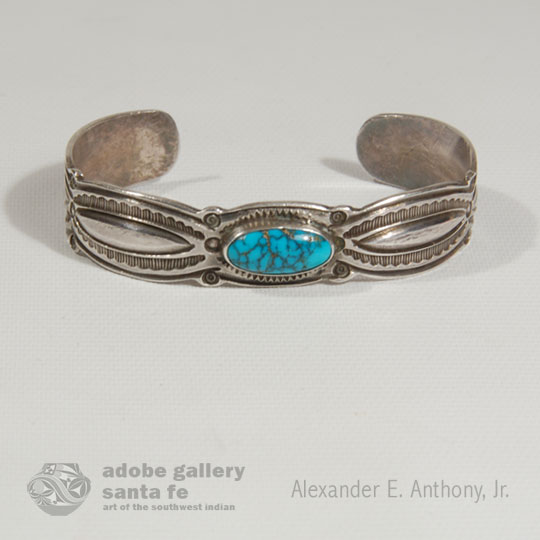 An elongated piece of high grade spiderweb turquoise rests on a band of sterling silver which has been decorated with repoussé domes. The repoussé technique requires the artist to work on the reverse side of the metal to form a raised design on the front. On this bracelet the raised ovals are framed with intricate sets of stampwork which accentuate the scalloped shape of the bracelet.
As is customary in Diné silverwork, the silver setting serves as a frame to accent the beauty of a single piece of turquoise. The center turquoise cabochon in this bracelet is robin's egg blue with a beautiful matrix. The piece was made in the mid-20th century, but is not a tourist piece, as the silver is more substantial than what was used in a typical Fred Harvey souvenir. The unsigned bracelet was created by an unknown, but highly skilled, silversmith.
#adobegallery #SouthwestIndianJewelry #Navajo #NavajoNation #Silver #Turquoise #Jewelry #SantaFeNM #NavajoJewelry
Historic Laguna Pueblo Small Olla with Boldly Colored Flowers - C4068o
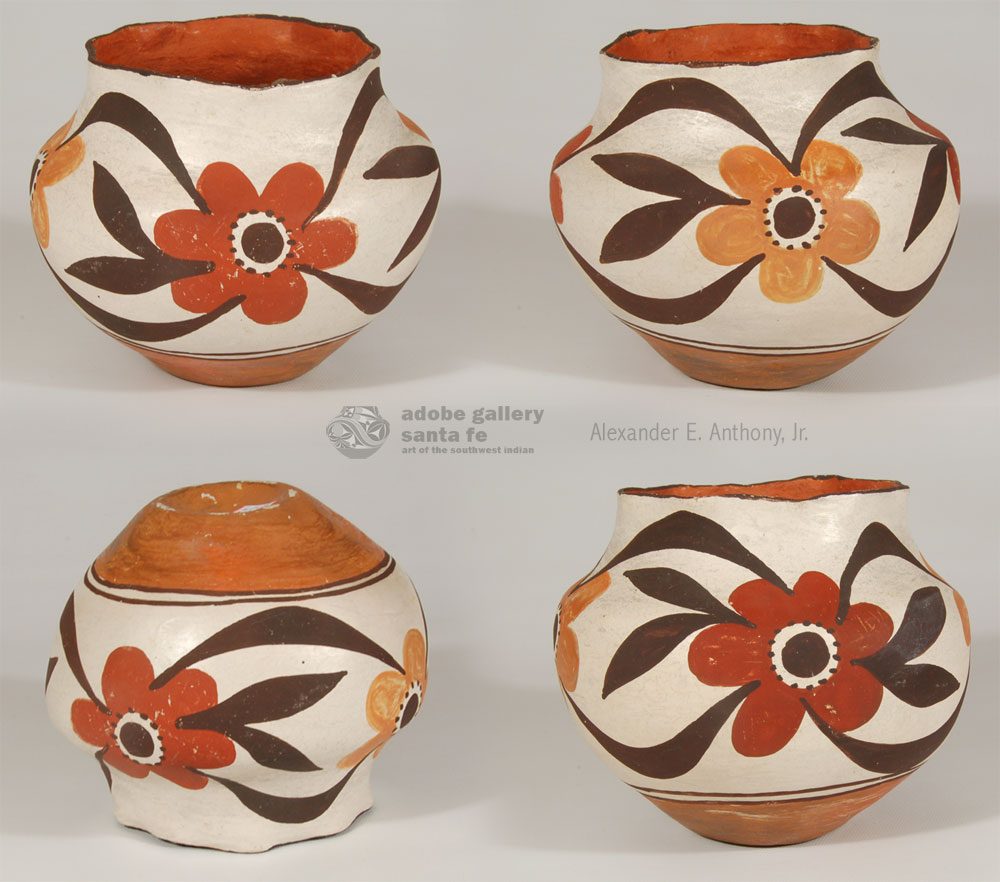 Laguna Pueblo is a nearby neighbor of Acoma Pueblo in Western New Mexico. Laguna was founded in 1699 by members of Acoma, Zuni and other pueblos following the upheavals and disruptions caused by the The Pueblo Revolt of 1680-also known as Popé's Rebellion. Pottery from Laguna resembles that of Acoma and it is generally difficult to distinguish between the two. Some designs, however, seemed to predominate at Laguna and those differed from designs used at Acoma.
When the transcontinental train came to New Mexico, it passed directly adjacent to Laguna Pueblo and there was a depot nearby. The train made stops at the pueblo to allow the travelers to purchase wares from the potters. The Laguna potters soon realized that the travelers preferred vessels that were easy to transport in their luggage or hand carry on the train. It was then that smaller versions of traditional vessel shapes developed.
#adobegallery #SouthwestIndianPottery #LagunaPueblo #IsletaPottery #PuebloPottery #SouthwestIndianArt #SantaFePottery #FinePuebloPottery #HistoricPottery
Navajo Silver and Turquoise Bracelet with Three Beautiful Stones - C4069C
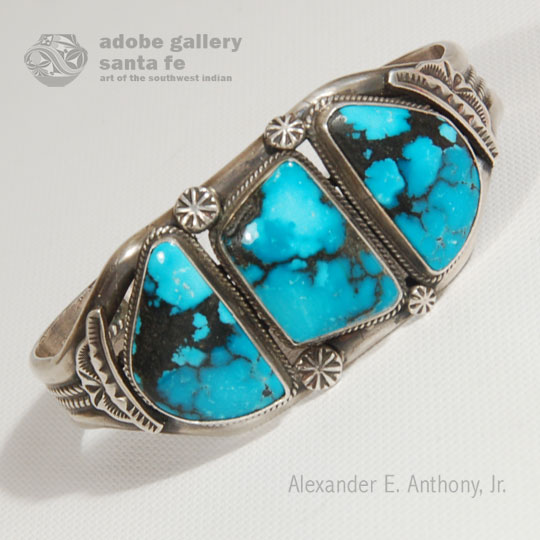 Three stunning deep blue cabochons are the centerpiece of this unique bracelet. As we are not experts in turquoise, we are not going to attempt to label the source of these stones. The depth and variation in color are spectacular regardless of its origin. The center cabochon is an irregular shaped rectangle set in a smooth handmade bezel surrounded by a small twisted wire and four star shaped silver drops. On either side of the center are two similarly shaped stones whose remarkable black matrix adds an almost three dimensional aspect to the bracelet.
The three unique stones are carefully soldered onto a solid base consisting of two twisted wires and two substantial bars of sterling silver. A small stamped crescent is appliqued on each side at the top of the shank where the four sections of silver merge. The bracelet dates from the mid 20th century. Nature created a masterpiece when she created these stones and an unknown, talented Diné silversmith set the masterpiece in silver.
#adobegallery #SouthwestIndianJewelry #Navajo #NavajoNation #Silver #Turquoise #Jewelry
#SantaFeNM #NavajoJewelry #TheCityDifferent
Apache Very Large Pictorial Basket Bowl - C4068C
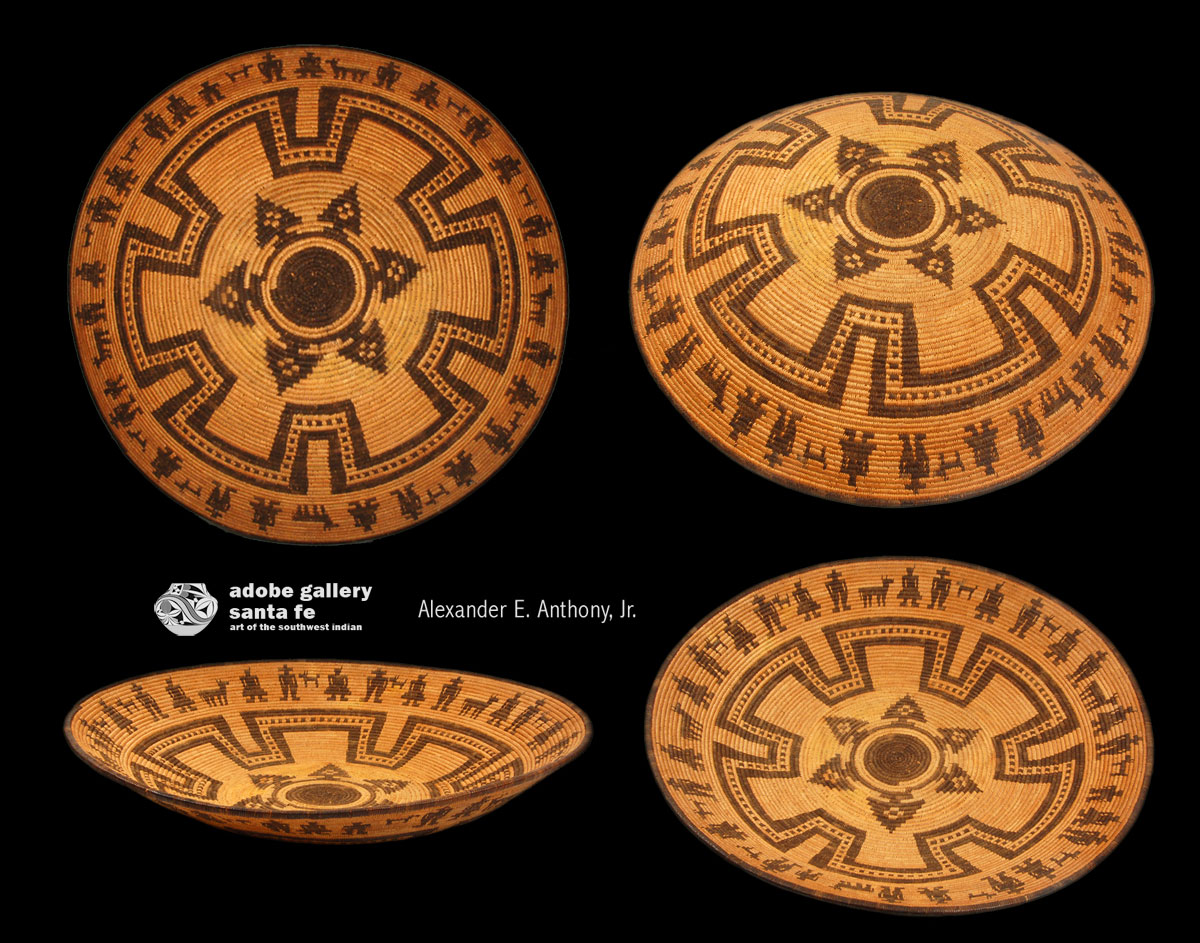 There are some baskets that demand one's attention and admiration. This world-class Apache basket bowl is large in size (22 inches) and amazing in design-39 animal and human figures. Such a basket must have required a year or more to make. The materials used for making it had to be gathered in a particular season when they were mature. Once gathered and stored, each blade of material had to be treated individually, such as splitting each to the correct width for the weft design. Devil's claw requires peeling the skin off the core of the plant. Foundation rods require soaking so that they can be properly bent.
Once all the materials have been gathered and prepared, the weaver can start making the basket. A basket of this size certainly could have taken her a year to complete. Each of the animal and human figures and other designs required a change of materials during the weaving process. This is a time-consuming procedure . To undertake such a monumental project requires the patience and skill of a master weaver.
#adobegallery #SouthwestIndianBaskets #Apache #Baskets #ApacheBaskets #IndianBaskets
#SantaFeNM #VisitCanyonRoad
Historic Isleta Pueblo Polychrome Small Serving Bowl - C3924S
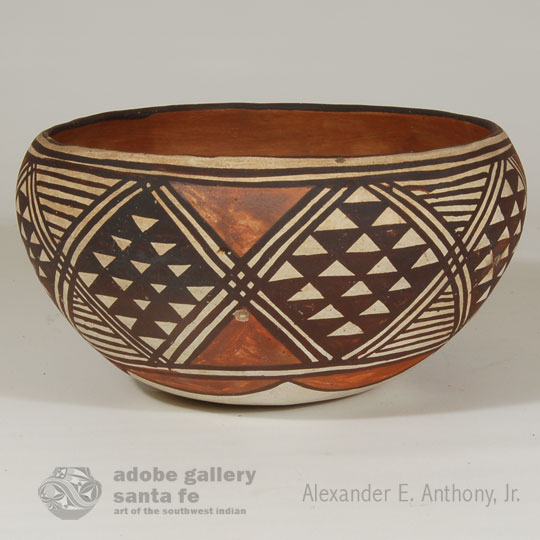 This bowl is typical of Isleta Polychrome pottery from 1880 to the present. At that time, Isleta potters learned new techniques and new designs to replace the traditional orange wares that were devoid of design. The poor quality red clay at Isleta was not suitable for making high-quality thin-walled pottery. Pottery from Isleta of that time is not in large quantity in any museum collection because it was not considered worthy of such. When one looks at it today, however, it is amazingly beautiful in its color purity and simplicity.
The change occurred in 1880 when a large group of Laguna Pueblo Indians permanently moved and set up a village near Isleta which they named Oraibi. The massive move was a result of a dispute within Laguna. The Laguna women were makers of polychrome pottery and they took the techniques and designs with them. Not only were the designs and colors attractive to potters at Isleta, the Laguna potters knew how to use proper temper to achieve strong and thin walls. Eventually, the Laguna style became the Isleta style and Laguna designs still appear today on pottery from Isleta.
#adobegallery #SouthwestIndianPottery #IsletaPueblo #IsletaPottery #PuebloPottery #SouthwestIndianArt #SantaFePottery #FinePuebloPottery #HistoricPottery
Zuni Pueblo Large Pottery Owl with two Owlets - C3974D
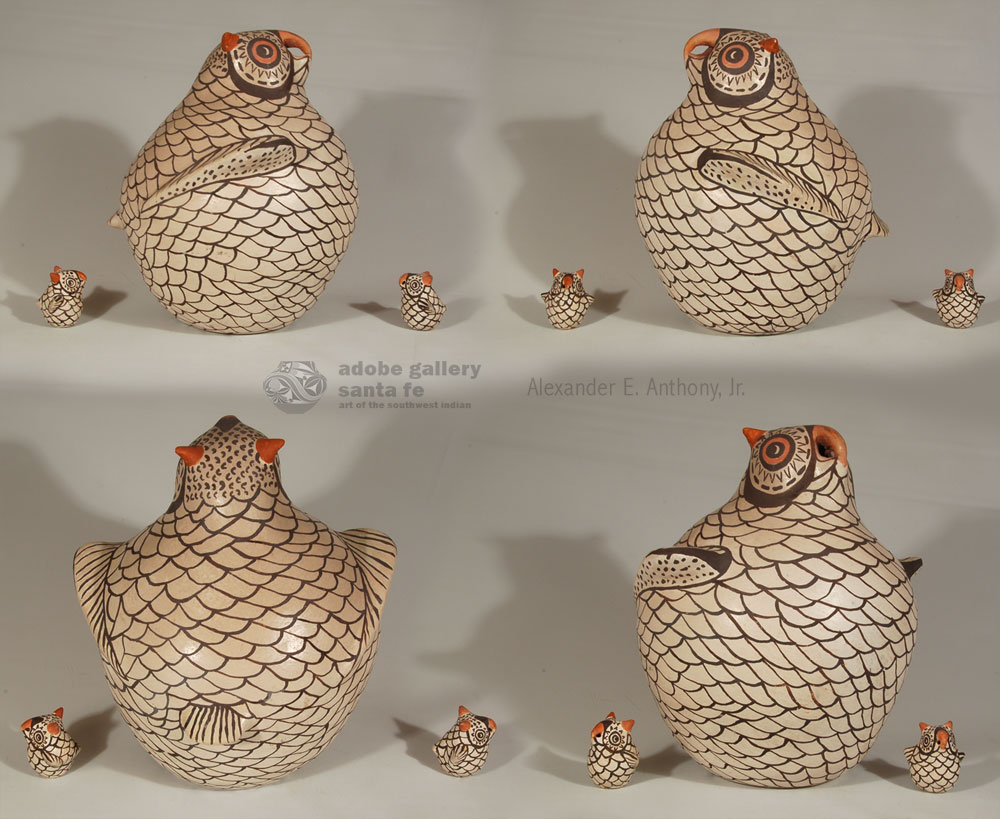 Pottery making at Zuni almost died out at the beginning of the 20th Century. Believing the Zuni were a "vanishing race," anthropologists from Eastern museums participated in the almost complete removal of pottery from the Pueblo. Boxcars were filled with ollas, dough bowls and other examples of Zuni material culture and sent back East. Young potters had no examples to look at, and residents of the pueblo had to rely on commercially-made vessels and containers for daily use. The art and tradition of pottery making almost died out. Because jewelry was easier to ship, traders encouraged artists to make jewelry instead of pottery.
It was not until the mid-20th Century, under the tutelage of Hopi potter Daisy Hooee, was there a revival of the tradition of pottery making. Hooee, the granddaughter of Hopi potter Nampeyo of Hano, was married to Sidney Hooee, a Zuni silversmith. She lived at Zuni and taught pottery making. Since that time, there has been a gradual revival of pottery making at Zuni.
#adobegallery #SouthwestIndianPottery #ZuniPueblo #PuebloPottery #SantaFePottery #FinePuebloPottery #SantaFeNM #ContemporaryPottery
Laguna Pueblo Small Historic Pottery Jar - C3925V
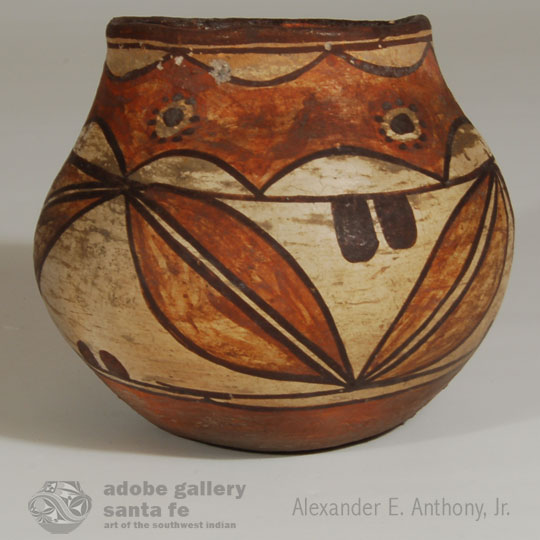 Small jars, such as this one, were certainly made for the tourist and collector market, as they had no daily function in a pueblo home. That does not diminish their importance in any way as they are just as historically relevant as something made for daily use in the home.
The design on the body is comprised of large split leaves and the neck design is a continuing rainbow arc. The jar tilts slightly and has an aged patina.
#adobegallery #SouthwestIndianPottery #LagunaPueblo #LagunaPottery #PuebloPottery #SouthwestIndianArt #SantaFePottery #FinePuebloPottery #HistoricPottery
Hopi Silver Overlay Belt with Talavai Katsina Mask by Manuel Hoyungowa - C4063E
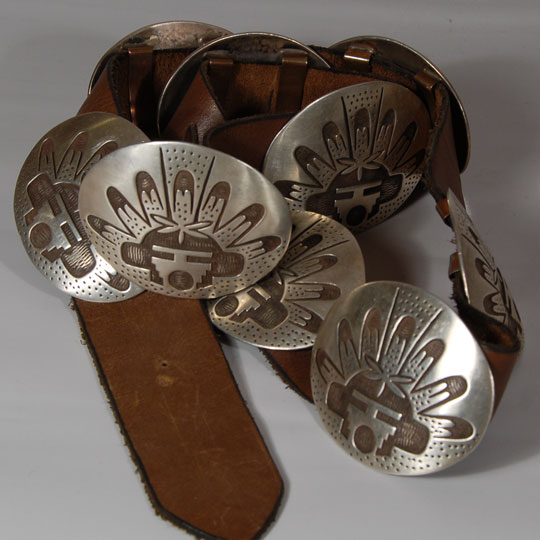 "The Talavai Kachina formerly appeared in pairs on the rooftops and sang songs, waking the people in the village. During the day they would dance with the other kachinas whom they led and prompted in the singing. This role is no longer used in any of the villages. They still appear with the other kachinas in the Powamu Ceremony and are most often standing in a set to one side of the main movement of the procession. Occasionally they sing as they stand holding their spruce trees and ringing their bells." Barton Wright 1973
#adobegallery #SouthwestIndianJewelry #NativeAmericanJewelry #HopiJewelry #HopiPueblo #Silver #ConchaBelt #SantaFeNM #TheCityDifferent
Navajo Sterling Silver Cast Belt Buckle with Five Stones - C4063i
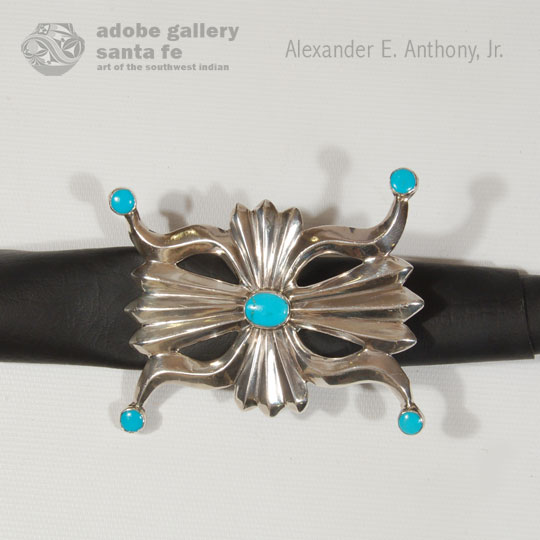 There is speculation about exactly when Navajos learned to work with silver, but most agree that the first smith was a man named Atsidi Sani (Old Smith). He went on to teach the craft to his relatives. By the beginning of the 20th Century, most parts of the reservation had working silversmiths.
One of the first methods used by Navajo silversmiths was the casting method. A design was carved into tufa stone and molten silver poured into the mold. After it cooled the artist would remove the piece and finish it off by adding stones or other embellishments.
#adobegallery #SouthwestIndianJewelry #Navajo #Diné #Silver #Turquoise #Jewelry #SantaFeNM #NavajoJewelry #SantaFeJewelry
Navajo Very Large Crystal Trading Post Rug - C3925A
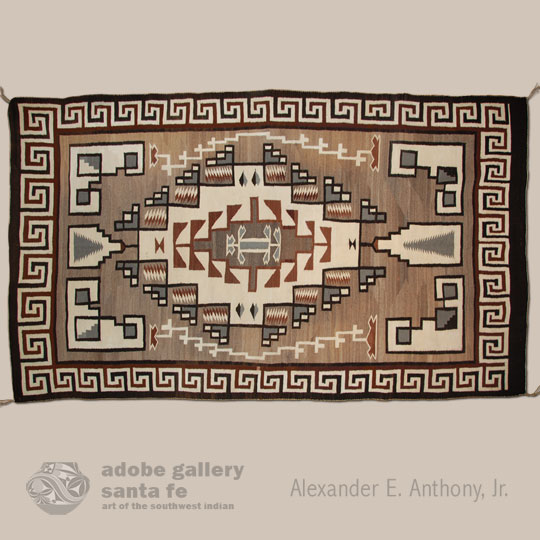 This is a Navajo Very Large Crystal Trading Post Rug, circa 1940s. The basic field of this Navajo textile was woven from all native wool, carded from brown sheep and white sheep, resulting in a beautiful blend of varying brown shades of color. The other carded color is gray, a blend of white and black yarns. It is possible that the black wool has been overdyed with commercial dye to enhance its color, otherwise, there is no dye in the rug.
#adobegallery #Navajo #Textiles #Blankets #Rugs #Diné # CrystalTradingPost #NavajoRugs #SouthwestIndianTextiles #SantaFeNM #TheCityDifferent
Very Large Historic Cochiti Pueblo Storage Jar - 26063
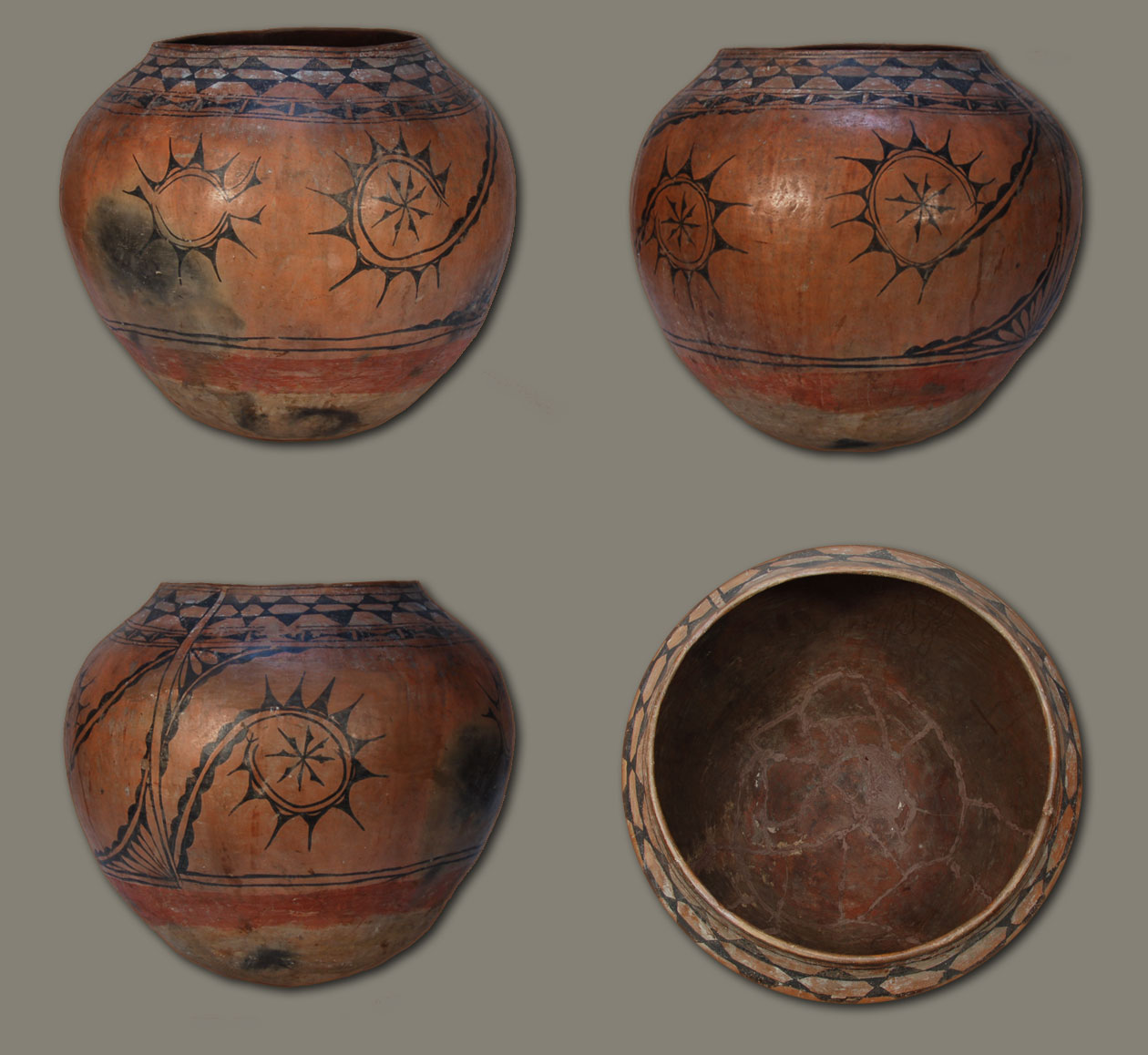 he historic period of pueblo pottery has been defined as beginning with the first contact with Europeans in 1540, the reasoning being that it was the Europeans who began documenting events, creating a history of the area, which was a logical beginning of the historic pottery period. At that time, pueblo potters made pottery for their own use and as a trade item to members of other pueblos or tribes.
With the arrival of the Spanish, the market for pueblo pottery greatly increased as it was easier and smarter to procure pottery from local pueblo potters than to wait for imports to arrive on the Camino Real from Mexico City, a journey that took over 6 months to complete. New shapes and new sizes of pottery were developed to satisfy the needs of the new markets. Large storage jars were standard measurements of volume to facilitate trade of wheat or grains to the market. In some cases, the historic jar in which the grain was stored was given with the sale of the grain as it was considered only a container of the product being sold. One wonders if the purchaser of a jar full of grain used the product then discarded the container.
#adobegallery #SouthwestIndianPottery #cochitiPottery #PuebloPottery #SouthwestIndianArt #SantaFePottery #FinePuebloPottery #VisitCanyonRoad #HistoricPottery
Circa 1950, Hopi Pueblo Sio Salako Katsina Doll - C4050E
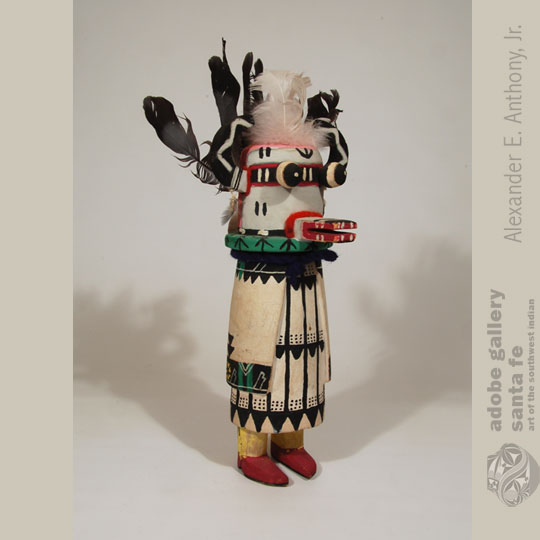 "The Sio Salako is a Hopi interpretation of the Shalako Ceremony of Zuni and thus receives the name Sio (Zuni). Sio Salako is portrayed like neither the Zuni nor the Hopi Salako but is instead a separate entity. He was introduced to the Hopis by a Tewa man around 1850 and first appeared as a group of four kachinas. Since that time changes in ceremonial have reduced the number to one and added Salako Manathat formerly did not appear.
"He appears in late spring on very rare occasions and is thought to be especially efficacious in bringing rain. A view of this nine-foot kachina is a rare sight indeed." Wright 1973
The basic difference in costume of the Zuni Shalako Katsina and the Hopi Sio SalakoKatsina is in body dress. Zuni Shalako are clothed in a white manta below the embroidered shoulder wrap. The Sio Salako at Hopi retains the Hopi style of feathers covering the body. The shoulder wrap is the same style as that at Zuni. The difference between the male and female version of the Sio Salako is that the male wears traditional moccasins and the female wears the white doe skin moccasins with leg wraps.
#adobegallery #HopiPueblo #Katsina #Kachina #SioSalako #Doll #SouthwestIndianArt #PuebloArt #SantaFeNM
Teec Nos Pos Regional Navajo Rug - C3969A
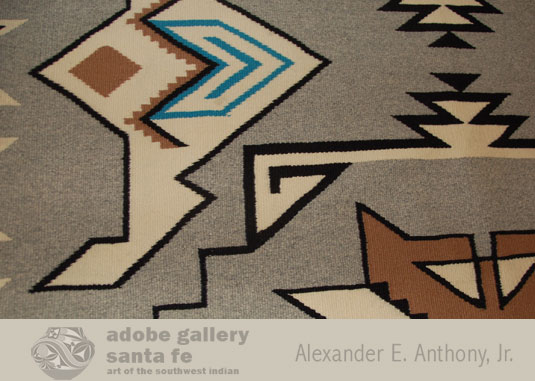 Navajo rugs from the Teec Nos Pos area of the Navajo Reservation are considered the most beautiful designed rugs of all and, at the same time, considered the least Navajo of all. The designs have been influenced by early traders at the trading post providing designs of Persian rugs to the weavers and, in one instance, painting such designs on the exterior walls of the trading post in the hopes that the weavers would copy those designs.
Teec Nos Pos (circle of cottonwoods) Trading Post was established in 1905 by Hambleton (Hamp) Bridger Noel, the first white man who was able to win the approval of the local Navajo to set up a trading post on their land. Ten years earlier, two potential traders were driven off. Hamp Noel married Eva Foutz in 1911 and eventually the Foutz family took over the post and still operate it today.
Teec Nos Pos rugs generally have large geometric figures arranged on a central rectangular plane. Before the 1940s, almost all the wool used for warp and weft was handspun and hand dyed. After World War II, the weavers began to use commercial 4-ply wool and then 3-ply Germantown wool in small amounts as filler elements. The trading post stocked these commercial yarns in vibrant colors desired by the weavers.
This Navajo textile follows the traditions of Teec Nos Pos in design and use of many colors. The center field is comprised of a commercial yarn grey background. There are three main design elements down the center of the textile and two triangular design elements on either side. Each of the three central elements is enclosed in an outline black stepped design. Yarn colors of brown, black, turquoise, red and white are used as accent designs.
#adobegallery #Navajo #Textiles #Blankets #Rugs #Diné #TeecNosPos #NavajoRugs #SouthwestIndianTextiles #SantaFeNM #TheCityDifferent
Hopi Pueblo Elaborately Designed Polychrome Jar by Rondina Huma - C4052F
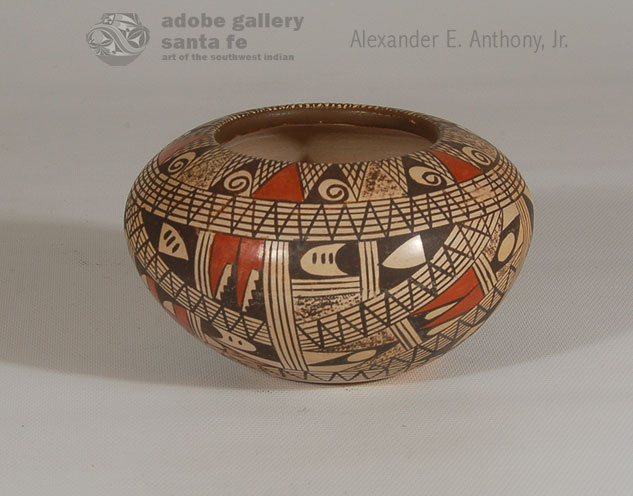 Rondina Huma's intricately designed pottery has been one of the most sought-after for over a decade. She has been featured in many publications and her work is represented in major galleries and museums throughout the country. There is no mystery as to why she has won many awards over the years for her exquisite work. She deserves every accolade bestowed on her. Her pottery is traditional in every manner. She hand coils all the vessels and uses only vegetal and mineral paints. Traditional firing is carried out as well. It is reported that she no longer can make pottery due to sight problems, a great loss to collectors.
This small jar is as magnificent as her larger works. It is filled with designs throughout its entire surface.
#adobegallery #SouthwestIndianPottery #SanIldefonsoPueblo #PuebloPottery #SantaFePottery #FinePuebloPottery #SantaFeNM #ContemporaryPottery #RondinaHuma
Hand Blown Replica of a Historic Acoma Olla - Mesa Pot - C4055i
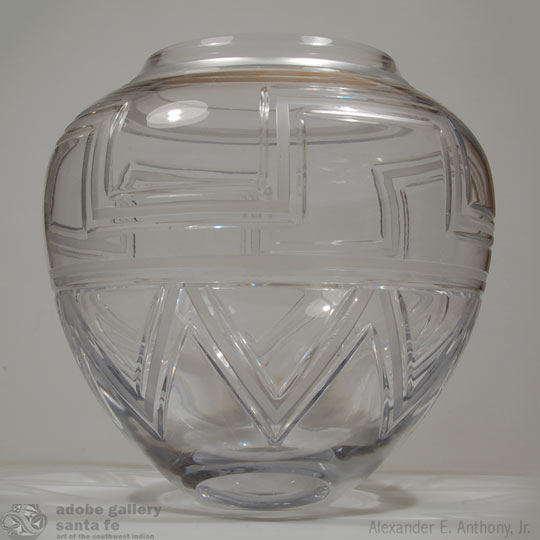 In the early 2000s, Nambe Mills of Santa Fe collaborated with the Museum of Indian Arts and Culture to create a limited edition of hand-blown crystal pottery vessels inspired by pieces in the museum's collection. Nambe Mills selected Rogaska Crystals of Croatia, to perform the hand-blown process to make the jars.
Nambe and Rogaska produced glass replicas of five different pueblo jars. According to Nambe staff, there were approximately 1000 hand-blown glass replicas of each historic jar.
#adobegallery #SouthwestIndianPottery #AcomaPueblo #PuebloPottery #SantaFePottery #FinePuebloPottery #SantaFeNM
Very Large Historic Acoma Pueblo Olla - C3969K
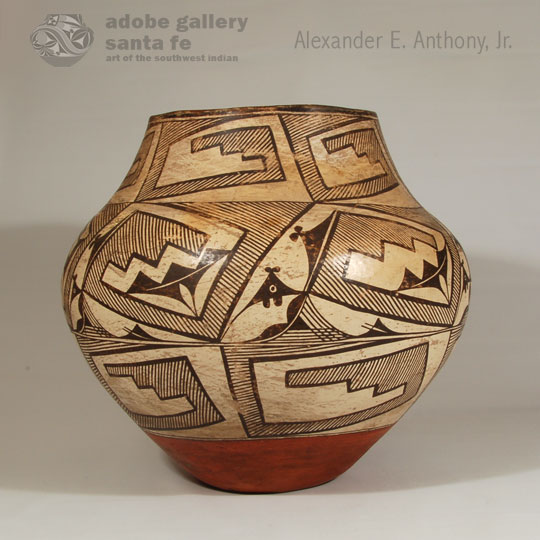 Early Acoma Black-on-white ollas generally have bold designs such as seen on this jar. The mid-body design features canted rectangles comprised of bars filled with black parallel fine lines. There are three horizontal bands with these elements-neck, mid-body and lower body. Jars with bounded hachure lines like these became very common after 1890. Harlow & Lanmon p.158
Complimentary with the bounded hachure designs are black triangles, triangular caps with paired ears, some of which have an eye in the middle. Those elements are limited to only the center band of design. This design facilitates dating this jar to circa 1900.
#adobegallery #SouthwestIndianPottery #AcomaPueblo #PuebloPottery #SantaFePottery #FinePuebloPottery #SantaFeNM #HistoricPottery