



Historic Laguna Pueblo Small Pottery Olla - C4068L
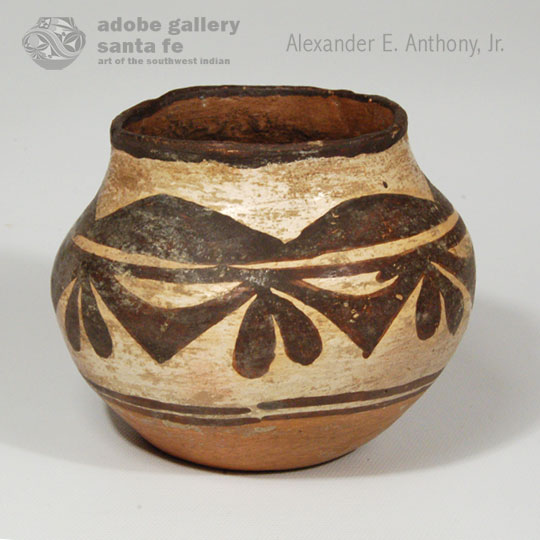 When the Atchison, Topeka and Santa Fe Railway arrived in New Mexico in 1879, it made a daily stop at Laguna Pueblo. It stopped long enough to allow passengers to get out of the train and visit with the pueblo residents and, in most cases, make a purchase from the potters. Laguna potters readily adapted their wares to items they thought the travelers would like as well as items that they could easily carry on the train conveniently. They made traditional water jars and bowls with which they were familiar, only they made them in diminutive scale.
This small water jar is typical of the size made for the tourist trade. It was not a size that had a function for a pueblo household. Interestingly, no shortcuts were taken by potters in making these smaller items. All materials were traditional to the pueblo and were the same materials used in pottery made for their own use. Only the size was different.

#adobegallery #SouthwestIndianPottery #LagunaPueblo #LagunaPottery #PuebloPottery #SouthwestIndianArt #SantaFePottery #FinePuebloPottery #HistoricPottery #IndianMarketCountdown2018 #NativeAmericanArts
Very Large Western Apache Open Bowl Basket - C4091A
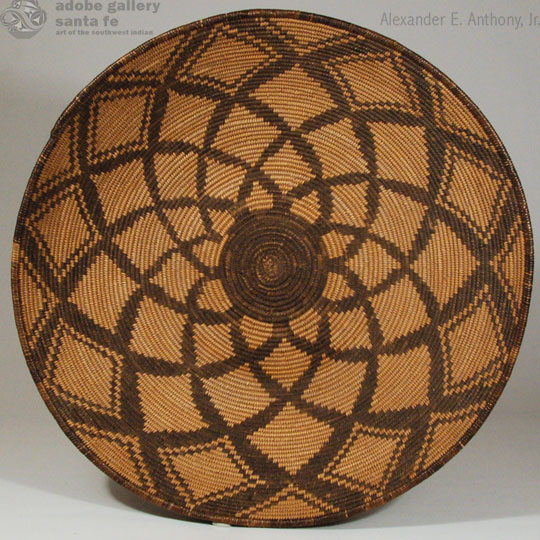 Western Apache basketry of the late nineteenth and early twentieth centuries is the best basketry of the Southwestern tribes and they are treasured by museums and collectors. The Western Apaches were not a single tribe but consisted of five separate and completely independent tribes-the Cibecue, San Carlos, White Mountain, and Northern and Southern Tonto. They are now considered collectively as Western Apache.
Basket makers of those Apache tribes made some of the largest ollas and bowls of any tribe of the Southwest. They also were some of the finest baskets made. The basket makers made baskets of the sizes with which they were familiar, sizes consistent with what they made for their own use. It is not unusual to see large bowls, such as this one, and large ollas standing over three feet tall. It is as if the basket makers were making sizes they could use and not be concerned whether someone wanted to purchase it or not.
That is quite likely the scenario with this oversized bowl. It was of a size that could be used for winnowing or storage by and for an Apache. If a client wished to purchase it, it would be for sale. If not, it would be for use by the maker.
#adobegallery #NativeAmericanBasket #SouthwestIndianBaskets #Apache #Baskets #ApacheBaskets #IndianBaskets #SantaFeNM #IndianMarketCountdown2018 #NativeAmericanArts
Hopi Pueblo Sakwa Hu Katsina Doll - C4104A
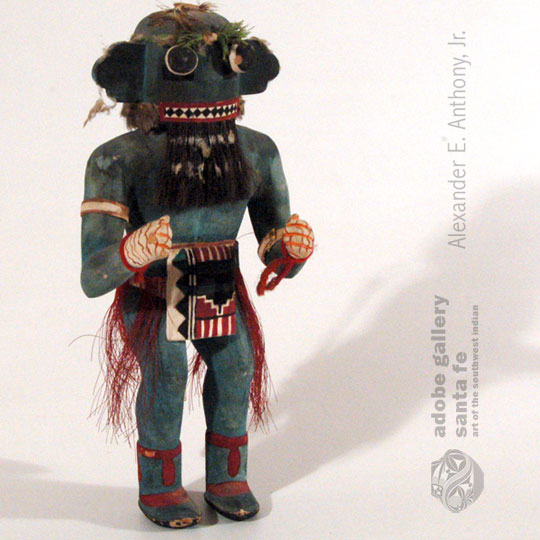 The Hopi Hú Katsina and the Sakwa Hu Katsina are quite different. The Sakwa Hu(Sakwa designating the directional color blue) is an old Katsina that has appeared with a great deal more frequency on Third Mesa. "He is most often portrayed by a small boy and accompanies the procession of the chief kachinas about the village as a guard during the Powamu in February." Wright 1973
The Hú Katsina is a participant in the initiation ceremony of young boys. The Crow Mother and her two sons, the Hu Katsinas, come to the kiva and give the initiates four strokes with their yucca whips.
This Sakwa Hu Katsina doll is an exceptional representation of the actual Katsina as it appears in reality. His body is painted blue and he has a long beard and red hair skirt. His moccasins are blue. A pair of grouped feathers is tied to the top of the mask, however, one of them is missing the feathers in this instance. This Hopi Pueblo carving appears to be circa 1950s.
#adobegallery #HopiPueblo #Katsina #Kachina #Doll #SouthwestIndianArt #PuebloArt #SantaFeNM #SakwaHu
Hopi Pueblo Soyaitaqa - Planting Stick Boy Katsina Doll - C4041D
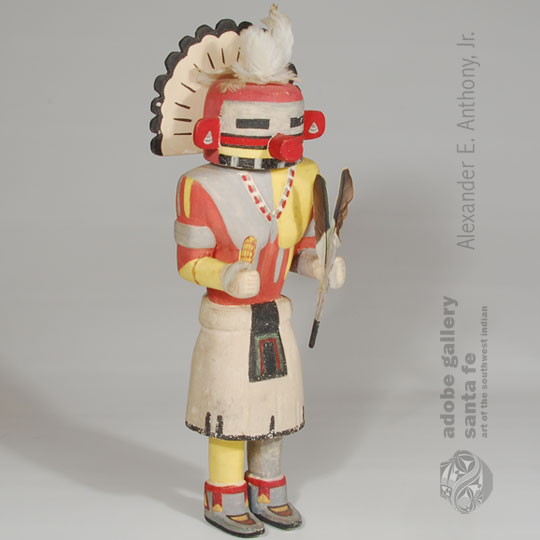 We had difficulty identifying this katsina doll when it first arrived, so we sent a photo to a friend on whom we rely when we have questions on katsinas or katsina dolls. He identified it as a Soyaitaqa Katsina, for which we were thankful. We then undertook a search through all the Hopi katsina books but could not find any listing for such a katsina, so back to our friend and he then referred us to a reference from Bahti Indian Arts. Thanks to our friend and to Mark Bahti for this assistance.
The katsina is spelled Soyaitaqa or Sooya'ytaqa and defined as "Planting Stick Boy." According to Mark Bahti, he has also been called a Laguna Gambler, but the origin of that misnomer is unknown. Bahti says another name given him is Koyung Taqa or Turkey Boy because of the fan of turkey feathers behind his head.
The katsina is one of the many Corn katsinas. There are several varieties of the Corn katsina, which is understandable as the Hopi grow several types of corn-red, yellow, white and blue. Bahti states that Corn katsinas represent the spirit of the corn plant, which provides life for the Hopi. The planting stick is used to penetrate the earth when planting seeds.
#adobegallery #HopiPueblo #Katsina #Kachina #Doll #SouthwestIndianArt #PuebloArt #SantaFeNM
Hopi Pueblo All Wood Talavai - Morning Katsina Doll by Kevin Pochoema - C4096C
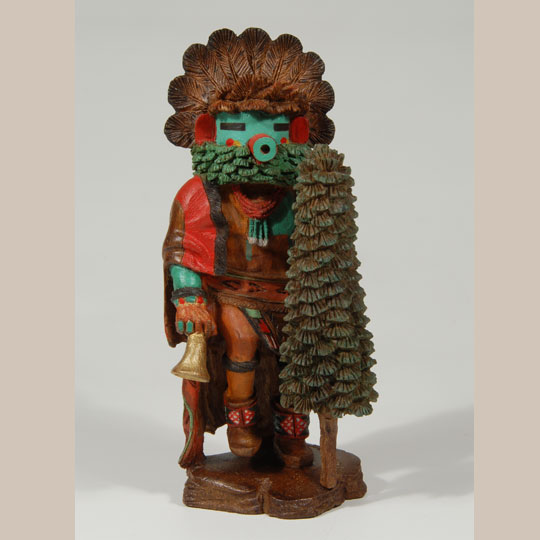 Kevin Pochoema surprised me when he walked into the gallery in February 2015 with this Morning (Talavai) katsina doll because I had not seen him in over 15 years. I used to visit him on the Hopi Reservation in an attempt to purchase katsina dolls from him because I always thought he was probably the best carver on the reservation. I never succeeded in getting any dolls from him because a dealer from Taos at that time purchased everything he carved. Now that Taos dealer is no longer in business, so we have been getting more carvings from him.
We sold this katsina doll shortly after acquiring it from Kevin and now we have it back to sell again because of family financial problems of the purchaser. I am pleased to have this Morning Katsina back again because it is one of my favorite katsinas.
#adobegallery #HopiPueblo #Katsina #Kachina # #Doll #SouthwestIndianArt #PuebloArt #SantaFeNM #KevinPochoema
Historic Kewa Pueblo Large Polychrome Pottery Moccasin - C4099C
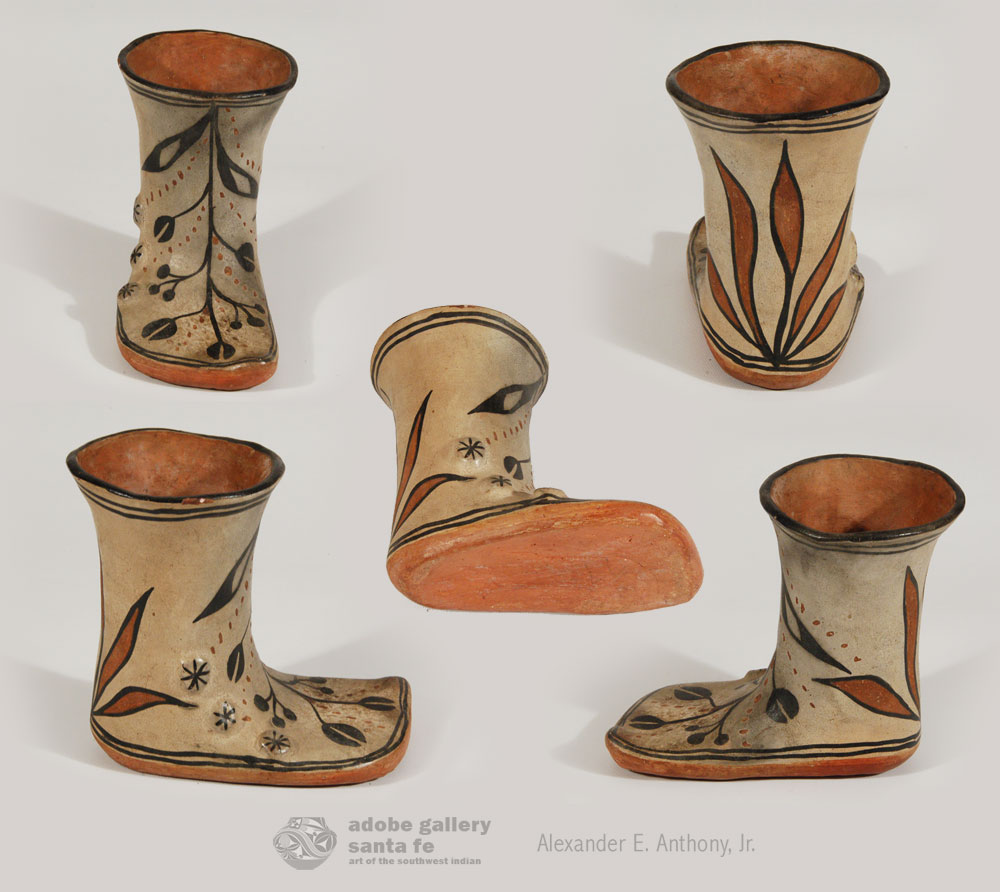 Tourists have always been fascinated with pueblo pottery, but the large, traditional bowls and jars that were in use in the pueblos in the late 19th century were too cumbersome to travel with, so the pueblo potters began making small souvenir pieces. Pottery moccasins filled this need. They were made at several of the pueblos in the late 1800s and early 1900s, following the arrival of the train on the Atchison, Topeka and Santa Fe Railway in 1879.
This moccasin from Santo Domingo Pueblo is well above the average of those made in the early 1900s. It is larger and more elaborately painted with floral designs. Additionally, three moccasin buttons were fashioned on one side, something not seen on most pottery moccasins. This is an exceptional one.
#adobegallery #SouthwestIndianPottery #KewaPueblo #KewaPottery #PuebloPottery #SouthwestIndianArt #SantaFePottery #FinePuebloPottery #HistoricPottery
Ohkay Owingeh Pueblo Polychrome Jar by Alvin Curran - C4100B
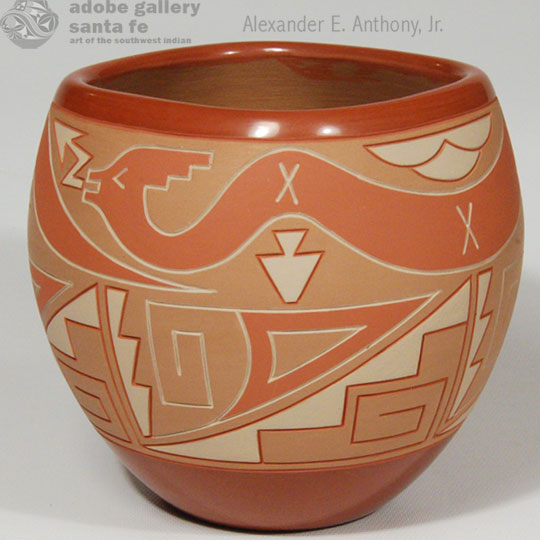 Alvin Curran was the only male potter at Ohkay Owingeh (formerly San Juan Pueblo) at the time he was potting there. He was part Ohkay Owingeh and part Quechan, a desert people along the southwest border between Arizona and California. He began living at Ohkay Owingeh at the age of one year with his maternal grandparents. He served as Chief of Police at the pueblo until his health prevented him from doing so. At that time, his mother-in-law encouraged him to learn to make pottery because she thought he would do well since there were few potters at the pueblo and he would be the only male potter.
Curran certainly learned rapidly and well. His pottery is the finest of all the traditional Ohkay Owingeh pottery produced in the last quarter of the 20th century. His designs were meticulously outlined in pencil, and then carved into the clay, once Curran was satisfied with the overall appearance. If not satisfied, he sanded off the pencil designs, and started anew.
#adobegallery #SouthwestIndianPottery #OhkayOwingehPueblo #OhkayOwingehPottery #PuebloPottery #SouthwestIndianArt #SantaFePottery #FinePuebloPottery #ContemporaryPottery #AlvinCurran
San Ildefonso Carved Design Shallow Bowl by Rose Gonzales - C4098B
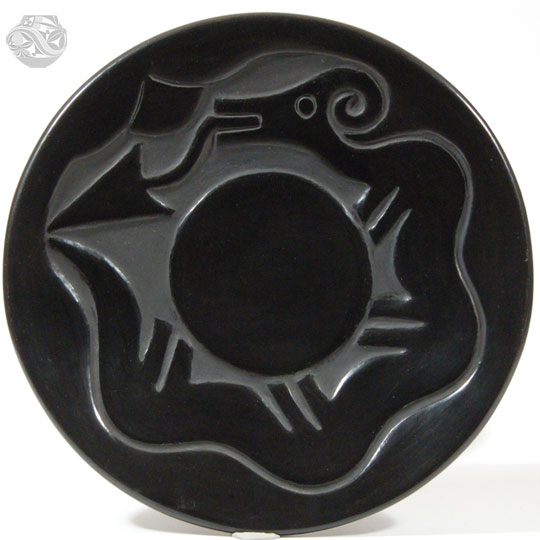 Around 1930, Rose Gonzales began carving pottery at San Ildefonso Pueblo. She soon was joined by neighbor Rosalie Aguilar and others. Rose said she got the idea when her husband brought home an ancient carved pottery shard. He found the piece while on a deer hunting trip. Rose liked the style and began carving pottery. About the same time at Santa Clara Pueblo, members of the Tafoya family began carving pottery.
Rose was born at San Juan Pueblo (now Ohkay Owingeh) around 1900. Her parents died from the swine flu epidemic, leaving Rose and her sister, Pomasena, orphans. The girls survived by staying at the Santa Fe Indian School. An elder woman relative, Mary Cata, adopted the girls and took care of them. In 1920, Rose married Robert Gonzales and moved to his pueblo of San Ildefonso. Pomasena also moved to San Ildefonso, living with Rose and Robert. Robert's mother, Ramona Sanchez Gonzales, was an excellent potter who taught young Rose how to make pottery.
#adobegallery #SouthwestIndianPottery #SanIldefonsoPueblo #SanIldefonsoPottery #PuebloPottery #SouthwestIndianArt #SantaFePottery #FinePuebloPottery #ContemporaryPottery #RoseGonzales
San Ildefonso Pueblo Small Wedding Vase signed Marie / Julian - C4099A
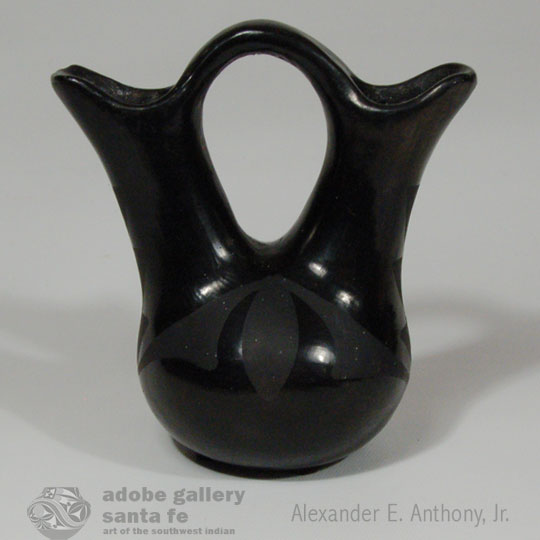 Excavations on the Pajarito Plateau (now Bandelier National Monument) were begun in 1907 under the auspices of Dr. Edgar L. Hewitt of the newly founded School of American Research in Santa Fe. Men from San Ildefonso Pueblo were hired to do the digging and Julian Martinez was among them. As they dug polychrome pottery sherds in the 1908 season, Maria Martinez was at the camp and saw the designs and she and Julian spent the winter producing polychrome vessels with designs based on those seen from the excavations. Polychrome pottery, which was what was being made at San Ildefonso at the time, was what they made from the sherds.
It was not until 1912 that Maria and Julian began producing polished black pottery. This was not a creation of theirs but a standard pottery being produced at the Tewa Pueblos-San Ildefonso, Santa Clara, San Juan, Nambe, Pojoaque and Tesuque. What they did, however, was to refine the form and create a highly lustrous finish.
In 1919, Julian experimented and discovered a way in which to apply a matte design on the polished black pottery Maria was making. He painted the design over the polished surface using the same slip that was used on the polished surface, but left this slip application without polishing it. Julian was an accomplished painter already so transferring his artistic talent from paper to pottery was natural. He painted the designs on the pottery using a paint brush made from the leaf of the yucca plant, removing the outer layer and leaving only the thin interior fibers as the paint brush.
By the 1930s, Maria and Julian were famous for their pottery-both polychrome and black. They were acknowledged as making the best pottery at the pueblo. They were encouraged and promoted by Hewitt and the Museum of New Mexico. They worked tirelessly together until Julian passed away in 1943. Maria continued making pottery until her son Popovi Da passed away in 1972, at which time she retired. She passed away in 1980 at an approximate age of 93.
#adobegallery #SouthwestIndianPottery #SanIldefonsoPueblo #SanIldefonsoPottery #PuebloPottery #SouthwestIndianArt #SantaFePottery #FinePuebloPottery #ContemporaryPottery #MarieMartinez
Magnificent Hopi Pueblo Pictorial Seed Jar by Mark Tahbo - C4096A
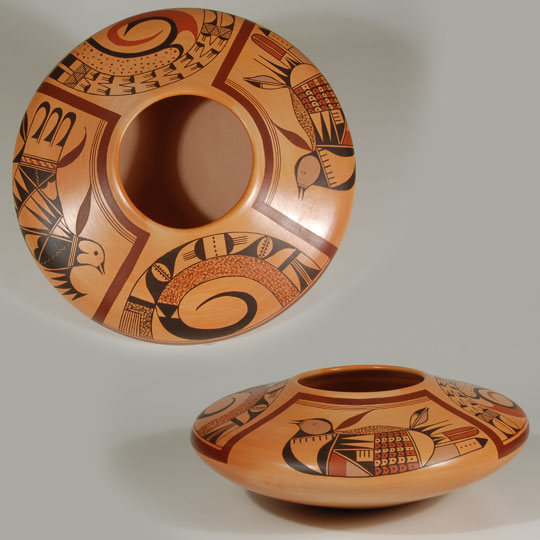 When Mark Tahbo brought us this jar on August 16, 2016, he surprised us with two innovations that were new in his artistic endeavors, but we will get to those a little later. Initially one needs only to take a look at the shape of this seed jar and admire the amazing pictorial designs on the upper portion. There are four design panels and each is different.
To start from the beginning, that is, the construction of the vessel, we listened to Mark explain where and why he chose the clay for this jar. Mark has always admired Garnet Pavatea and her production of pottery so he decided to visit the clay source Garnet used and to gather enough of that clay to make this jar. That clay bed is on the side of the road from the village of Polacca to the top of the mesa where Garnet lived.
After building the vessel with the "Garnet" clay, as he said, he set it aside until he could decide what decorations to use. He then fell back to the inspirations from Nampeyo of Hano and her use of Sikyatki designs. The panel of design with a sweeping red curve, that represents a stylized Sikyatki bird, has multi-colored polka dots on the body. Mark said he thought the earlier potters would have used dots placed on with the end of a stick rather than stippling as seen on later Hopi pottery. Arched over this bird is a band of rain clouds and rain.
#adobegallery #SouthwestIndianPottery #HopiPueblo #HopiPottery #PuebloPottery #SouthwestIndianArt #SantaFePottery #FinePuebloPottery #ContemporaryPottery #MarkTahbo
Navajo Ceremonial Basket of Traditional Design - C4091C
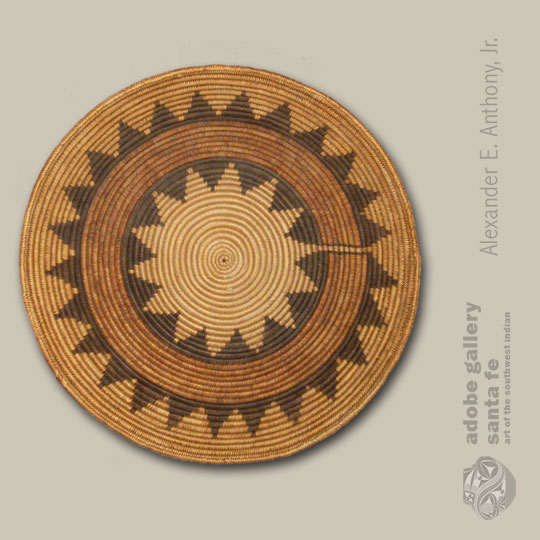 The distinctive feature of older baskets is the two-rod foundation, resulting in a finer weave and smoother walls than the later three-rod foundation. The rims are always woven in a herringbone pattern. This is a distinctive Diné characteristic that was eventually adopted by the Paiute when they started making wedding baskets for the Diné.
Navajo baskets or Ts'aa' have a number of uses. They are used ceremonially to hold prayer sticks and medicine bundles, because it is taboo for ritual objects to touch the ground. They are important for Kinaalda' ceremonies, the coming of age ceremony for young women at puberty, where they are used to hold yucca suds for ritual baths and hair washing of the young woman. They are used in wedding ceremonies to hold corn pollen and food.
The designs in Navajo baskets have significance and depending on the interpretation can symbolize the creation myth, life's journeys or be a map of the Navajo cosmos. The simplest interpretation is that the white center is the emergence area, or area of birth. The black coils represent clouds or four sacred mountains. The red band is the sun's rays which bring life. There is always a line from the center of the basket to the outer rim, a path from the center for the Spirit to come and go. The pathway meets at the outer edge where the weaver has stopped coiling.
#adobegallery #NativeAmericanBasket #SouthwestIndianBaskets #Navajo #Diné #DinéBasket #NavajoBasket #SantaFeNM
Navajo Ceremonial Basket with Unusual Outlining - C4091G
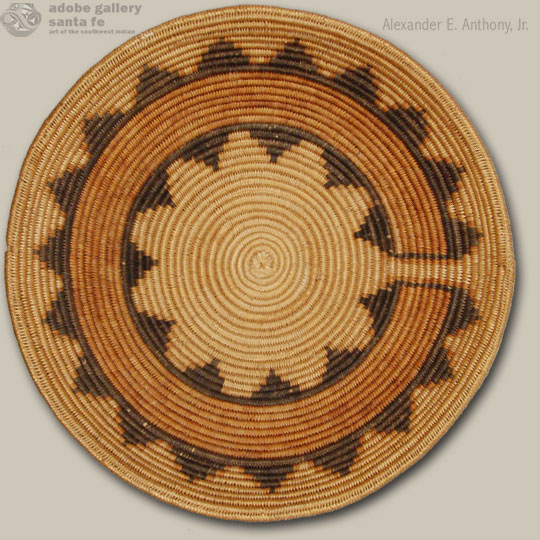 This basket was formed over a two-rod sumac foundation. Navajo baskets have been made with multiple rod foundations-three rods and even up to seven rods. Two-rod foundation baskets display thinner coils, resulting in a more symmetrical and tighter weave. Baskets with three or more rod foundation display thicker coils and are, therefore, faster to make. Generally, they are not as desirable or as exquisite looking.
This basket has the traditional Navajo wedding basket design, but the weaver took liberty to make some changes. What is normally presented as red rows have, in this basket, been replaced with a more rust color. The black triangular steps pendant to the colored bands have been outlined with the rust color, something not done in the more traditional style. Everything else seems to follow tradition.
This basket is larger than those made for a medicine man's use, therefore, it was probably made to be sold to a collector. It is quite possible that the basket maker was a traditionalist who made those mentioned changes so as not to sell a basket used in traditional ceremonies to a non-Indian.
#adobegallery #NativeAmericanBasket #SouthwestIndianBaskets #Navajo #Diné #DinéBasket #NavajoBasket #SantaFeNM
Navajo Deep Traditional Ceremonial Design Bowl - C4091D
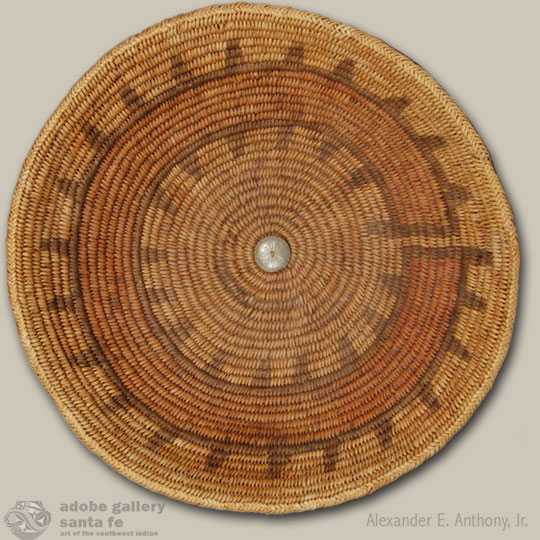 When one thinks of a Navajo ceremonial basket, what comes to mind is a shallow bowl of a defined design that is used by a medicine man in a hogan ceremonial event. Usually, such a basket is about 3 inches deep and 12 inches diameter. It has a strip of red around the middle of the wall. The red is sandwiched between black stepped triangles on the top and bottom. The rim is finished in a herringbone weave and ends at the point of the ceremonial line break through the design.
Other Navajo ceremonial baskets that feature the same design as the one required by a medicine man for wedding or healing ceremonies differ in size and somewhat modified in design. This bowl is a good example of a pseudo-ceremonial basket-larger in size, deeper than usual, and a design that invokes a ceremonial basket but modified slightly. Such baskets are traditional and are used by medicine men too. They are needed by a medicine man to hold sacred corn meal, prayer feathers, medicines, stirring rods, flints, claws, colored earth, and other things as part of his ceremonial bundle. They are necessary because it is taboo for ritual objects to touch the ground. They are important for Kinaalda' ceremonies, the coming of age ceremony for young women at puberty, where they are used to hold yucca suds for ritual baths and hair washing of the young woman. They are used in wedding ceremonies to hold corn pollen and food.
#adobegallery #NativeAmericanBasket #SouthwestIndianBaskets #Navajo #Diné #DinéBasket #NavajoBasket #SantaFeNM
Navajo Early Twentieth Century Ceremonial Basket - C4091B
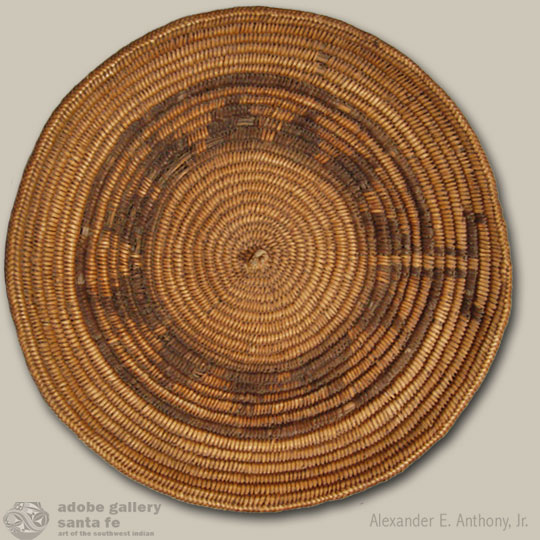 When the members of today's Navajo tribe arrived in the Southwest around 1500, they were a nomadic people of Athapaskan heritage from the north. On arrival, they split into what we know today as Navajo and Apache tribes. The Navajo settled in northern New Mexico, mingled with the Pueblo peoples and adopted some of their culture. They planted corn and other crops and settled into semi permanent family camps. Their ceremonial life became more elaborate once they settled.
The Pueblo Revolt of 1680 had effects on the Navajo as well. When the Spanish reconquest forced many Pueblo people to flee their villages, they took refuge among the Navajos. The Navajos accepted the refugees and, during the period between 1700 and 1770, they acquired many skills and practices which are accepted today as Navajo tradition. Among these, was basket weaving.
The Navajo made baskets for daily use, particularly after their release from imprisonment at Bosque Redondo. Each Navajo family was alloted two sheep and their personal belongings at the time of their release. Materials for making baskets were free so their use became routine. Following the devastation of their lives during imprisonment, ceremonial functions became important to restore their health and for the well being of their home, flocks, and fields, and for their security.
#adobegallery #NativeAmericanBasket #SouthwestIndianBaskets #Navajo #Diné #DinéBasket #NavajoBasket #SantaFeNM
Nineteenth Century Diné Very Large and Deep Basket - C4091F
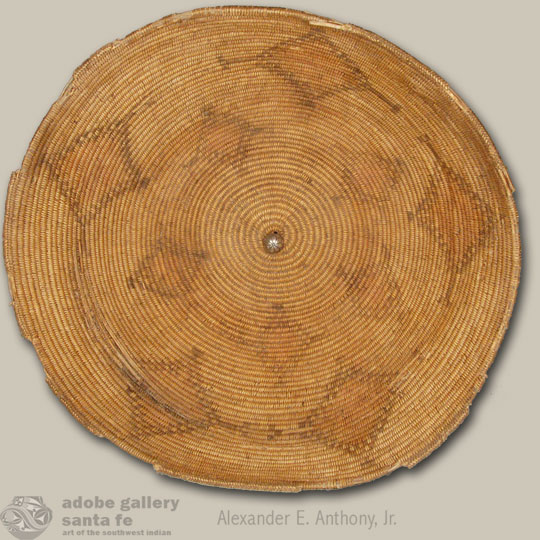 It has become common knowledge that members of the Paiute Tribe have made ceremonial baskets for the Navajo for over a hundred years. There are several reasons the Navajo turned to their northern neighbors for this favor. When the Diné were released from imprisonment by the government, they were poor and broken in spirit. From the depths of poverty and humiliation, they turned to spirituality for salvation. They developed serious ceremonial functions that required strict adherence to ritual and rules.
One of the items developed in conjunction with this spirituality was a "ceremonial" basket needed by the medicine man to hold sacred corn meal, prayer feathers, medicines, stirring rods, flints, claws, colored earth, and other things as part of his ceremonial bundle. Because of the importance to the ceremony of the basket, it was considered special. It was not allowed to touch the ground. The woman who made one had many restrictions placed on her. She was forbidden to have intercourse while making a basket, not allowed to be touched by anyone, kept in isolation to observe dietary restriction, could not work while menstruating, and had to undergo ceremonial cleansing before and after making a basket. Her weaving materials had to be placed so nobody would step over them. It was then that the Navajo invited the Paiutes to make ceremonial baskets for their use, as they had no such restrictions. Whiteford 1988:32
#adobegallery #NativeAmericanBasket #SouthwestIndianBaskets #Navajo #Diné #DinéBasket #NavajoBasket #SantaFeNM
Nineteenth Century Diné Very Large Basket - C4091H
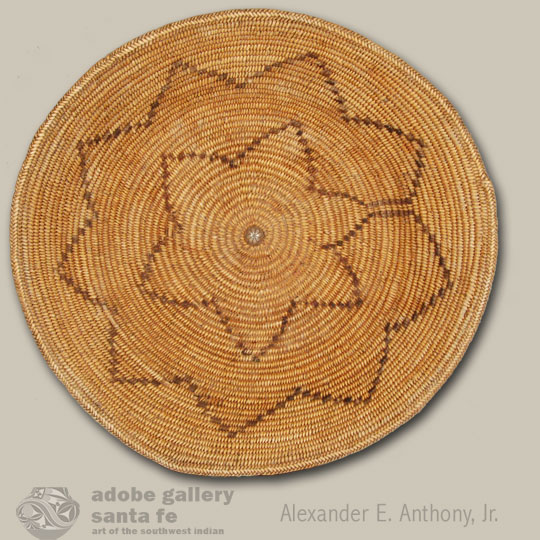 The standard wedding basket as we know it today is rare in collections of nineteenth century Navajo baskets in museums such as the Smithsonian Institution, the Field Museum of Natural History, and the Peabody Museum of Harvard University. Most of the baskets in those collections are decorated with a variety of designs, none of which is like the design of today's wedding basket. Designs such as Spider Woman crosses, spirals, whirling vanes or zigzag designs were used. There were no tribal restrictions on designs in the nineteenth century.
This very large basket has a design that might be called a zigzag design. Like traditional nineteenth century ones, this one is comprised of only two colors-golden color of yucca and dark brown of dyed yucca. The large star pattern at the bottom center provides the opening for the ceremonial line break as one tip of the star divides the banded pattern above. As was true then, and is still true today, the ceremonial line break is located at the point were the herringbone rim comes to an end. That is a deliberate action necessary for a medicine man to locate the ceremonial break when the basket is in use in a dark hogan during a ceremony in which the ceremonial line break must point to the east.
#adobegallery #NativeAmericanBasket #SouthwestIndianBaskets #Navajo #Diné #DinéBasket #NavajoBasket #SantaFeNM
Navajo Two Rod and Bundle Nineteenth Century Basket - C4091E
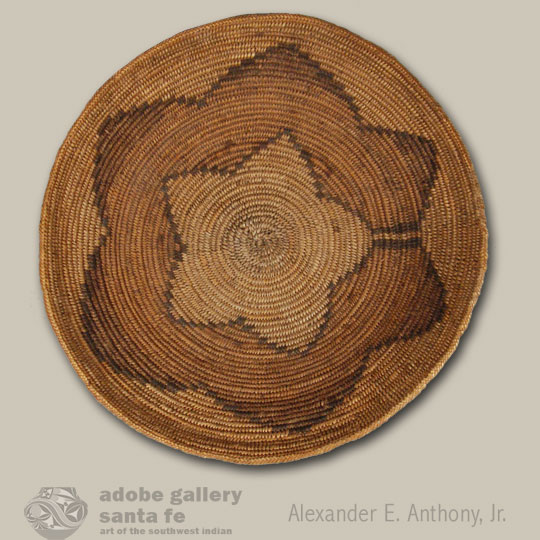 According to Andrew Hunter Whiteford, in his book Southwestern Indian Baskets Their History and Their Makers, the design on this nineteenth-century Navajo basket may be "ancestral to the classic wedding basket design, which is rare on old two-rod-and-bundle baskets." Whiteford 1988;36. His meaning is that the red zigzag band morphed into the straight-edged band now seen in the wedding baskets of today. The wedding basket design of today is rare in nineteenth-century baskets but it seems to have had its start with the design of this one.
This Native American Basket has the same two colors seen in later wedding baskets-russet red and black- another clue to this design eventually transferring to today's wedding basket design.
#adobegallery #NativeAmericanBasket #SouthwestIndianBaskets #Navajo #Diné #DinéBasket #NavajoBasket # #SantaFeNM
Western Apache Very Large Pictorial Basket - C4082A
 The Western Apaches were not a single tribe, but consisted of five separate and completely independent tribes-the Cibecue, San Carlos, White Mountain, and Northern and Southern Tonto. They are now considered collectively as Western Apache.
The Western Apache were of less trouble to the United States Government in the 19th century than some of the more aggressive Apache tribes. They were not displaced by the military like the more belligerent Apache of other tribes. As a result, they retained their lands and much of their culture. Their fine basketry is the best known of the Apache tribes and they are treasured by museums and collectors.
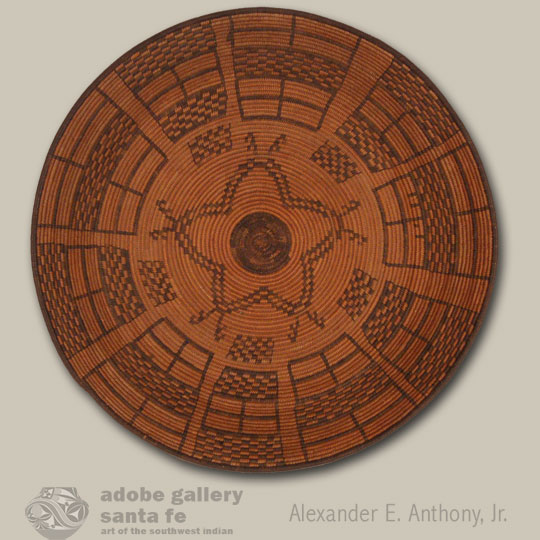
This large Native American Basket bowl likely dates to the very early 20th century and features a design that is most unusual. The large rectangular panels on the inner wall resemble windows or tall buildings.
Traditionally, and in this basket, the foundation was made from a grouping of three willow rods. They were placed so tightly together that it appears to be a single rod. The stitches also were made from willow. The black areas are of devil's claw. The brown circle of the center of the basket and the brown rim are standard and rarely change. Between these two areas, the design was from the mind of the weaver.
#adobegallery #NativeAmericanBasket #SouthwestIndianBaskets #Apache #WesternApache #Basket #PuebloBaskets #IndianBaskets #SantaFeNM
Historic Acoma Black on White design Jar with Ladle Wear Pattern - C4068W
 There are mixed reactions among collectors, some of whom desire pristine pottery that does not show it was ever used and others who look seriously for pottery that shows it was used at the pueblo prior to appearing on the market for sale. Fortunately there are both types available to satisfy both preferences.
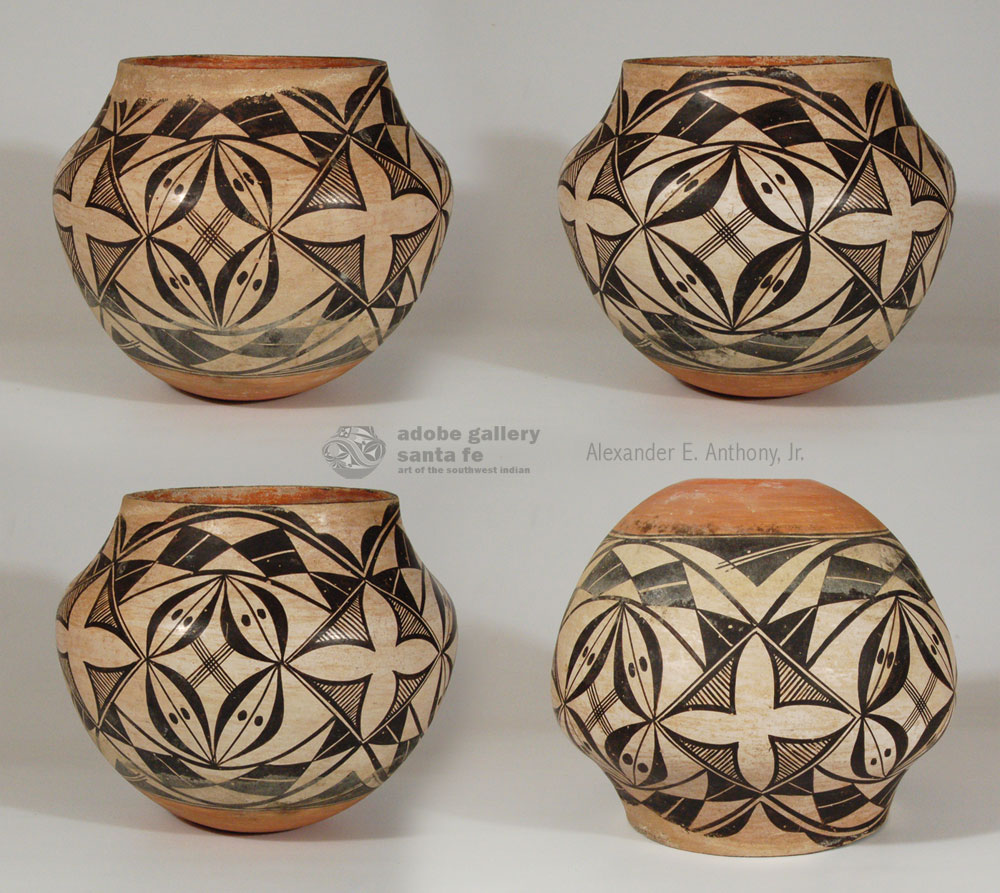
This Acoma Pueblo jar has significant wear to the area of the rim, evidence of many years of use as a water jar, with the handle of a ladle wearing away the painted surface and some of the clay body around the rim. Further evidence of use as a water jar is the white calcium residue on the interior of the jar and also on the exterior from water evaporation through the porous clay. This is very desirable from an historic pottery perspective.
The mid-body design consists of a chain of bold black elements that float beautifully around the body. One element consists of a square containing a clover-like blossom surrounded by parallel black lines. Another element is lighter in presentation and is a kite-like element surrounded by leaves with black dots. Over and under these alternating mid-body designs are split black diamond and triangle boxes filling the space voids. The overall result is a strong and impressive design that elevates the jar to a pleasing object of art.
#adobegallery #SouthwestIndianPottery #AcomaPueblo #AcomaPottery #PuebloPottery #SouthwestIndianArt #SantaFePottery #FinePuebloPottery #HistoricPottery
Cochiti Pueblo Traditional Storyteller Figurine by Dorothy Trujillo - C4094B
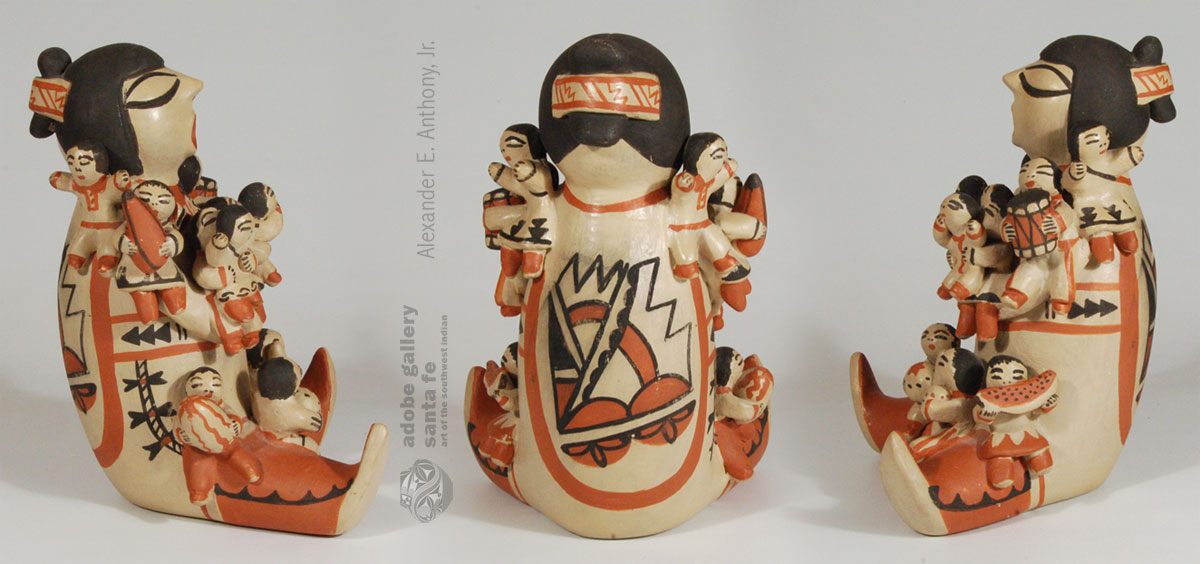
Dorothy Trujillo, who passed away in 1999, was an outstanding potter. She was originally from Jemez Pueblo, but moved to Cochiti following her marriage to Onofre Trujillo, and obtained permission to make pottery using Cochiti clay.
In true Cochiti Pueblo tradition, Dorothy made her figurine with eyes closed and mouth open. The closed eyes represent "thought" and the open mouth represents "storytelling." The adult figurine is beautifully painted with a design on the back and wearing a squash blossom necklace. There are twelve children, four on the right side, four on the left side and four on the legs. The children have a variety of items in their hands-drum, watermelon, balls, and other shapes.
#adobegallery #SouthwestIndianPottery #CochitiPueblo #CochitiPottery #PuebloPottery #SouthwestIndianArt #SantaFePottery #FinePuebloPottery #ContemporaryPottery