



Historic Zuni Pueblo Small White on Red Olla - C4068N
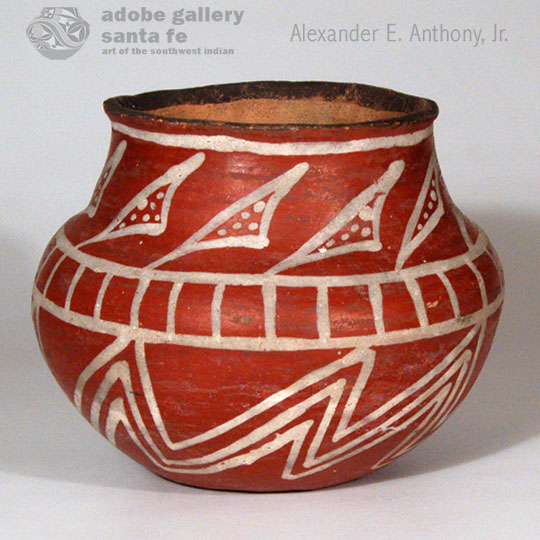 According to published information, Zuni potters experimented with putting red slip on pottery, rather than the standard cream slip, and painting the design with white slip, rather than the black normally used on Zuni Polychrome wares. This anomaly existed during the period designated as Zuni Polychrome, however, it was short-lived, lasting only from 1890 to 1920.
There is no published information stating why the White-on-red period ended in the 1920s. Speculation is that the newly-arrived trader at Zuni, C. G. Wallace, perhaps discouraged production of White-on-red in favor of the potters sticking to the traditional Zuni Polychrome style because he believed Polychrome wares would sell better. He was the primary, if not the sole, outlet for Zuni wares in the 1920s.
This White-on-red jar is smaller than others we have had in the past and those we currently have on our site, which makes it quite unique. The white slip was expertly applied in a thick coat on an equally thick coat of red slip. There is no weakness in the application. The red slip extends to the bottom of the vessel, Normally, Zuni jars have a brown lower body but not when jars are slipped in red. The rim is dark brown, the only brown on the jar.

#adobegallery #SouthwestIndianPottery #ZuniPueblo #ZuniPottery #PuebloPottery #SouthwestIndianArt #FinePuebloPottery #HistoricPottery #IndianMarket #sfim2018 #NativeAmericanArts
RARE Large Cochiti Pueblo Dough Bowl - 25521
 Cochiti Pueblo made very little utilitarian pottery after the 1880s because of the large demand for figurative pottery. Cochiti was the premier pueblo for making large figurines and there was a market for them, primarily by collectors, as museums thought them non-traditional and not worth putting in their collections.
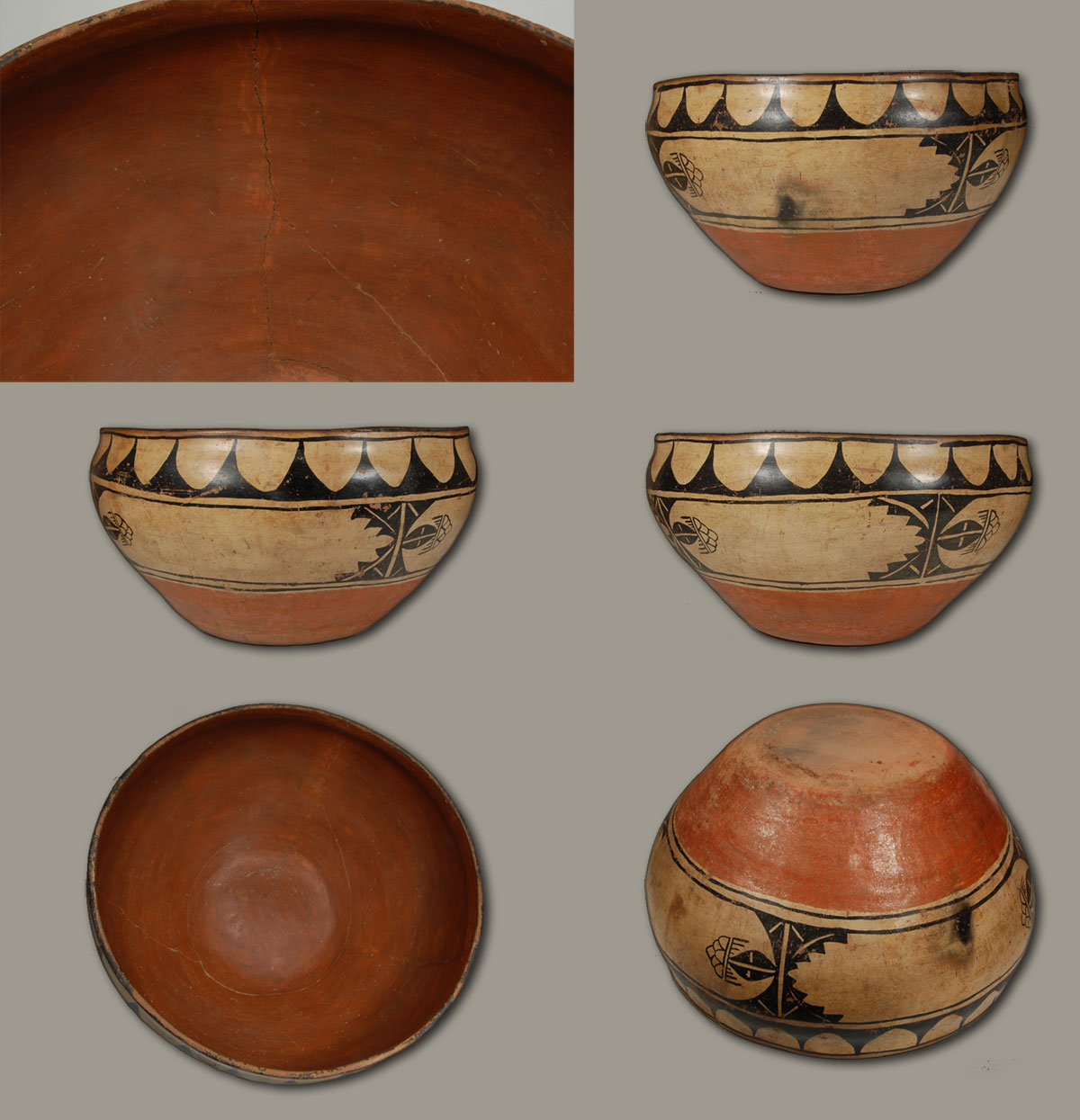
A large dough bowl such as this one is relatively rare from Cochiti. Many Cochiti families purchased dough bowls and large storage vessels from Santo Domingo neighbors. This dough bowl was made by Reyes Romero, according to members of her family. Apparently she was making bread in 1960 and sat the bowl on a chair. As the dough rose the bowl fell to the floor and broke. A gentleman from Tucson, Arizona, purchased the broken bowl from the family and we purchased the re-assembled bowl from him.
This bowl's designs are subtle and sparse. The main design, which includes an interesting sideways rain cloud pattern, is repeated four times around the bowl's exterior. Its patina is beautiful, and its size is impressive. The repairs are visible on the bowl's interior, but are fortunately invisinle on its exterior.
#adobegallery #SouthwestIndianPottery #cochitiPueblo #CochitiPottery #PuebloPottery #SouthwestIndianArt #FinePuebloPottery #HistoricPottery #IndianMarket #sfim2018 #NativeAmericanArts
Santo Domingo Pueblo 19th Century Dough Bowl - 16876
 According to Jonathan Batkin (1987), the Smithsonian Institution collected very little pottery from Kewa Pueblo in 1879 and 1880, an indication that potters were making what they needed for daily use and not producing for sale to merchants or collectors. This situation changed in 1880 when a railroad stop was built near the pueblo and potters then began making pottery for sale. (That trading post at the railroad stop burned down and was closed a number of years ago but has just recently, in 2015, been restored and re-opened.) Pottery being made for use at the pueblo and pottery made for sale in the 1880s was of the highest quality and this persisted until around 1920.
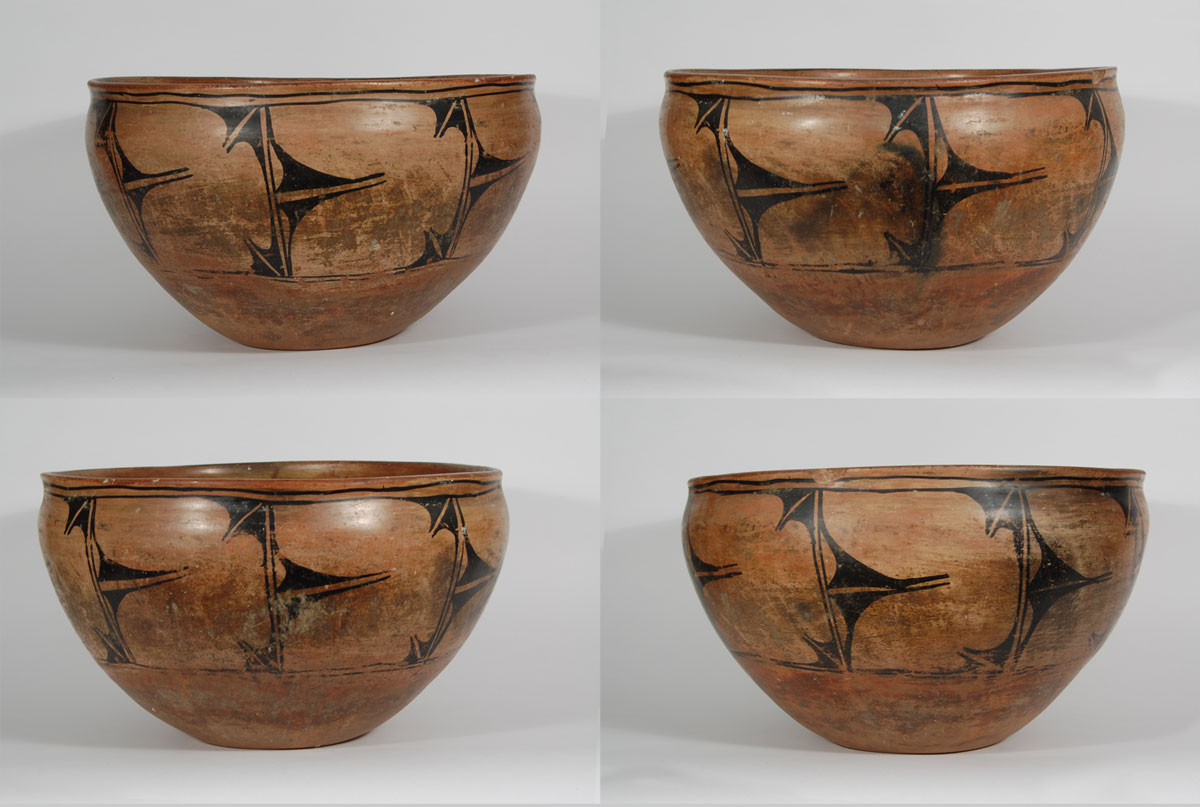
This Kewa Pueblo polychrome dough bowl dates to the 1880s or 1890s. It has the traditional rag-wiped bentonite slip, black rim around the top, and paired black framing lines above and below the decorated panels. The main body is decorated with sparsely spaced black cloud elements that frame otherwise large areas of undecorated expanse. The undecorated areas appear to be the focal point of the decoration from the manner in which the black designs frame them. Its fire clouds (natural decoration during the firing process when the fuel falls against the vessel and creates a dark area) are soft and beautiful. Fire clouds are a natural decoration during the firing process when the fuel falls against the vessel and creates a dark area.
#adobegallery #SouthwestIndianPottery #KewaPueblo #KewaPottery #PuebloPottery #SouthwestIndianArt #FinePuebloPottery #HistoricPottery #IndianMarket #sfim2018 #NativeAmericanArts
Zuni Pueblo Bola Tie of an Antelope or Deer Image - C4109F
 It is well established that Zuni Pueblo lapidary artisans are amazingly creative in making pictotrial jewelry in mosaic style. This bola features the head of an antelope or possibly a deer. The antlers were made from mother of pearl and tipped with jet. The animal's face was made from white shell and jet, ears of spondylus shell, and crown of white shell, turquoise and spondylus shell in triangular cuts. The mother of pearl neck ruff is in raised form, a trait started years ago by Zuni jeweler Leo Poblano. This is an incredible image that was beautifully and expertly created in the 1940s.
#adobegallery #SouthwestIndianJewelry #NativeAmericanJewelry #zuniJewelry #ZuniPueblo #Silver #Turquoise #sfim2018 #IndianMarket2018
Zuni Pueblo Magnificent Multi Stone Inlay Thunderbird Bola Tie - C4109E
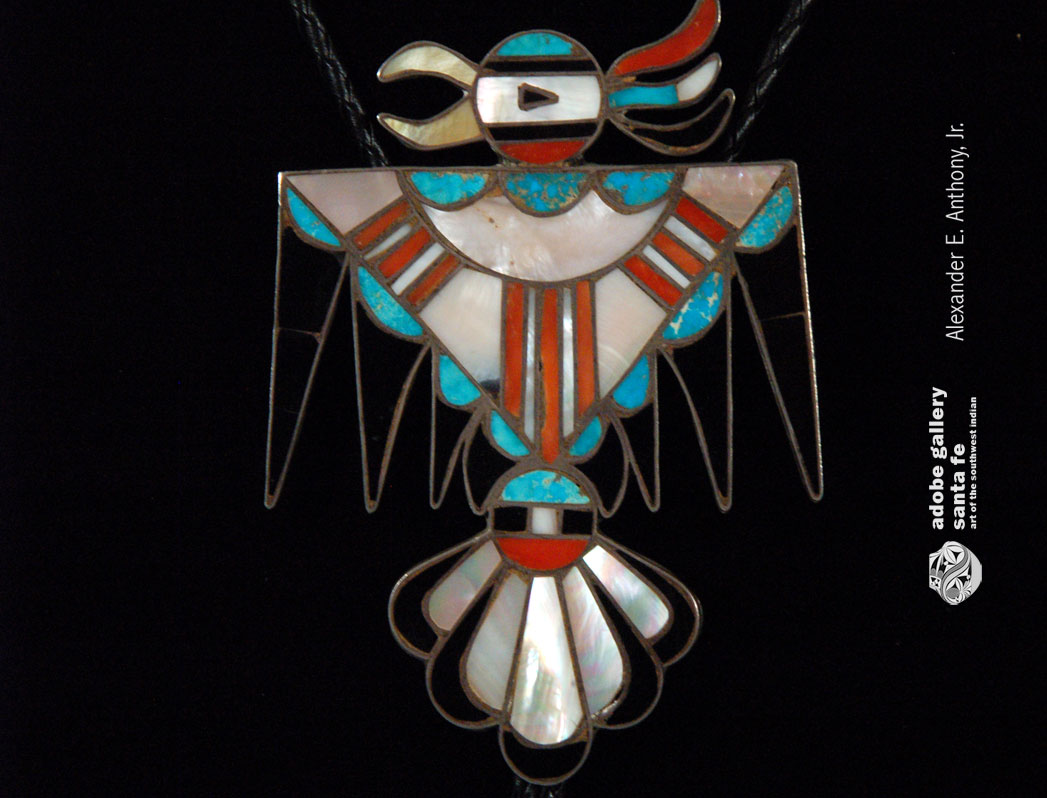 The Zuni are masters at lapidary work. The manner in which a lapidary artisan cuts a variety of stones and fits them together to form wonderful geometric patterns or figural elements is unequalled by any other jewelry-making tribes. The precise manner in which each stone is shaped is akin to an artist creating a painting-it is mosaic work of the finest quality.
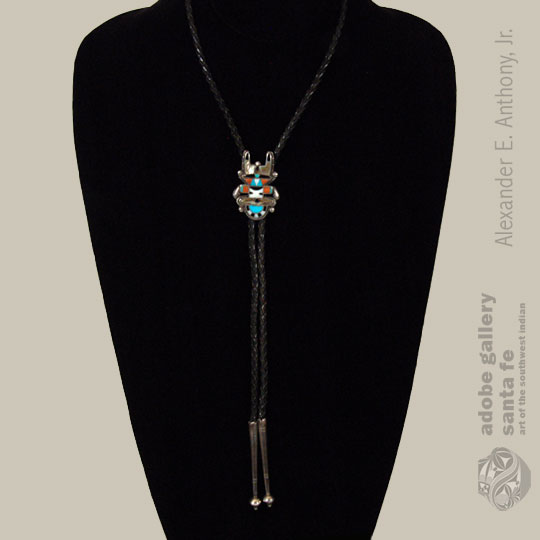
This mid-twentieth century Zuni Pueblo masterpiece features the legendary thunderbird. It was executed with turquoise, mother of pearl, coral (maybe spondylus), and jet, each cut in a variety of shapes from half moon, rectangular, trapezoidal, triangular and free form. It must have been a nightmare for the lapidary artisan who labored over it. The silver tips each have mosaic inlay feathers that are pendant and swing freely.
This is a spectacularly strong image that was beautifully created in the 1940s or 1950s.
#adobegallery #SouthwestIndianJewelry #NativeAmericanJewelry #zuniJewelry #ZuniPueblo #Silver #Turquoise #IMSF2018
Santa Clara Pueblo Polished Black Melon Jar by Angela Baca - C4107A
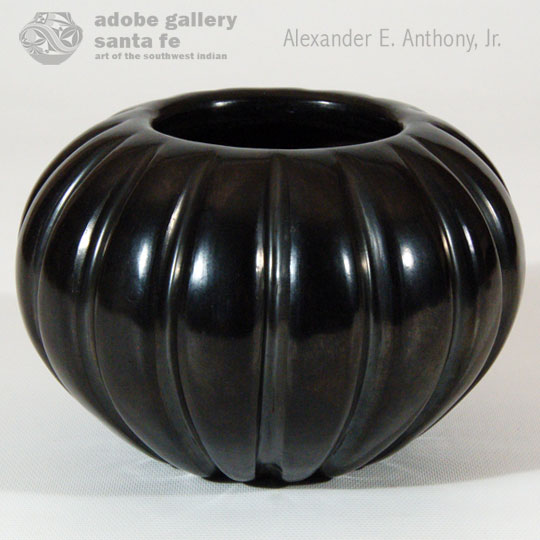 Angela Baca is most likely represented in every collection of contemporary pottery with one of her black melon jars, the style and shape that has been associated with her since the 1960s. She was probably the first potter to produce melon jars. I recall that the very first purchase I made at The Covered Wagon in Albuquerque in the 1960s was a black melon jar by Angela Baca at a price of $35. I was so impressed when I saw it that I put it on lay-away immediately.
Others must have thought like me because Angela's pottery received awards at Santa Fe Indian Marketevery year she entered for competition. She also was awarded Best of Show at the Heard Museumand was presented with a Special Award by the French government. Her pottery was included in an exhibit of pottery by Maria and Julian Martinez in 1984 at a gallery in New Jersey and included in an exhibit of pottery by Margaret Tafoya at Sid Deusch Gallery in New York in 1985.
This jar has 16 ribs that run vertically from the rim to the base. The depressions between ribs were stone polished as well. It probably dates to the last quarter of the twentieth century. It is signed Angela Baca Santa Clara on the underside.
#adobegallery #SouthwestIndianPottery #SantaClaraPueblo #SantaClaraPottery #PuebloPottery #SouthwestIndianArt #SantaFePottery #FinePuebloPottery #ContemporaryPottery #IMSF2018 #AngelaBaca #NativeAmericanArts
Painting of a San Ildefonso Pueblo Dance by Tonita Peña - C4084i
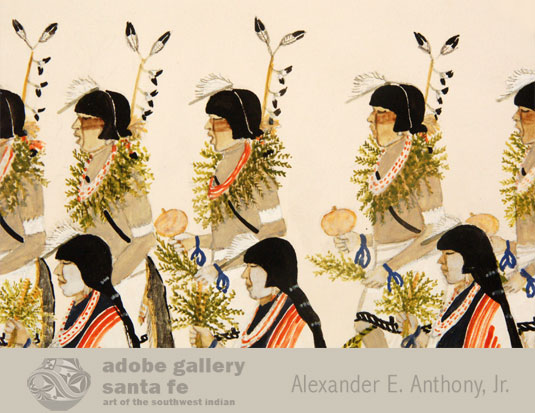 Tonita Peña (1893-1949) Quah Ah was born in 1893 at the small New Mexico pueblo of San Ildefonso. The pueblo is located on the Rio Grande, just north of Santa Fe. When Peña was just twelve years old, her mother passed away. Her father, unable to raise her while tending to his responsibilities at the pueblo, took her to live with her aunt and uncle at Cochiti Pueblo. This was where she would spend the remainder of her life. Peña was the only woman in the group of talented early pueblo artists referred to as the "San Ildefonso Self-Taught Group," which included such noted artists as Julian Martinez, Alfonso Roybal, Abel Sanchez, Crecencio Martinez, and Encarnación Peña. These artists were the earliest known pueblo painters. Today, their works are highly collectible not just because of their historical significance but because of their quality.
Peña is recognized as the first Pueblo Indian woman to make a living as a painter. By the time she was 25 years old, she was a successful easel artist. Her work was being displayed in museum exhibitions and in commercial art galleries in Santa Fe and Albuquerque. She painted what she knew best-scenes of life at the pueblo. She mostly painted ceremonial dances, and occasionally depicted everyday events. She did so with incredible skill and sensitivity. It is apparent in her works that she truly knew and respected each of the rituals she depicted. In the years since her passing she has come to be regarded as one of the greatest Indian artists of all time. Her works are displayed in prominent public and private collections around the country.
#adobegallery #SouthwestIndianPainting #NativeAmericanPainting #SanIldefonsoPainting #TonitaPena #FineArt #IndianMarketCountdown2018 #NativeAmericanArts
San Ildefonso Pueblo Painting of an Eagle Dance by Tonita Peña - C4084G
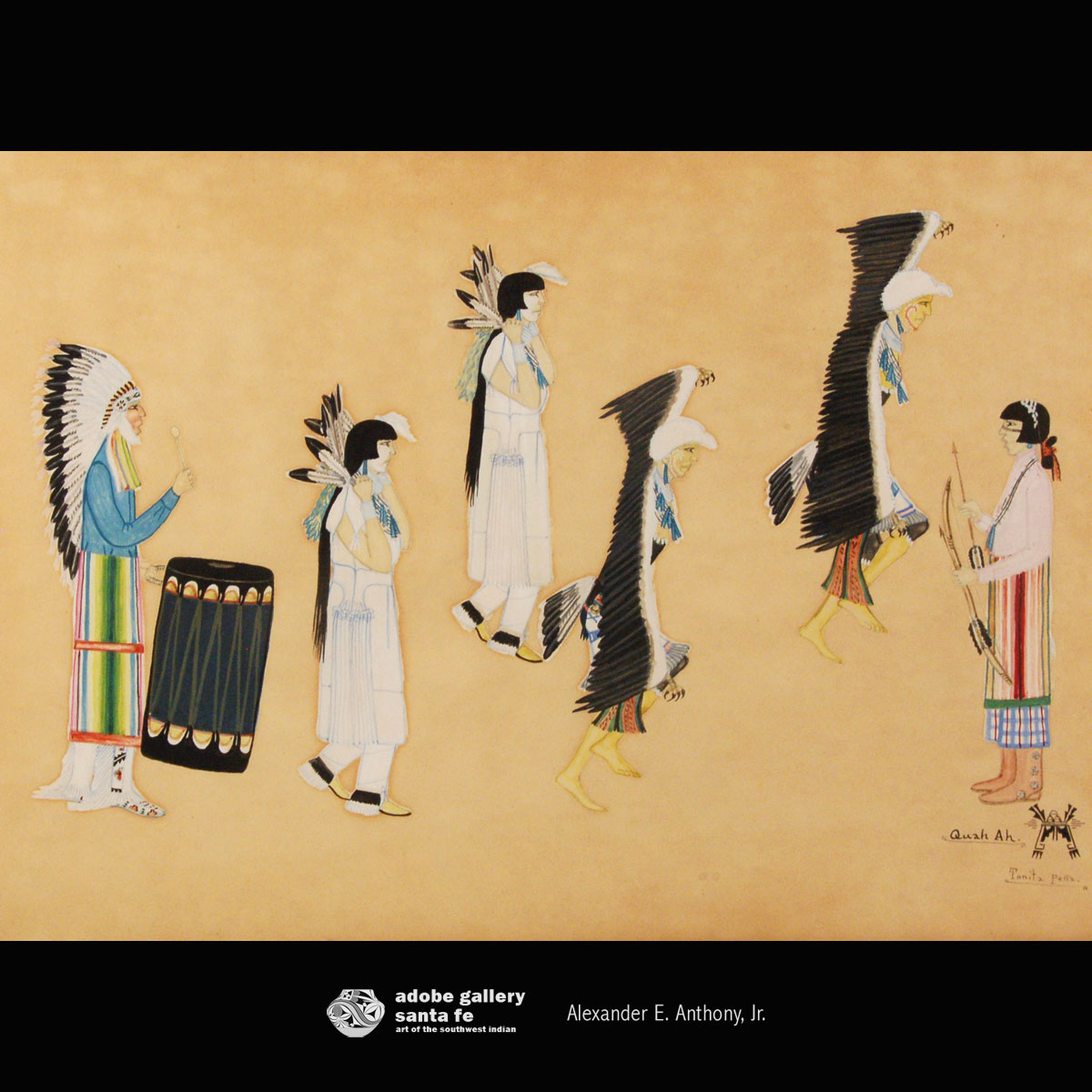 Tonita Peña (1893-1949) Quah Ah was born in 1893 at the small New Mexico pueblo of San Ildefonso. The pueblo is located on the Rio Grande, just north of Santa Fe. When Peña was just twelve years old, her mother passed away. Her father, unable to raise her while tending to his responsibilities at the pueblo, took her to live with her aunt and uncle at Cochiti Pueblo. This was where she would spend the remainder of her life. Tonita was the only woman in the group of talented early pueblo artists referred to as The San Ildefonso Self-Taught Group, which included such noted artists as Julian Martinez, Alfonso Roybal, Abel Sanchez, Crecencio Martinez, and Encarnación Peña. These artists were the earliest known pueblo painters. Today, their works are highly collectible not just because of their historical significance but because of their quality.
#adobegallery #SouthwestIndianPainting #NativeAmericanPainting #SanIldefonsoPainting #TonitaPena #FineArt #IndianMarketCountdown2018 #NativeAmericanArts
San Ildefonso Pueblo Painting of a Comanche Dance by Gilbert Atencio - C4084D
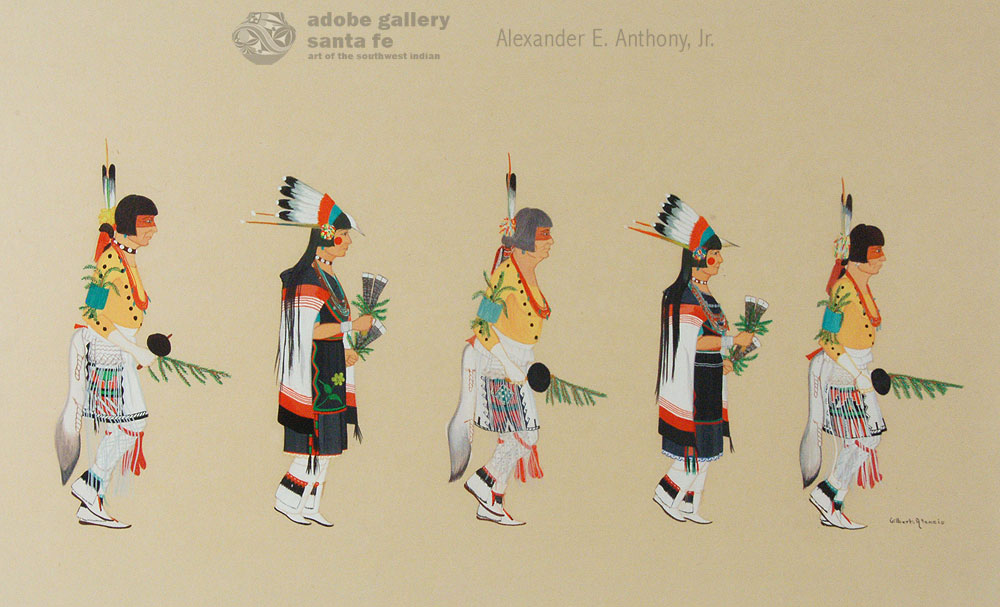 Gilbert Atencio (Wah Peen) was born in 1930 in Greeley, Colorado and died in April of 1995. He was the son of Isabel M. Montoya and the nephew of Maria Martinez. He was educated at San Ildefonso Day School and graduated from the Santa Fe Indian School in 1947. He served in the U.S. Marine Corp and lived most of his life in Santa Fe, New Mexico. Much of his inspiration for paintings came from stories his aunts told him about their lives. His style varied from the traditional "flat style" done early in his career, to abstract or semi-abstract paintings done in the 1980s. He was a medical and technical illustrator, too, working for Los Alamos National Laboratories.
Towards the end of his life Atencio said about his work: "I do my paintings both for myself and for other people, especially for people who enjoy Indians, their way of life, their ceremonies. The people who buy my paintings are that type of people. They know some history of the Pueblo Indians. I do it for myself and for them. For the non-Indians who buy my work, I do it so they will appreciate Indian art and understand the Pueblo Indians-for more understanding between non-Indians and Indian life. If they come into the pueblo and if they have a painting of a certain dance, they known that what I have painted is the old version, and what they are seeing now-even though the young girls have cut their hair-is still the same dance. And so, appreciate the dance. Have respect for the way." (Wyckoff, p. 66)
#adobegallery #SouthwestIndianPainting #NativeAmericanPainting #SanIldefonsoPainting #GilbertAtencio #FineArt #IndianMarketCountdown2018 #NativeAmericanArts
San Ildefonso Painting of a Pueblo Deer Dancer by Julián Martinez - C4084K
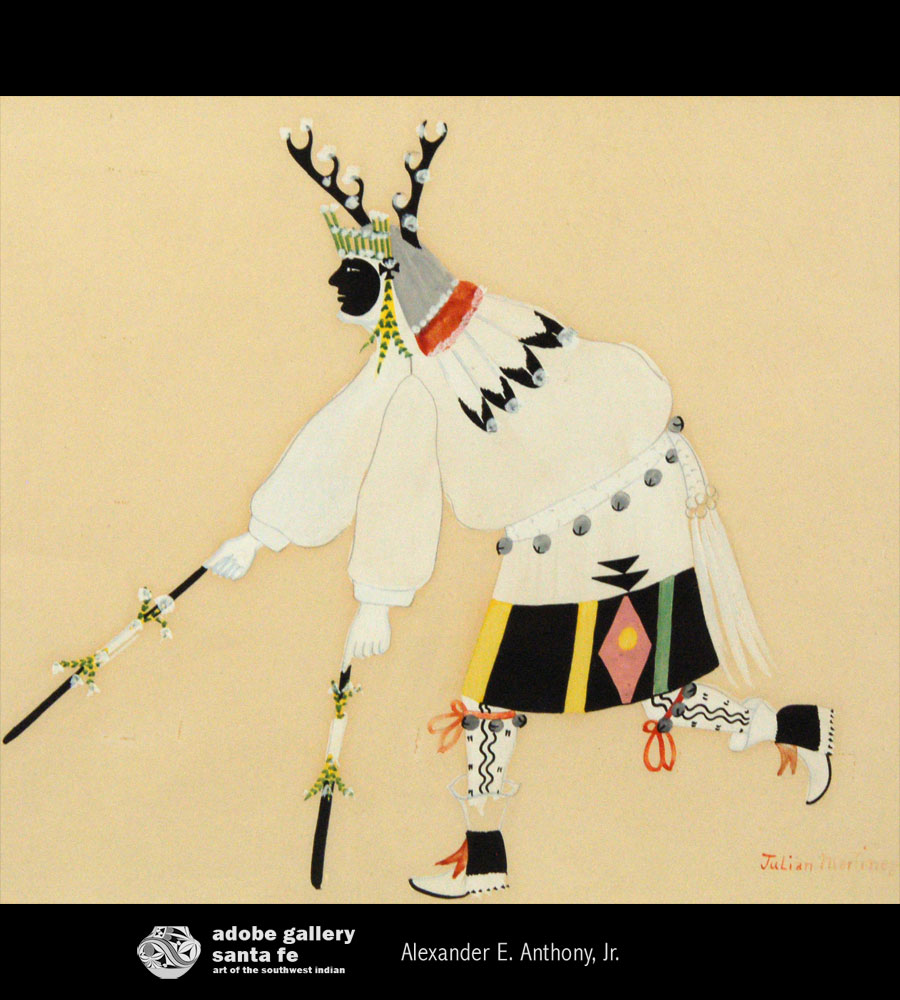 Julián Martinez (1885-1943) Pocano - Coming of the Spirits was an artist who was born, lived most of his life, and died at the small but artistically rich San Ildefonso Pueblo. He is perhaps best known for painting designs onto the pottery vessels created by his wife-the famous San Ildefonso potter Maria Martinez. He painted works on paper, too, and did so successfully despite receiving no formal art education. He was the father of Popovi Da and the grandfather of Tony Da, both of whom went on to become famous and successful artists themselves. Martinez was an important part of two major artistic movements: the beginnings of both black-on-black San Ildefonso pottery and traditional "flat style" pueblo painting.
His works on paper are considered most rare, simply because he didn't have time very much to paint. Besides painter and pottery designer, his various occupations included farmer, laborer, Museum of New Mexico janitor, and Governor of San Ildefonso Pueblo. According to Jeanne Snodgrass' American Indian Painters: A Biographical Directory, Martinez began painting around 1920. He mostly painted traditional pueblo "flat style" depictions of pueblo dancers, but occasionally strayed away from tradition and towards abstract symbolism. Martinez' paintings were among those selected by Mary Jane Colter to decorate La Fonda Hotel in Santa Fe, New Mexico. He received several commissions for murals, which can be seen at the Santa Fe Indian School; Mesa Verde National Park, Colorado; and the School for Advaced Research in Santa Fe.
#adobegallery #SouthwestIndianPainting #NativeAmericanPainting #SanIldefonsoPainting #JulianMartinez #FineArt #IndianMarketCountdown2018 #NativeAmericanArts
San Ildefonso Painting of a Warrior on Horseback by Julián Martinez - C4084B
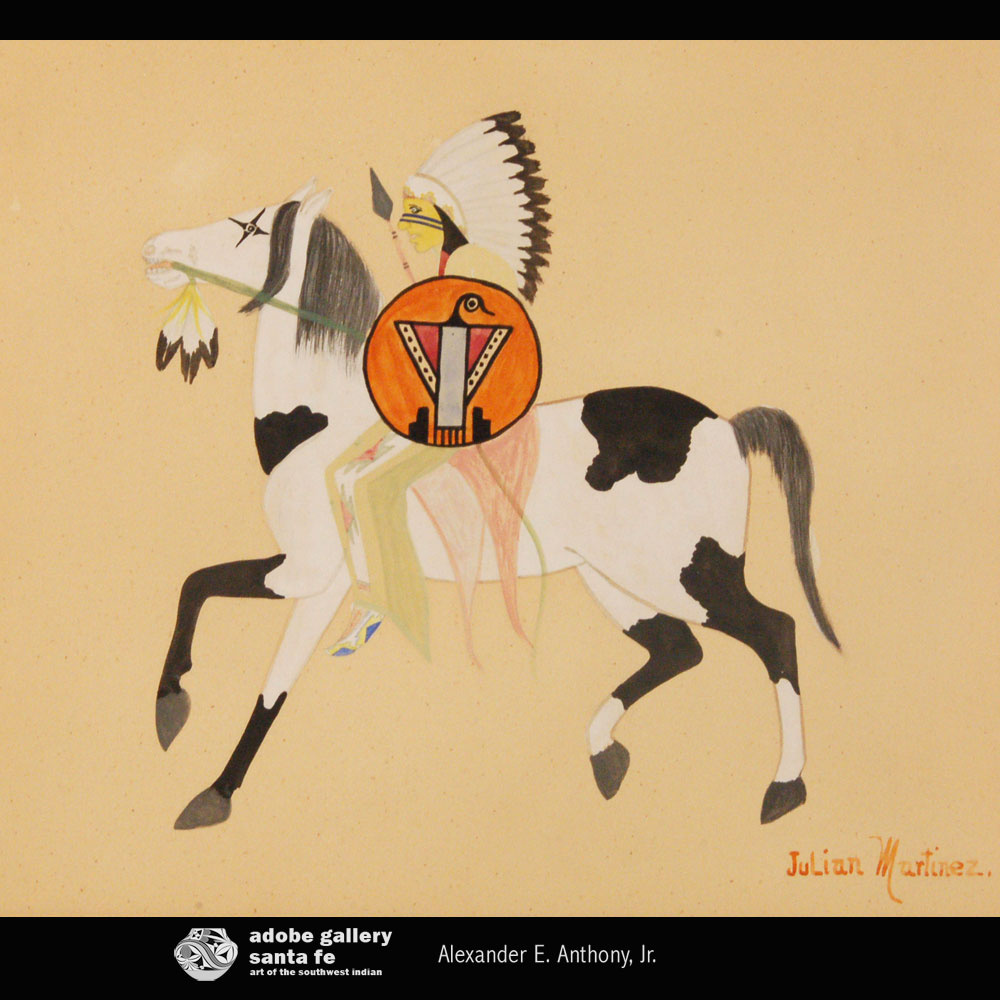 Julián Martinez (1885-1943) Pocano - Coming of the Spirits was an artist who was born, lived most of his life, and died at the small but artistically rich San Ildefonso Pueblo. He is perhaps best known for painting designs onto the pottery vessels created by his wife-the famous San Ildefonso potter Maria Martinez. He painted works on paper, too, and did so successfully despite receiving no formal art education. He was the father of Popovi Da and the grandfather of Tony Da, both of whom went on to become famous and successful artists themselves. Martinez was an important part of two major artistic movements: the beginnings of both black-on-black San Ildefonso pottery and traditional "flat style" pueblo painting.
His works on paper are considered most rare, simply because he didn't have time very much to paint. Besides painter and pottery designer, his various occupations included farmer, laborer, Museum of New Mexico janitor, and Governor of San Ildefonso Pueblo. According to Jeanne Snodgrass' American Indian Painters: A Biographical Directory, Martinez began painting around 1920. He mostly painted traditional pueblo "flat style" depictions of pueblo dancers, but occasionally strayed away from tradition and towards abstract symbolism. Martinez's paintings were among those selected by Mary Jane Colter to decorate La Fonda Hotel in Santa Fe, New Mexico. He received several commissions for murals, which can be seen at the Santa Fe Indian School; Mesa Verde National Park, Colorado; and the School for Advanced Research in Santa Fe.
#adobegallery #SouthwestIndianPainting #NativeAmericanPainting #SanIldefonsoPainting #JulianMartinez #FineArt #IndianMarketCountdown2018 #NativeAmericanArts
San Ildefonso Painting of Pueblo Thunderbird by Julián Martinez - C4084L
 Julián Martinez (1885-1943) Pocano - Coming of the Spirits was an artist who was born, lived most of his life, and died at the small but artistically rich San Ildefonso Pueblo. He is perhaps best known for painting designs onto the pottery vessels created by his wife-the famous San Ildefonso potter Maria Martinez. He painted works on paper, too, and did so successfully despite receiving no formal art education. He was the father of Popovi Da and the grandfather of Tony Da, both of whom went on to become famous and successful artists themselves. Martinez was an important part of two major artistic movements: the beginnings of both black-on-black San Ildefonso pottery and traditional "flat style" pueblo painting.
His works on paper are considered most rare, simply because he didn't have time very much to paint. Besides painter and pottery designer, his various occupations included farmer, laborer, Museum of New Mexico janitor, and Governor of San Ildefonso Pueblo. According to Jeanne Snodgrass' American Indian Painters: A Biographical Directory, Martinez began painting around 1920. He mostly painted traditional pueblo "flat style" depictions of pueblo dancers, but occasionally strayed away from tradition and towards abstract symbolism. Martinez' paintings were among those selected by Mary Jane Colter to decorate La Fonda Hotel in Santa Fe, New Mexico. He received several commissions for murals, which can be seen at the Santa Fe Indian School; Mesa Verde National Park, Colorado; and the School for Advaced Research in Santa Fe.
#adobegallery #SouthwestIndianPainting #NativeAmericanPainting #SanIldefonsoPainting #JulianMartinez #FineArt #IndianMarketCountdown2018 #NativeAmericanArts
Acoma Pueblo Black on White Design Jar by Mary Histia - C4068P
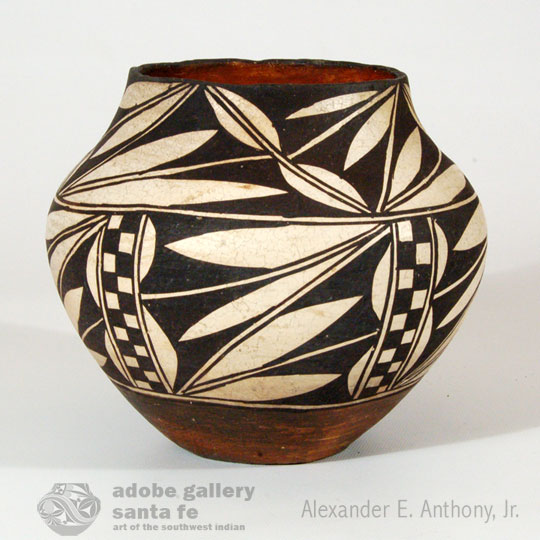 The black on white design on this jar has previously been identified as a design by Mary Histia. The vessel thinness is consistent with known examples of Histia's work and the preciseness of the painted design certainly follows her known quality of work. It appears safe to say that this unsigned jar was made by Mary Histia of Acoma, probably in the mid-twentieth century.
#adobegallery #SouthwestIndianPottery #AcomaPueblo #AcomaPottery #PuebloPottery #SouthwestIndianArt #MaryHistia #FinePuebloPottery #HistoricPottery #IndianMarketCountdown2018 #NativeAmericanArts
Original Painting of Navajo Man on Horseback by Narciso Abeyta - C4093
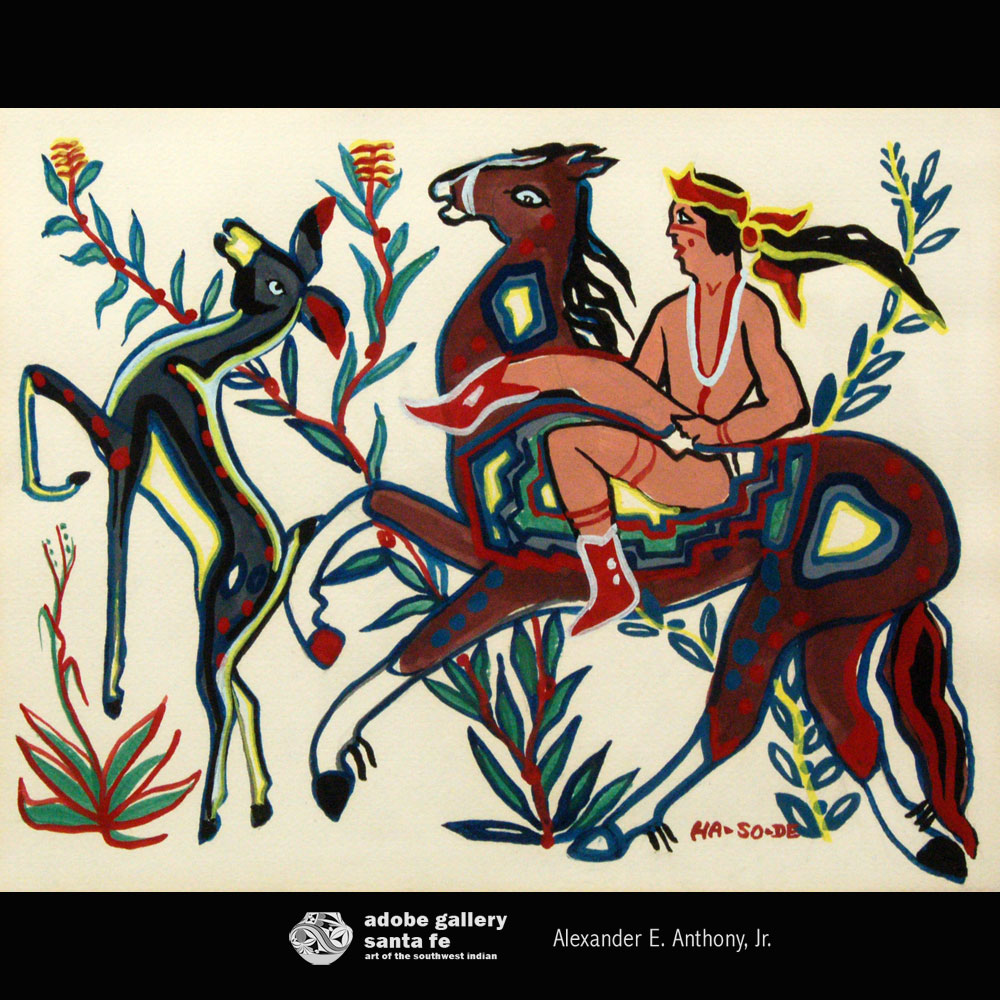 Narciso Platero Abeyta (1918-1998) Ha So De - Fiercely Ascending was a Diné painter and silversmith. He was, among other things, a Golden Gloves boxer and one of the hundreds of Navajo Code Talkers who served in the Marines during World War II. He and wife Sylvia Ann had seven children, many of whom-Tony Abeyta and Elizabeth Abeyta Rohrscheib and Pablita Abeyta-became notable artists themselves. He is highly revered by collectors of Native American art, and his works are included in numerous prestigious public and private collections. Because of his singular style, his enormously talented children, and his influence on younger painters, he is regarded as one of the most significant Native American painters.
#adobegallery #SouthwestIndianPainting #NativeAmericanPainting #Navajo #Diné #FineArt #Painting #IndianMarketCountdown2018 #NativeAmericanArts #NarcisoAbeyta
Zuni Pueblo Mukikwe Okya - Hopi Harvest Kachina Girl - C3535.59
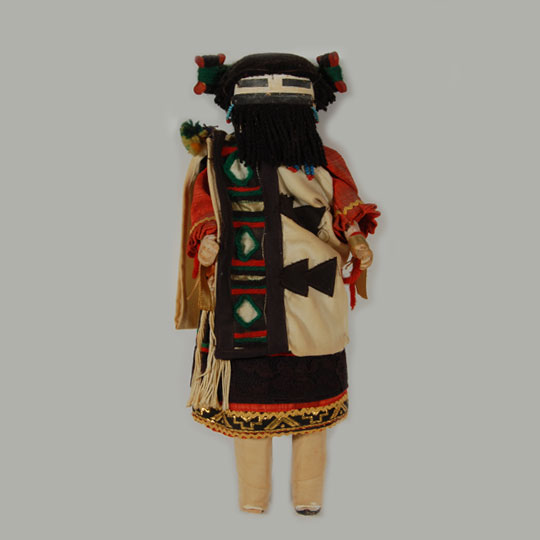 This Zuni Pueblo Katsina is a female and is referred to under several names, depending on the function and ceremony. She is known as Kokwele, the Grinding Maiden; Kokwele, The Kachina Girl; and Mukikwe Okya, the Hopi Harvest Kachina Girl.
This katsina doll represents the third of the above katsinas; that is, she is Mukikwe Okya, the Hopi Harvest Kachina Girl. Her name derives from a Zuni dance called Mukikwe, which has been acknowledged as having derived from the Hopi, therefore it is sometimes called the Hopi Harvest Dance and she the Hopi Harvest Kachina Girl.
The Mukikwe Dance is performed indoors at night in the winter. The female Mukikwe Okya is dressed entirely in Zuni fashion except for the hair style, which is worn in Hopi butterfly whorls.
This doll exemplifies the finest of Zuni katsina dolls. She is beautifully dressed in handmade clothing of the finest detail. Layer upon layer of handmade clothing adorns the doll. Her hair is up in the Hopi maiden style worn by this katsina.
#adobegallery #ZuniPueblo #Katsina #Kachina #Doll #SouthwestIndianArt #PuebloArt #SantaFeNM #IndianMarketCountdown2018 #NativeAmericanArts
Original Jemez Pueblo Painting of a Kachina by José Rey Toledo - C3703
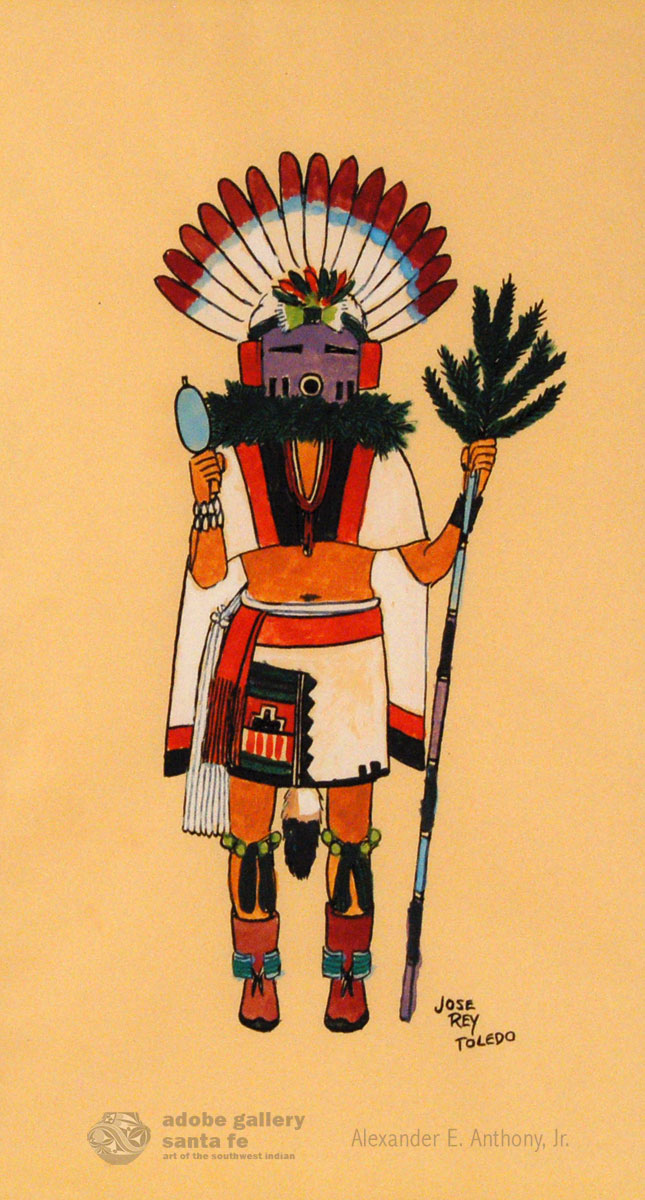 José Rey Toledo (1915-1994) Towa, from Jemez Pueblo, was a man of many interests and talents. He is listed as having been an art instructor, education health specialist, administrator of Indian health programs, actor, educator, lecturer, muralist and painter. It is this last category-painter-that is of particular interest to Adobe Gallery. His interest in painting was sparked by his cousin Velino Shije Herrera - Ma Pe Wi of Zia Pueblo. He attended the Albuquerque Indian School in the 1930s, then went to the University of New Mexico (UNM). By 1955, he had obtained a Master's Degree. After his time at UNM, he served as head of the art department at the Santa Fe Indian School. He obtained a Masters of Public Health degree from the University of California Berkeley in 1972.
Toledo painted infrequently while pursuing his degrees. Today, it is rare to find his works available on the market. The majority of his paintings are traditional pueblo in style and subject matter-single or group dance figures and village scenes. Usually, the dance figures show a great deal of activity. Generally, he did not paint background scenes, just the flat figures against a plain background. Despite not being as prolific as his contemporaries, he is highly regarded by collectors. The Museum of Indian Arts and Culture in Santa Fe, New Mexico, mounted a retrospective of his works in 1994, just months before he passed away.
#adobegallery #SouthwestIndianPainting #NativeAmericanPainting #PuebloPaintings #JemezPueblo #FineArt #IndianMarketCountdown2018 #NativeAmericanArts
Hopi Pueblo Tasap Katsina Doll circa 1940s - C4104C
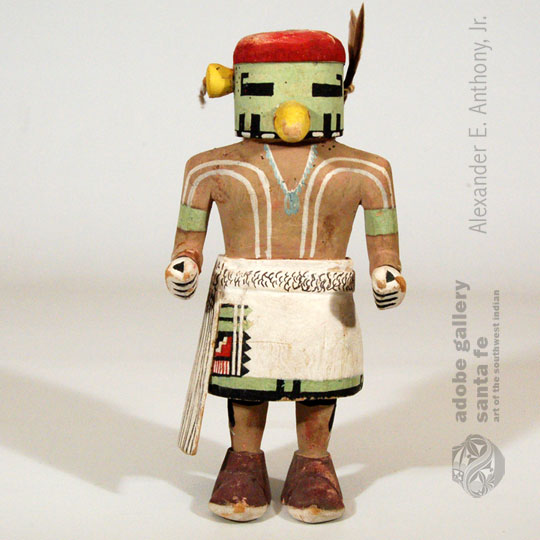 This is an exceptional Hopi Tasap Katsina doll carved from a piece of cottonwood root. Tasap is a Hopi representation of a Navajo God. There are Hopi versions of katsinam that honor and depict other tribes, such as the Navajo, Havasupai, Comanche, Zuni and other Pueblos.
This is the Hopi version of what they see as a way to honor their Navajo neighbors. These katsinam are not borrowed from the Navajo, as they are unique to the Hopi. They have the same purpose and functions as all the Hopi Katsinam. They are messengers and/or intermediaries to the rain gods. Since they are katsinam in every respect, they are afforded the same reverence and dignity during their visits.
This Tasap male katsina wears a ceremonial kilt and rain sash, and has a green face and red hair. The male, along with a companion female, appears during Angak'wa and the summer katsina day dances. Since they depict the Navajo, their songs may have some Navajo words speaking of the good things of life and/or words representing moisture.
#adobegallery #HopiPueblo #Katsina #Kachina #Doll #SouthwestIndianArt #PuebloArt #SantaFeNM #IndianMarketCountdown2018 #NativeAmericanArts
San Ildefonso Pueblo Black-on-Black Terrace Rim Bowl by Maria Martinez - C4104B
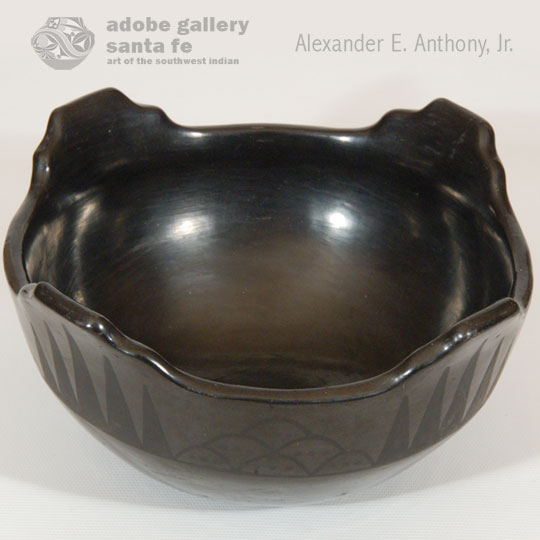 Maria and Julian Martinez are perhaps the best-known names in Southwest Indian Pottery. It was because of their enthusiasm for making pottery that it is acknowledged that the pottery revival in New Mexico pueblos, starting in the early 1900s, is their legacy. Their success inspired other San Ildefonso potters and, eventually, inspired potters at other New Mexico pueblos.
Maria and Julian were exposed to pottery being excavated on the Pajarito Plateau in 1907 and excitedly undertook to recreate the ancestral pottery, in their own way. They were inspired by the designs from the ancestral sherds and used them in their newly-made Polychrome pottery.
In 1912, they began making plain polished Black pottery. Black ware existed at all the Tewa villages at the time, but Maria and Julian refined the form and achieved a more highly polished finish that appealed to buyers. It was from this endeavor that their reputation was established. It was also at this time that Julian began painting designs on Maria's vessels with a yucca brush and clay slip.
#adobegallery #SouthwestIndianPottery #SanIldefonsoPueblo #SanIldefonsoPottery #PuebloPottery #SouthwestIndianArt #SantaFePottery #FinePuebloPottery #HistoricPottery #IndianMarketCountdown2018 #NativeAmericanArts #MariaMartinez
Original San Ildefonso Painting of Owl and Skunk by Alfonso Roybal - C4091i
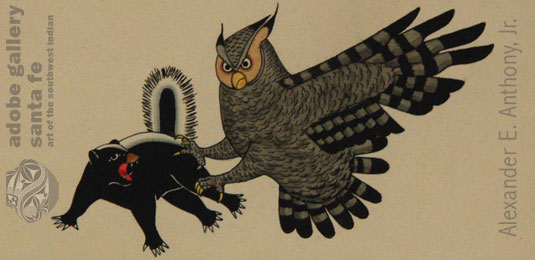 Alfonso Roybal (1898-1955) Awa Tsireh was many things to his pueblo of San Ildefonso: he was a farmer, pottery painter, museum employee, painter and silversmith. He had many trades and skills, but is primarily remembered today as a painter and metalworker. He began painting in 1917, which makes him among the very first pueblo painters. His artworks are currently featured in "Awa Tsireh: Pueblo Painter and Metalsmith," a comprehensive exhibition at Phoenix's Heard Museum. His works are included in many major public and private collections, including that of the Smithsonian Institution's National Museum of the American Indian.
Awa Tsireh, one of the first pueblo painters, was recognized beyond his native world as an outstanding artist. His watercolors where sent by Alice Corbin Henderson to the Arts Club of Chicago for a special exhibit in 1920. His paintings appeared in early exhibits in Santa Fe, and he was among the several artists to receive prizes at the first Santa Fe Indian Market. In 1925, the Chicago papers were generous in their acclaim for his exhibit in the Newberry Library. The Exposition of Indian Tribal Arts in New York in 1931 included Awa Tsireh paintings. He is generally regarded as one of the best pueblo painters, and his works continue to increase in value as his historical significance becomes more widely recognized.
#adobegallery #SouthwestIndianPainting #NativeAmericanPainting #PuebloPaintings #SanIldefonsoPueblo #FineArt #AlfonsoRoybal #IndianMarketCountdown2018 #NativeAmericanArts
Navajo Silver and Robin Egg Blue Turquoise Ring - C4070L
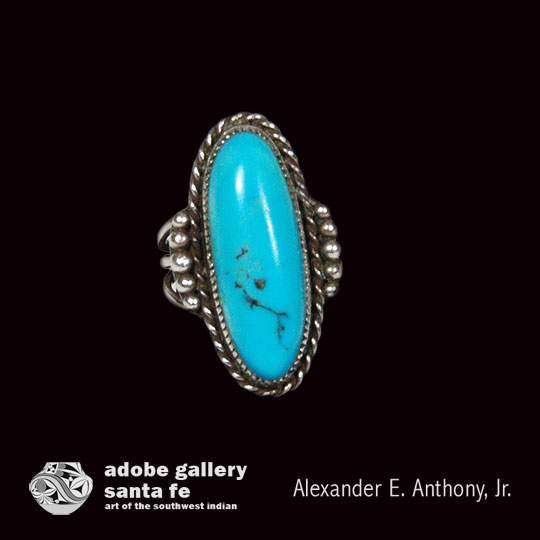 The robin egg blue long oval turquoise cab is beautifully domed and encased in a sawtooth bezel that is attached to a flat silver base surrounded by twisted silver rope. The shank was made from three silver wires attached at the base and spread out at the foundation.
#adobegallery #SouthwestIndianJewelry #Navajo #Diné #Silver #Turquoise #Jewelry #SantaFeJewelry #NavajoJewelry #IndianMarketCountdown2018 #NativeAmericanArts